
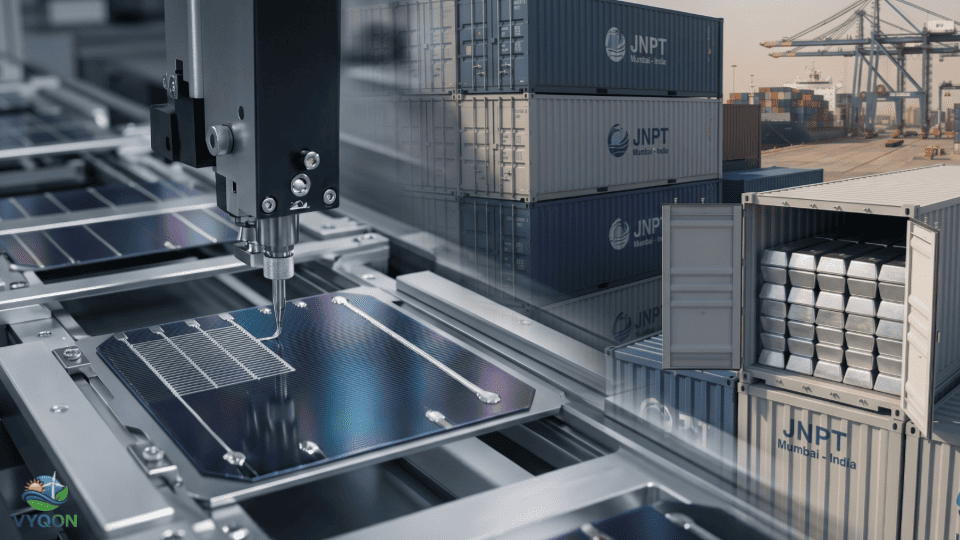
The Policy Change: DGFT Notification 57/2023
On January 15, 2024, the Ministry of Commerce and Industry, via the Directorate General of Foreign Trade (DGFT), issued Notification No. 57/2023. This directive implemented structural amendments to the import policy for silver under Chapter 71 of the ITC(HS) 2022, Schedule-1.
- Affected Classifications: The notification specifically modifies the import conditions for ITC(HS) codes 71069210 and 71069290. These codes encompass semi-manufactured silver products, including silver paste, sheets, plates, strips, tubes, pipes, electrodes, wires, and silver brazing alloys in any form.
- Actual User Criteria: Import status is classified as “Free” for “Actual Users” within the Electrical, Electronics, Engineering, Glass, and Solar industries. These entities may import these materials for their own manufacturing processes without a restrictive license.
- Research and Development: Imports intended for R&D by Government or Government-recognized research institutions also maintain a “Free” status.
- Regulatory Channeling: For entities falling outside the “Actual User” or recognized R&D definitions, imports must be routed through Nominated Agencies as notified by the RBI (for banks) or the DGFT.
Macroeconomic Context and Market Volatility
The revision of import guidelines follows the Union Budget 2026-27, which provided a 30% increase in renewable energy allocation to support India’s 500 GW non-fossil fuel capacity target by 2030. This expansion occurs within an increasingly unstable global commodity environment:
- Silver Price Trajectory: In January 2026, silver breached the $110/oz psychological barrier, eventually reaching a peak of $117/oz on January 27, 2026. While prices fluctuated within the 70s–80s range by February 2026, the baseline remains significantly higher than the 2023-2024 period.
- Supply-Side Constraints: Domestic silver production is currently limited to approximately 800 to 900 tons annually. In contrast, Indian demand necessitates imports of 5,000 to 5,500 tons per year.
- Global Drivers: Volatility is sustained by a projected sixth consecutive year of global supply deficits, Federal Reserve interest-rate cuts, and heightened geopolitical tensions. Furthermore, supply tightening has been exacerbated by the implementation of silver export licensing rules in China.
- Fiscal Measures: The government maintains a 15% customs duty on silver to prioritize foreign exchange (forex) preservation while necessitating transparency in industrial sourcing.
Implications for the Solar Manufacturing Sector
Silver price volatility has disrupted the marginal utility of traditional photovoltaic (PV) cell architectures, necessitating an industry-wide pivot toward base-metal metallization.
- Velocity of Cost Pressure: In 2023, silver represented approximately 3% of the per-watt price of a solar module. This figure escalated rapidly to 12% in August 2025, and reached over 17% by October 2025.
- Thrifting and Substitution Dynamics: Manufacturers are accelerating “thrifting” protocols to reduce silver loading and “substitution” to replace silver with pure or silver-coated copper. This transition is technically more feasible in Back-Contact (BC) cell architectures than in mainstream TOPCon technology, influencing the speed of adoption across different market leaders.
- Industry Technical Transitions:
- Longi Green Energy Technology: Transitioning to base metals for back-contact cells; mass production is scheduled for Q2 2026.
- Jinko Solar: Expecting large-scale output of copper-based panels within the 2026 calendar year.
- Aiko Solar: Currently operating an initial 6.5 GW capacity for silver-free solar cells.
- India’s Industrial Gap: The projected installation of 100 GW of solar capacity in India over the next five years will require an estimated 200 tons of silver paste. The domestic industry remains 100% reliant on imports for this component due to a total lack of domestic silver paste manufacturing facilities.
Sourcing Mechanisms and Compliance Protocols
The regulatory framework establishes distinct channels for the procurement of semi-manufactured silver to ensure trade transparency and market liquidity.
- Nominated Agencies: Imports for non-actual user manufacturing are restricted to agencies specifically notified by the RBI and DGFT.
- IIBX Mechanism: The policy permits imports through “Qualified Jewellers” notified by the International Financial Services Centres Authority (IFSCA) via the India International Bullion Exchange (IIBX). This provides a secondary channel for price discovery and liquidity.
- Technical Standards: To maintain the high purity levels required for industrial electrodes and solar paste, industry bodies emphasize adherence to London Bullion Market Association (LBMA) and London Platinum and Palladium Market (LPMA) refining standards.
- Oversight Objectives: The DGFT’s dual-track approach facilitates essential industrial imports supporting “Make in India” and Production Linked Incentive (PLI) schemes while maintaining rigorous oversight through Nominated Agency licensing for the non-industrial sector. Compliance with revised ITC(HS) conditions is mandatory for all solar manufacturing entities to avoid supply chain disruptions.
Leave a Comment