
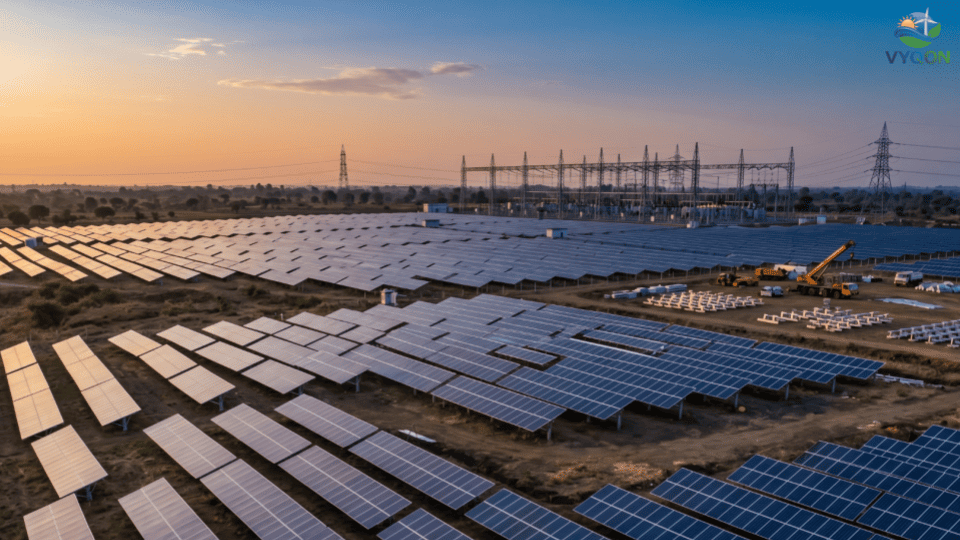
Adoption of Levelized Tariff and Regulatory Alignment
The Central Electricity Regulatory Commission (CERC) has issued a formal order adopting the levelized tariff for Unit 3 of the Neemuch Solar Project. The Commission approved a tariff of ₹2.15/kWh for the 170 MW unit, which is located within the Neemuch Solar Park in Madhya Pradesh. This regulatory milestone occurs under the strategic framework of the Madhya Pradesh Renewable Energy Policy—2025, gazetted on April 4, 2025, which underscores the state’s commitment to large-scale renewable deployment through public-private partnerships.
Technical Infrastructure and Connectivity Framework
The project’s integration into the grid is governed by technical specifications established during the Western Regional Power Committee (WRPC) proceedings. Unit 3 is part of a broader 500 MW development for which Stage-II Connectivity and Long-term Access (LTA) applications were initiated as early as March 2021.
The evacuation of power from the project is supported by the following infrastructure:
- ISTS Substation: Power will be evacuated via the Neemuch PS (400/220 kV, 1×500 MVA).
- Dedicated Transmission System: A dedicated 220kV S/c line connects Neemuch Unit 3 to the Neemuch PS, including associated bays at the generation end.
- Total Park Capacity: The 500 MW Neemuch Solar Park is divided into three segments:
- Unit 1: 160 MW
- Unit 2: 170 MW
- Unit 3: 170 MW
Project Governance and RUMSL’s Strategic Role
Rewa Ultra Mega Solar Limited (RUMSL), a joint venture between Madhya Pradesh Urja Vikas Nigam and the Solar Energy Corporation of India (SECI), serves as the solar park developer and implementing agency. Under Section 1.5 of the Madhya Pradesh Renewable Energy Policy—2025, RUMSL is recognized for pioneering business models that supply power to public institutional consumers. This project specifically targets such institutional offtake, aligning with the state’s goal of providing cost-effective renewable energy to government entities.
Development Chronology and Corrective Tendering
The current tariff adoption follows a significant regulatory lead time and the resolution of prior contractual defaults. Although initial connectivity applications date back to early 2021, the development of Unit 3 faced delays following the default of the original developer. This resulted in the termination of previous agreements by state authorities and Indian Railways. To maintain project viability, RUMSL issued a fresh tender in March 2024. This corrective action was essential to meet the state’s revised renewable energy targets and to ensure the utilization of the already-planned ISTS Substation infrastructure.
Selection of Developer and PPA Execution
The selection of the new developer was finalized through a competitive bidding process and a subsequent e-reverse auction. Waaree Forever Energies Private Limited was identified as the successful bidder with the lowest bid of ₹2.15/kWh. Following this selection, the administrative timeline has been set for the formal execution of Power Purchase Agreements (PPAs) in February 2025.
Power Offtake and Capacity Allocation
The power generated by the 170 MW project is allocated to fulfill the requirements of public institutional consumers and state utilities. The specific offtake distribution includes:
- Madhya Pradesh Power Management Company Limited (MPPMCL)
- Indian Railways (specifically West Central Railways)
This allocation facilitates the state’s objective of decarbonizing public infrastructure and provides West Central Railways with long-term access to renewable power at a competitive levelized rate.
Regulatory Assessment and Compliance
In its final findings, the CERC confirmed that the bidding process conducted by RUMSL was fully compliant with the guidelines issued by the Ministry of Power. The Commission noted that the project received all necessary state government approvals regarding procedural relaxations necessitated by the rebidding phase. The regulatory body expressed satisfaction with the transparency of the e-reverse auction, concluding that the determined tariff reflects the prevailing market conditions and adheres to the statutory requirements for competitive procurement.
Leave a Comment