
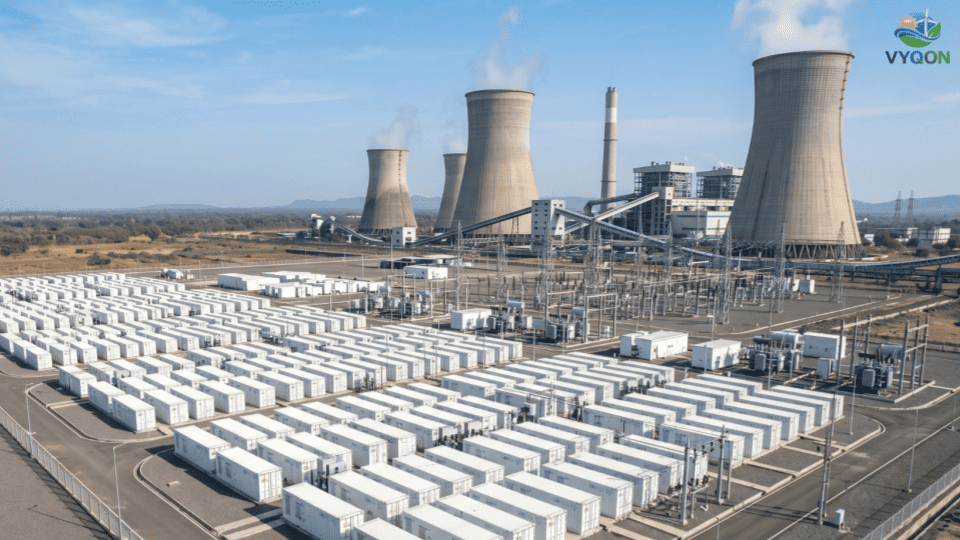
The ₹776 Crore Energy Storage Milestone
Pratap Technocrats Pvt Ltd has announced its strategic entry into the green energy sector after securing a ₹776.13 crore contract from NTPC Limited in May 2026. The contract mandates the Engineering, Procurement, and Construction (EPC) of 570 MWh of Battery Energy Storage Systems (BESS) at the Gadarwara Super Thermal Power Station in Madhya Pradesh and the Khargone Super Thermal Power Station in Madhya Pradesh. For Pratap Technocrats, this single award represents approximately 56% of its reported ₹1,380 crore revenue for the financial year ending March 31, 2025, marking a transformative pivot from its legacy in telecom infrastructure toward grid-scale energy assets.
Project Technical Specifications and Site Allocation
The 570 MWh capacity is divided to support operational stability at two of NTPC’s high-capacity thermal facilities:
- Gadarwara Super Thermal Power Station: 320 MWh BESS capacity.
- Khargone Super Thermal Power Station: 250 MWh BESS capacity.
The technical scope of the package requires comprehensive integration with existing thermal assets. According to the NTPC tender requirements, the implementation includes:
- Advanced Battery Management Systems (BMS) and Energy Management Systems (EMS).
- Thermal Management Systems (TMS) for optimized cell performance.
- SCADA, Power Conversion Systems (PCS), and Inverter Duty Transformers (IDT).
- 220 kV DC and AC cabling and 220 kV switchyard infrastructure.
- Interconnection systems including 33 kV pooling switchgear and protection systems.
- Auxiliary power systems, HT & LT systems, and fire-fighting equipment.
The contract includes a Comprehensive Annual Maintenance Contract (CAMC) covering the entire design life of the battery system to ensure sustained performance and reliability.
Corporate Evolution: From Telecom Infrastructure to Grid-Scale Storage
Headquartered in Gurugram with its registered office in Jaipur, Pratap Technocrats is undergoing a rapid strategic evolution. While the company is historically recognized as a provider of telecom network infrastructure, it has recently demonstrated significant momentum in public infrastructure, bolstered by a Compound Annual Growth Rate (CAGR) of 26%.
This BESS award follows other major infrastructure wins, including three middle-mile network packages under the BharatNet Phase 3 program covering Rajasthan, Haryana, and Assam.
“This project marks a significant milestone for our organization,” stated Devendra Singh Shekhawat, Chairman of Pratap Technocrats. “It reflects the trust placed in our execution capabilities and strengthens our role in supporting India’s transition toward resilient and sustainable energy infrastructure.”
Context of the NTPC 2.67 GWh BESS Tender
The award to Pratap Technocrats is a critical component of NTPC’s broader BESS initiative (Bidding Document No.: CS-0011-171B-9). This tender involves the deployment of 2.67 GWh of storage capacity across nine thermal stations to mitigate the intermittency of renewable energy. Other major allocations within this tender framework include:
- SPML Infra: Awarded a 1 GWh BESS project at the Barauni Thermal Power Station in Bihar, valued at approximately ₹1,128 crore.
- SolarWorld Energy: Awarded a 50 MW / 100 MWh BESS EPC project at the Feroze Gandhi Unchahar Thermal Power Station in Uttar Pradesh for approximately ₹108 crore.
NTPC plans to fund these Lot-2 packages through a combination of debt and equity as per its capital expenditure framework.
Implementation Timeline and National Impact
The project adheres to an 18-month execution timeline for design, engineering, and commissioning, followed by a 15-year operation and maintenance (O&M) phase.
From an analyst’s perspective, NTPC’s preference for BESS over traditional storage like pumped hydro is driven by the technology’s compactness, rapid response capabilities, and significantly smaller gestation period. These attributes are essential for frequency regulation and peak load management in a grid increasingly dominated by variable renewable energy (VRE).
By integrating high-capacity battery storage with conventional thermal assets, this project serves as a cornerstone for India’s goal of reaching 500 GW of non-fossil fuel capacity by 2030. The deployment is fundamentally designed to enhance energy reliability and grid stability, ensuring a secure transition toward India’s long-term energy security targets.
Leave a Comment