
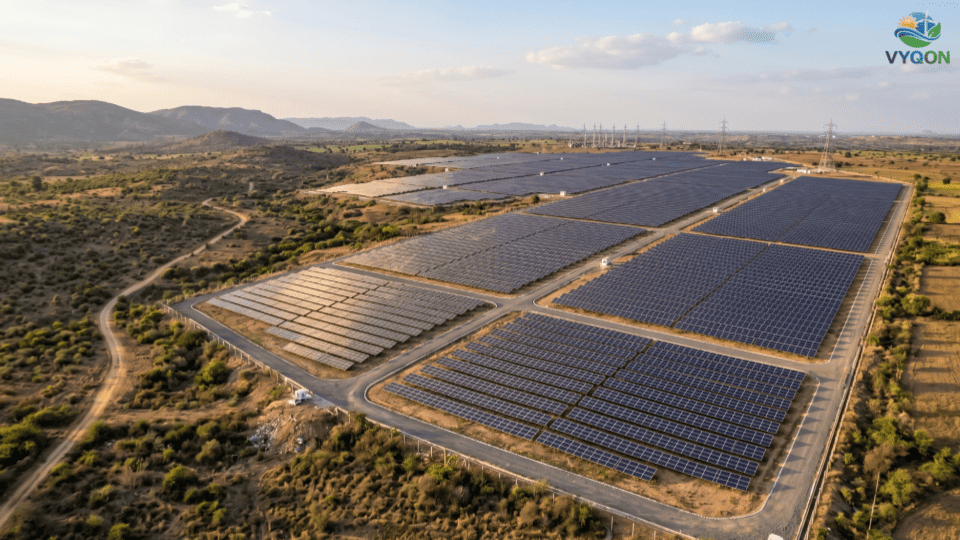
India’s renewable energy (RE) sector is projected to unlock approximately $15 billion in land-related investments by 2030. This capital influx is fundamentally necessitated by the “India RE Mission 500,” which targets 500 GW of non-fossil fuel capacity by the end of the decade. To meet these milestones, the annual capacity addition of solar and wind energy must scale by roughly 3x, transitioning from current levels to a massive sustained run-rate required to satisfy the 2030 trajectory.
Key Data & Requirements Breakdown
The transition to a high-capacity RE grid requires significant scaling of land acquisition and capital deployment. Sector analysts highlight the following metrics as critical for B2B stakeholders:
- Capacity Targets: To achieve the 500 GW mission, solar run-rates must reach 33–35 GW per annum (p.a.), while wind additions must scale to 9–10 GW p.a. by 2030.
- Land Surface Requirements: Fulfilling these targets requires ~0.5 million hectares of land by 2030, expanding to ~2.5 million hectares by 2050.
- Project Scaling: The “Development of Solar Parks and Ultra Mega Solar Power Projects” scheme targets 40,000 MW of capacity. As of June 30, 2023, 37,990 MW across 12 states has been sanctioned.
- Technical Efficiency Scale: For upstream manufacturing, the “minimum efficient scale” for wafer and cell production is currently identified at 2–3.5 GW.
- Central Financial Assistance (CFA) Nuances:
- DPR Funding: Up to Rs 25 lakh per solar park for Detailed Project Reports.
- Infrastructure Splits (Modes 1–4): The Rs 20 lakh/MW CFA is bifurcated—Rs 12 lakh/MW to Solar Power Park Developers (SPPD) for internal infrastructure and Rs 8 lakh/MW to CTU/STU for external transmission infrastructure.
- Mode-Specific Allocations: Mode 7 (SECI as SPPD) provides Rs 20 lakh/MW solely for external transmission, while Mode 8 provides the same amount exclusively for internal infrastructure.
Structural Details: Acquisition Mechanisms and Infrastructure
Operational efficiency in land acquisition is being redefined through specialized development models and regulatory workarounds.
1. The Solar Park Model
SPPDs serve as implementing agencies to provide “common infrastructure” (transmission, roads, water, and communication), reducing individual developer costs. The Ministry of New and Renewable Energy (MNRE) recognizes eight selection modes for SPPDs, ranging from State PSUs (Mode 1) and SECI Joint Ventures (Mode 2) to private entrepreneurs without CFA (Mode 6).
2. Solar vs. Wind Land Dynamics
While solar requires contiguous land, wind energy is pivoting toward “Wind Repowering.” Replacing sub-1MW turbines with modern 3MW+ platforms can increase installed capacity by 50% in under two years. This shift is estimated to unlock ~INR 20,000 Cr of electricity consumption per annum.
3. The “Long Lease” Workaround
In Rajasthan, the “long lease” model is utilized to bypass the “Ceiling Act” and the “Rajasthan Land Revenue (Conversion of Agricultural Land for Non-Agricultural Purposes in Rural Areas) Rules, 2007.” This model allows developers to avoid the cumbersome process of converting agricultural land to non-agricultural (NA) use while reducing upfront capital expenditure by amortizing costs through lease rentals.
4. Barren Land Utilization
India possesses 16–17 million hectares of barren land, with two-thirds located in RE-rich states. While only 11–12% of current RE projects utilize barren land, utilizing just 1/6th of this available resource would satisfy India’s entire 2050 land requirement.
Geographic Hotspots and Regional Implementation
Investment is concentrating in districts with high resource potential and available barren land.
- Top Districts: Twenty-five districts account for over 30% of total auctioned capacity. Key hubs include Bikaner, Jaisalmer, Kutch, Koppal, Tumkur, Neemuch, and Barmer.
- RE-Rich States: Eight states—Rajasthan, Gujarat, Maharashtra, Karnataka, Andhra Pradesh, Tamil Nadu, Madhya Pradesh, and Telangana—are the primary drivers of activity.
- Regulatory Landscapes:
- Favorable: Gujarat, driven by a strong top-down push from the Gujarat Energy Development Agency (GEDA).
- High Risk: Andhra Pradesh and Telangana are characterized by increased bureaucracy and the withdrawal of previous liberal policy benefits.
Implementation Challenges and Bottlenecks
A technical assessment of current projects reveals structural mismatches and legal hurdles:
- UMREPP Delays: Roughly 60% of capacity under the Ultra Mega Renewable Power Parks scheme is stalled. A breakdown of these delays shows 23% due to evacuation/transmission issues and 20% due to land disputes.
- Transmission Mismatch: There is a 4–5 GW delay in commissioning due to the structural mismatch in construction cycles; the transmission construction cycle (2.5+ years) is significantly longer than the RE project construction cycle (~1.5 years).
- Legal Gridlock: Case studies show projects like the 0.4 GW Dholera Solar Park (Ph-I) stalled in GERC and APTEL due to PPA disputes, while 0.5 GW in Neemuch was delayed by land transfer lags between RUMSL and PGCIL.
Official Statement and Growth Outlook
To meet 2030 targets, industry experts advocate for a multi-tiered monitoring framework to de-bottleneck project execution.
National RE Acceleration Outlook: The proposed implementation strategy involves a “three-tier war-room” structure:
- National-level: Quarterly reviews chaired by the Secretary, MNRE.
- State-level: Monthly reviews chaired by the Chief Secretary.
- District-level: Fortnightly monitoring chaired by District Magistrates (DMs) to resolve local Right of Way (RoW) and land title issues.
The industry further requires the digitization of at least 30 years of historic land records to resolve ownership disputes. This acceleration of RE capacity is a non-negotiable prerequisite for India’s energy transition and the expansion of industrial corridors for OEMs. Moving forward, the focus remains on bottom-up transmission planning at the state level to ensure infrastructure availability aligns with central capacity targets.
Leave a Comment