
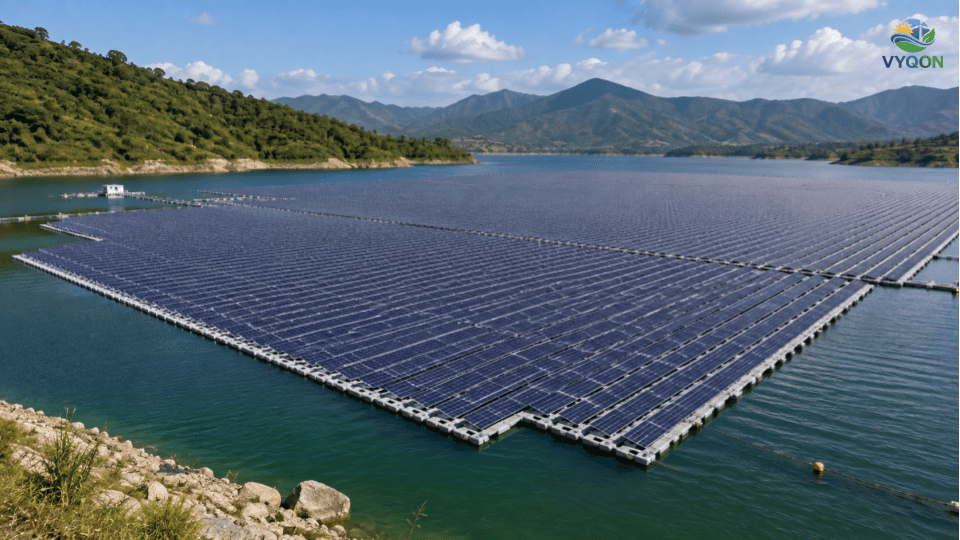
The central sector scheme targets 5,000 MW of floating solar capacity integrated with battery storage to optimize reservoir utilization and mitigate clean energy curtailment.
On July 31, 2026, the Union Cabinet, chaired by Prime Minister Narendra Modi, approved the Pradhan Mantri Surya Sarovar Yojana (PM-SSY). This strategic initiative mandates the deployment of 5,000 MW of Floating Solar Photovoltaic (FSPV) capacity integrated with co-located Energy Storage Systems (ESS). By utilizing existing reservoirs and industrial ponds, the scheme addresses the structural constraints of land scarcity while providing the “clean flexibility” required to stabilize the national grid during midday solar surges.
Program Outlay and Financial Framework
The PM-SSY is established as a Central Sector Scheme with a total financial commitment designed to de-risk floating solar technology and incentivize state-level participation. All States and Union Territories are eligible for benefits under the following framework:
| Component | Financial Detail |
| Total Scheme Outlay | ₹5,070 Crore (₹50.7 Billion) |
| Central Financial Assistance (CFA) | ₹1 Crore per MW for commissioned projects |
| Feasibility Study Support | Up to ₹50 Lakh per project for bathymetric, hydrographic, and environmental assessments |
| Implementation Period | FY 2026–27 to FY 2030–31 (Sanction Period) |
| Financial Disbursement | Extended support available up to FY 2032–33 |
Technical Specifications and Storage Mandates
To ensure grid reliability, the PM-SSY integrates a mandatory storage component for all projects, executed via tariff-based competitive bidding. These requirements align with Central Electricity Authority (CEA) advisories regarding 2-hour co-located storage to manage intermittency.
- Standard Storage Requirement: Projects must incorporate a minimum 2-hour storage capacity.
- Modular Augmentation Pathway: For projects where the Commercial Operation Date (COD) slips beyond FY 2029-30, the storage mandate scales to a 4-hour duration to account for higher future grid flexibility needs.
- Cumulative Target: The scheme aims to deliver a total storage volume of 10,000 MWh (10 GWh).
- Strategic Co-location: Storage must be situated at the solar site to provide immediate frequency response and downward reserves, effectively absorbing surplus generation.
Resource Assessment and National Potential
The PM-SSY is grounded in a data-driven assessment by the National Institute of Solar Energy (NISE), which identifies a total floating solar potential of 102.18 GWp across India. Crucially, this estimate is conservative, based on utilizing only 20% of the surface area of existing reservoirs to ensure environmental sustainability and avoid interference with other water uses.
The scheme marks a significant scale-up in national capacity; India currently has approximately 700 MW of installed FSPV. By adding 5,000 MW, the PM-SSY will drive a more than sevenfold increase in total capacity to 5,700 MW. High-potential regions identified for prioritized deployment include Maharashtra, Madhya Pradesh, Karnataka, Odisha, Telangana, and Gujarat, which possess the highest concentrations of suitable inland water bodies and industrial ponds.
Environmental and Economic Impact Projections
The Ministry of New and Renewable Energy (MNRE) projects that the scheme will facilitate a transition toward high-efficiency, land-neutral power generation with the following outcomes:
- Carbon Offset: Estimated annual reduction of 10 million tonnes of CO2 emissions.
- Job Creation: Generation of 16,000–17,000 full-time equivalent (FTE) jobs across the solar value chain.
- Domestic Manufacturing: Promotion of local supply chains for specialized floatation systems, PV modules, and Battery Energy Storage Systems (BESS).
- Evaporation Mitigation: Floating arrays are expected to reduce water evaporation by 20–30%, providing a critical co-benefit for irrigation and drinking water reservoirs.
Strategic Context: Grid Stability and Coal Inflexibility
The prioritization of FSPV with integrated storage addresses a critical “structural constraint” in the Indian power sector. Current grid data indicates that coal-based power plants often reach their Minimum Technical Levels (MTL)—approximately 55% of rated capacity—during midday solar peaks. Because these plants cannot ramp down further without risking operational safety, grid operators are frequently forced to curtail renewable energy.
The 10 GWh storage mandate under PM-SSY is designed to absorb this midday surplus, preventing the waste of clean power. By discharging this energy during evening peak hours, the scheme reduces the grid’s reliance on coal for flexibility and provides the necessary downward reserves that traditional plants lose once they hit their MTL floor.
The Pradhan Mantri Surya Sarovar Yojana reinforces India’s trajectory toward achieving 500 GW of non-fossil fuel capacity by 2030. By bypassing land acquisition hurdles and integrating advanced storage, the scheme serves as a vital, land-neutral complement to ground-mounted and rooftop solar, ensuring a more resilient and decarbonized energy architecture.
Official Citations and Resources
- Central Electricity Authority (CEA), Ministry of Power
- Advisory on co-locating Energy Storage Systems (ESS) with Solar Power Projects to enhance grid stability and cost efficiency. (Published 18 February 2025).,
- Ministry of New and Renewable Energy (MNRE) / National Institute of Solar Energy (NISE)
- Solar PV Potential of India (Floating Solar) Report: Comprehensive assessment estimating 102.18 GWp floating solar potential across India.,,
- MNRE Official Website
- Press Information Bureau (PIB), Government of India
- India’s Solar Growth Enters a New Era: Backgrounder on solar expansion and the Pradhan Mantri Surya Sarovar Yojana (PM-SSY). (Published 02 August 2026).,
- Cabinet Approves Pradhan Mantri Surya Sarovar Yojana (PM-SSY): Official release on the ₹5,070 crore outlay for floating solar and storage.,
- PIB Press Release Archive
- Godavari Marathwada Irrigation Development Corporation (GMIDC), Government of Maharashtra
- Expression of Interest (EOI) for 200 MW Floating Solar Project with BESS at Purna Reservoir. (Published 03 August 2026).,
- Solar Energy Corporation of India (SECI)
- Nodal agency for tariff-based competitive bidding and implementation of large-scale solar initiatives.,
- SECI Official Guidelines
Leave a Comment