
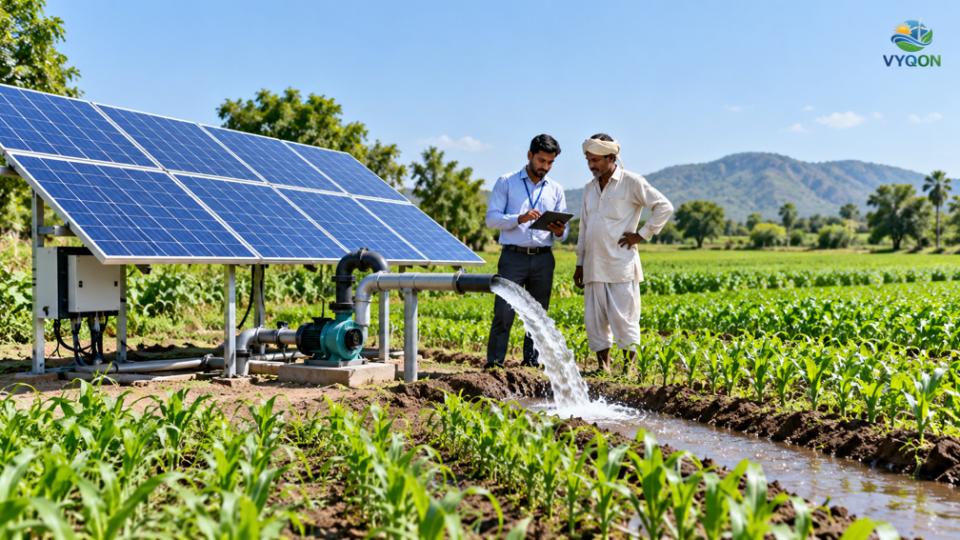
The MSEDCL contract covers 5,000 off-grid solar photovoltaic water pumping systems under the Magel Tyala Saur Krushi Pump Yojana/PM-KUSUM Component B, including installation, commissioning and five years of maintenance and remote monitoring.
Saatvik Green Energy Limited has secured an order worth approximately ₹100 crore from Maharashtra State Electricity Distribution Company Limited (MSEDCL) for the supply and installation of 5,000 off-grid DC solar photovoltaic water pumping systems across identified agricultural locations in Maharashtra. The contract forms part of the Magel Tyala Saur Krushi Pump Yojana / PM-KUSUM Component B programme, which supports the adoption of standalone solar-powered irrigation systems. The company disclosed the order through a regulatory filing dated 10 October 2026, confirming that the awarded systems will include pump capacities of 3 HP, 5 HP and 7.5 HP. The total contract value is approximately ₹100 crore, excluding Goods and Services Tax (GST).
The order covers a comprehensive range of activities, including system design, manufacturing, supply, transportation, installation, testing and commissioning at identified farmers’ locations. Saatvik will also be responsible for complete system warranty, repair, maintenance and remote monitoring for a period of five years. The contract requires installation and commissioning within 60 days from the issuance of the applicable Notice to Proceed (NTP) or work order by the respective circle office. This represents a significant implementation responsibility because the installations will be distributed across multiple agricultural sites rather than concentrated within a single solar power facility. The announced order therefore involves not only equipment supply but also field deployment and long-term operational support.
Maharashtra Solar Pump Order Strengthens Decentralised Agricultural Energy Development
The MSEDCL contract reflects the increasing importance of decentralised renewable energy solutions in agricultural electricity supply. Solar photovoltaic water pumping systems allow farmers to operate irrigation pumps using electricity generated directly from sunlight, reducing dependence on conventional electricity connections or diesel-powered pumping arrangements where such alternatives are otherwise required. Under an off-grid configuration, the pumping system is designed to operate independently of the electricity distribution network during normal solar-powered operation. This can be particularly useful for agricultural locations where grid connectivity is unavailable, unreliable or difficult to extend.
The three pump categories covered under Saatvik’s order are intended to address different agricultural pumping requirements. A 3 HP system may be appropriate for relatively modest pumping duties, while 5 HP and 7.5 HP systems can support applications requiring higher mechanical output, subject to the available water source and hydraulic conditions. However, pump horsepower alone does not establish the volume of water delivered. Actual performance depends on factors such as total dynamic head, groundwater depth, pipeline losses, pump efficiency and available solar irradiation. The selection of appropriate system components is therefore essential to ensuring that each installation meets the requirements of the intended agricultural application.
A complete solar pumping installation generally includes photovoltaic modules, mounting structures, electrical cabling, a pump controller, suitable protection devices and a motor-pump assembly. Photovoltaic modules convert sunlight into direct-current electricity, which is managed by the pumping system’s power electronics to operate the motor according to the available solar input and system design. Unlike conventional irrigation pumping arrangements dependent on purchased fuel, solar pumping can reduce recurring energy expenditure after installation. Nevertheless, system performance varies throughout the day with sunlight intensity, weather conditions and the operating characteristics of the pump.
The order also supports the wider objective of increasing renewable energy use in agriculture. Under PM-KUSUM Component B, the central programme framework has supported the installation of standalone solar agricultural pumps, particularly in off-grid areas. Maharashtra’s Magel Tyala Saur Krushi Pump Yojana similarly focuses on providing solar-powered pumping solutions to eligible agricultural consumers. Although Saatvik’s filing identifies the order with these schemes, the announcement should not be interpreted as confirmation of a newly sanctioned central subsidy allocation. The contract itself establishes the equipment and service responsibilities assigned to the company.
Installation Timeline and Five-Year Maintenance Responsibilities
One of the most important conditions of the MSEDCL order is the requirement to complete installation and commissioning within 60 days of the relevant NTP or work order. This timeline does not begin automatically on the date of the company’s stock-exchange announcement. Instead, the contractual period is linked to instructions issued by the appropriate MSEDCL circle office. Consequently, different installation locations may have different execution schedules depending on when their respective work orders are issued.
Implementing 5,000 solar pumping systems across geographically dispersed agricultural locations requires careful coordination between equipment suppliers, transportation teams, installation contractors, utility representatives and farmers. The company must ensure that the required equipment reaches each identified site and that installation work is performed according to the applicable technical specifications. Site conditions can vary considerably depending on agricultural land layout, available installation space, water-source characteristics and accessibility. These differences make field surveys, suitable equipment selection and installation planning important elements of successful project execution.
Before commissioning, installers must verify the condition of photovoltaic modules, mounting structures, electrical connections, protective equipment and pump controllers. Appropriate testing helps establish whether the installed system can operate safely and deliver water under the required conditions. Although the public filing does not disclose detailed testing procedures for each location, safe electrical installation, structural stability and functional pump testing are important considerations for standalone solar pumping projects. The availability of trained installation teams and timely site inspections will play an important role in meeting the contractual requirements.
Beyond initial commissioning, Saatvik will provide a five-year comprehensive system warranty, repair and maintenance service, together with remote monitoring. This long-term obligation is particularly significant because agricultural solar pumping systems are exposed to changing weather conditions, dust accumulation, seasonal operating patterns and mechanical wear. Photovoltaic modules, electrical connections, controllers and pump assemblies require suitable inspection and maintenance to sustain reliable operation. The effectiveness of the programme will therefore depend not only on completing installations but also on maintaining system functionality throughout the contracted service period.
Remote monitoring can assist in identifying operational interruptions, equipment faults and abnormal system behaviour, depending on the sensors and communication functions included in the final installations. Such systems may improve maintenance planning and reduce delays in identifying technical problems. However, remote monitoring cannot eliminate the need for physical servicing, particularly when faults involve mechanical components, damaged electrical connections or site-specific water-source conditions. Maintaining spare-parts availability and an effective field-service network across Maharashtra will be essential to meeting long-term support obligations.
Implications for Solar Agriculture and India’s Off-Grid Energy Market
The order highlights the role of solar photovoltaic technology in applications beyond utility-scale electricity generation and conventional rooftop installations. Agricultural pumping represents an important segment of decentralised energy because it connects renewable electricity generation directly with a practical productive use. Instead of supplying electricity through the conventional grid, standalone solar pumping systems can provide energy at or near the point where irrigation water is required. This approach can reduce exposure to diesel fuel costs and offer greater daytime pumping flexibility, subject to local water availability and system performance.
For India’s solar industry, such projects also create demand for photovoltaic modules, mounting systems, controllers, electrical components, installation services and maintenance capabilities. Successful implementation requires coordination across manufacturing, logistics, engineering and after-sales support. Companies participating in this market must therefore demonstrate the ability to deliver complete functioning systems rather than focusing only on module manufacturing capacity or equipment supply volumes.
At the same time, solar-powered irrigation must be implemented with attention to groundwater sustainability. Reduced energy costs can improve irrigation affordability, but they may also encourage more frequent pumping if water extraction is not managed responsibly. The long-term agricultural benefits of solar pumping are strongest when reliable equipment is combined with appropriate irrigation practices, efficient water use and consideration of local groundwater conditions.
From a commercial perspective, the approximately ₹100 crore order strengthens Saatvik Green Energy’s portfolio of solar-related activities. However, the awarded contract value should not be treated as revenue already received, and the 5,000 systems should not be described as installed or commissioned. The disclosure establishes the order and its execution obligations, while actual project progress will need to be measured through installation milestones, acceptance records and subsequent operational performance.
Conclusion
Saatvik Green Energy’s approximately ₹100 crore order for 5,000 solar water pumping systems in Maharashtra represents a development in the deployment of decentralised renewable energy solutions for agriculture. Awarded by MSEDCL under the Magel Tyala Saur Krushi Pump Yojana / PM-KUSUM Component B framework, the contract combines equipment supply, installation, commissioning and five years of maintenance and remote monitoring.
The requirement to complete installations within 60 days of the applicable work orders places considerable importance on execution planning, technical quality and coordination across agricultural locations. Successful implementation could improve access to solar-powered irrigation while supporting demand for India’s off-grid photovoltaic equipment and service ecosystem.
The project’s long-term significance will ultimately depend on timely commissioning, reliable pumping performance and sustained maintenance support, demonstrating how decentralised solar technology can contribute to agricultural energy reliability and India’s broader clean energy transition.
Reference:
Saatvik Green Energy Limited – Official Stock Exchange Disclosure (PDF)View Original Company Announcement – 10 October 2026
National Stock Exchange (NSE) – Official Filing (PDF)View Original NSE Regulatory Filing
Leave a Comment