
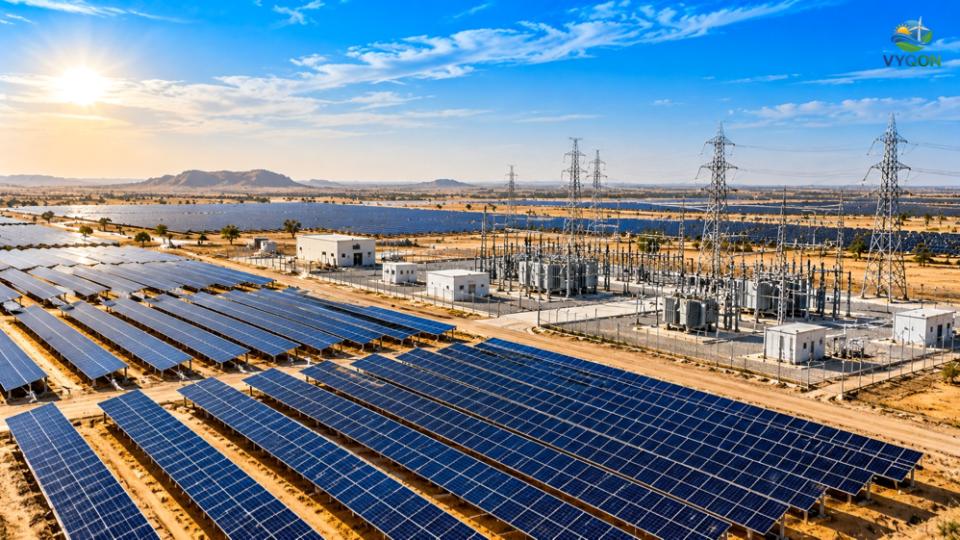
TGREDCO invites bids for 3,000 MW of solar PV projects integrated with 1,000 MW/6,000 MWh of energy storage, introducing six-hour peak-supply obligations and 25-year power purchase agreements.
Telangana Renewable Energy Development Corporation Limited (TGREDCO) has issued a Request for Selection (RfS) for developing 3,000 MW of solar photovoltaic projects integrated with 1,000 MW/6,000 MWh of Energy Storage Systems (ESS) across India. The tender, published on 13 October 2026, aims to strengthen renewable electricity procurement for Telangana’s distribution companies by combining large-scale solar generation with storage infrastructure capable of supporting electricity delivery during designated peak-demand periods.
The tender has been issued under reference TGREDCO/Plg/PP/2026-27/001 through a tariff-based competitive bidding process followed by an electronic reverse auction. Selected developers will establish projects under a Build–Own–Operate (BOO) model, with Telangana’s distribution companies (TGDISCOMs) procuring electricity through 25-year Power Purchase Agreements (PPAs). The proposed arrangement is intended to provide long-term renewable electricity supply while addressing the variability associated with conventional solar generation.
According to the official procurement schedule, the pre-bid meeting will be held on 22 October 2026 at 11:00 AM, while the online bid submission deadline is 4 November 2026 at 6:00 PM. Bid opening is scheduled for 9 November 2026. The proposed solar and storage capacity represents a procurement opportunity rather than commissioned infrastructure, with final project allocations dependent on successful bidding, contractual agreements and subsequent development.
Solar and Energy Storage Configuration
The proposed procurement combines 3,000 MW of solar PV generating capacity with 1,000 MW of storage discharge power and 6,000 MWh of stored energy capacity. The storage configuration corresponds to a nominal six-hour duration at the stated power rating, making it significantly different from shorter-duration storage installations commonly considered for renewable energy integration.
Under the RfS, developers must install a minimum of 0.333 MW/2 MWh of energy storage for every 1 MW of contracted project capacity. For example, a developer securing a 100 MW solar power contract would need to arrange at least 33.3 MW of storage discharge power with 200 MWh of energy capacity, subject to the applicable project specifications.
An important feature of the procurement is its technology-neutral approach to energy storage. The tender permits different storage technologies, including Battery Energy Storage Systems (BESS) and pumped hydro storage plants, allowing developers to evaluate solutions according to technical suitability, commercial viability and project location.
Where batteries are selected, the storage system must be co-located with the solar PV installation, subject to the provisions for projects developed across multiple locations. In contrast, a pumped hydro storage facility may be established at a separate location, provided the developer satisfies the applicable connectivity and transmission requirements.
This flexibility allows project developers to consider different technical configurations rather than relying exclusively on battery installations. However, the choice of storage technology will influence capital investment, energy efficiency, operating strategy, equipment requirements and long-term maintenance expenditure.
The six-hour storage rating also requires careful interpretation. While a 1,000 MW/6,000 MWh system has a nominal six-hour energy duration, actual electricity delivery will depend on available stored energy, equipment efficiency, operating restrictions and the obligations established under the power purchase agreement.
Peak-Hour Power Supply and Operational Requirements
One of the most significant features of TGREDCO’s tender is its specific requirement for assured electricity delivery during peak-demand periods. Unlike conventional solar procurement, which primarily focuses on electricity generated when sunlight is available, this arrangement requires developers to manage energy generation and storage to satisfy defined supply schedules.
According to the RfS, TGDISCOMs may select six peak-supply hours within the period from 6:00 PM to 9:00 AM the following day. The selected hours need not all be consecutive, although the schedule must include at least one hour of continuous storage discharge.
Developers are required to deliver 2 MWh of electricity per MW of contracted project capacity during the designated peak hours each day, in accordance with the buying entity’s schedule. For a 100 MW contracted project, this corresponds to 200 MWh of peak-period electricity delivery. The tender also defines an hourly energy allocation equivalent to approximately 0.333 MWh per MW of contracted capacity.
These requirements establish a clearer relationship between solar generation, storage operation and electricity delivery. Developers must ensure that sufficient energy is available to meet scheduled obligations while managing charging losses, storage availability and variations in solar generation.
Effective forecasting and energy management will therefore be important for project performance. Solar generation can fluctuate because of seasonal irradiation, cloud cover and temperature conditions, while storage availability depends on charging schedules and technical operating limits. Project operators will need appropriate control systems to coordinate photovoltaic generation, storage charging and electricity discharge.
The tender also allows developers to source up to 5% of annual energy from other eligible renewable energy sources, subject to specified conditions. This provision may offer limited operational flexibility when solar generation is insufficient to meet delivery requirements.
Importantly, a six-hour storage system does not provide continuous round-the-clock electricity generation. Its principal contribution is the ability to shift a defined quantity of renewable energy into periods selected by the electricity purchaser.
Project Development, Grid Connectivity and Commercial Responsibilities
Under the BOO model, successful developers will be responsible for identifying suitable project locations, developing generating and storage infrastructure, obtaining necessary approvals and arranging grid connectivity.
The projects may be established at eligible locations across India. Depending on the project location and applicable regulations, developers can connect through the Inter-State Transmission System (ISTS) or, for eligible projects located within Telangana, the state’s transmission network.
Grid integration is particularly important because the combined solar and storage configuration introduces additional requirements for protection systems, power conversion equipment, electrical metering and scheduling coordination. Developers must ensure that the selected storage technology can satisfy contractual energy delivery obligations while maintaining compliance with grid operating requirements.
The RfS permits bids for a minimum contracted capacity of 50 MW and a maximum of 1,500 MW per bidder or qualifying group, with bids submitted in multiples of 10 MW. This structure allows participation by developers pursuing different project sizes while limiting the maximum allocation to an individual bidding group.
Successful bidders will also need to consider financing costs, engineering requirements, equipment procurement, insurance, operating expenditure and long-term performance obligations. For battery-based projects, these assessments may include cell degradation, thermal management, warranty coverage and replacement planning. Pumped hydro proposals involve different considerations, including civil infrastructure, water availability and site-specific engineering.
The tender establishes the Scheduled Commencement of Supply Date at 24 months from the effective date of the PPA for the full contracted project capacity. Developers must therefore coordinate land arrangements, financing, procurement, transmission connectivity and construction within the contractual implementation schedule.
Any project delays or energy delivery shortfalls may have financial consequences under the applicable tender and PPA provisions, making realistic project planning particularly important.
Significance for India’s Renewable Energy Sector
Telangana’s procurement reflects an increasing emphasis on renewable energy projects that can deliver electricity beyond their immediate generation periods. Solar capacity additions contribute to clean electricity supply, but higher renewable penetration also creates a need for flexible resources capable of responding to changing demand and generation conditions.
By combining solar PV with a substantial six-hour storage requirement, the tender seeks to improve the ability of renewable projects to meet defined electricity delivery schedules. The long-term procurement model may also provide developers with a contractual framework for evaluating investment in storage infrastructure.
The initiative could create opportunities for solar module manufacturers, energy storage technology providers, power conversion equipment suppliers, engineering contractors and grid integration specialists. However, actual equipment demand will depend on project awards, financing and the commencement of construction.
TGREDCO has also published separate procurement invitations for 2,000 MW of firm and dispatchable renewable energy round-the-clock power and 800 MW of wind power, indicating a broader approach to securing renewable electricity from different technologies and supply configurations.
The immediate milestones for the solar-plus-storage tender will be the completion of bidding, tariff discovery, developer selection and execution of power purchase agreements. Subsequent construction and commissioning will determine when the proposed capacity begins contributing to Telangana’s electricity supply.
Conclusion
TGREDCO’s 3,000 MW solar procurement with 1,000 MW/6,000 MWh of energy storage represents a significant step towards integrating renewable electricity generation with scheduled peak-hour supply.
The technology-neutral approach, six-hour storage requirement and 25-year PPAs could support investment in more flexible renewable energy infrastructure. Successful implementation will depend on competitive tariffs, reliable storage performance, timely grid connectivity and effective project execution.
1. Official Tender Document (RfS)
Download Official TGREDCO Tender PDF
2. Additional Official Sources
Tender Identification
| Particular | Details |
|---|---|
| Tender authority | TGREDCO |
| Tender number | TGREDCO/Plg/PP/2026-27/001 |
| Tender search code | TGREDCO-2026-TN000004 |
| Publication date | 13 October 2026 |
| Bid submission deadline | 4 November 2026, 6:00 PM |
Leave a Comment