
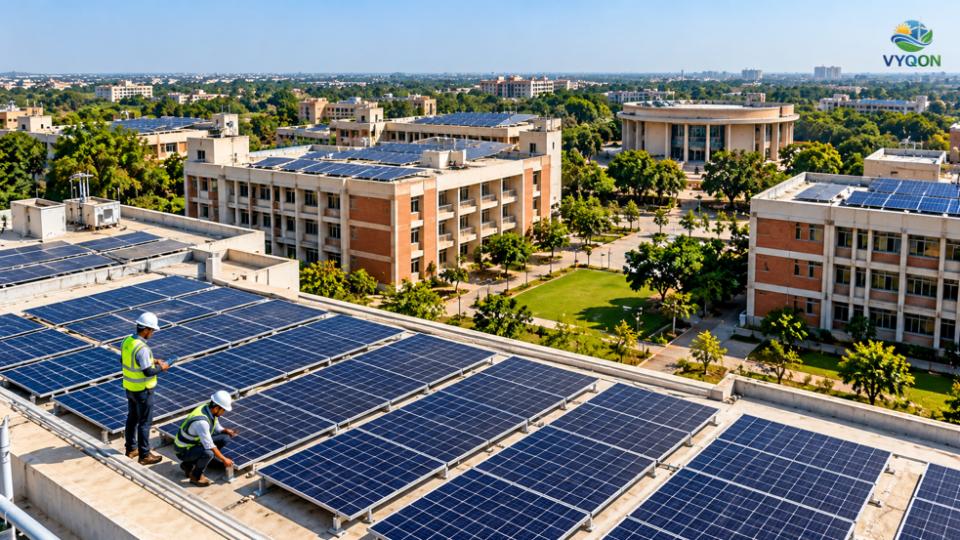
The institute has invited bids for rooftop photovoltaic installations across academic, residential and supporting campus buildings, with a 180-day completion period and a submission deadline of 3 November 2026.
The Indian Institute of Technology (IIT) Palakkad has issued a new tender for the supply, installation, testing and commissioning of a 1,252 kWp rooftop solar photovoltaic generation system at its Sahyadri Campus in Kerala. The procurement, published on 14 October 2026, forms part of the institute’s permanent-campus development programme under Phase B and covers solar PV modules, grid-connected inverters, supporting structures, electrical connections, protection equipment and associated infrastructure.
The tender has been issued by IIT Palakkad’s Engineering Works Division under reference 17/IITPKD/EWD/2026-27/337, with an estimated project cost of ₹5,83,44,429, approximately ₹5.83 crore. According to the official Notice Inviting E-Tender, interested contractors must submit their bids by 3 November 2026 at 11:00 AM, while the opening of eligibility bids is scheduled for the same day at 11:30 AM. The tender also specifies an Earnest Money Deposit (EMD) of ₹11,66,889 and a project completion period of 180 days from the contractual commencement of work.
The proposed installation is intended to integrate solar electricity generation into the campus’s existing electrical infrastructure. By distributing photovoltaic systems across suitable building rooftops, the project could help the institute utilise available structural space for renewable energy generation while reducing its dependence on purchased grid electricity. However, the procurement remains at the bidding stage, and no successful contractor, final awarded contract value or commissioning date has been announced.
Rooftop Solar Development Across Campus Buildings
The project involves the installation of rooftop photovoltaic systems across multiple buildings within IIT Palakkad’s Sahyadri Campus at Kanjikode West. Unlike a single ground-mounted solar plant, the proposed configuration will use several rooftop areas, each requiring a suitable combination of photovoltaic modules, inverters, mounting structures and electrical interconnection equipment.
According to the official tender scope, the proposed installation covers the Saraswati Academic Block (A01), Department Buildings B03 and B04, Malhar and Saveri hostel blocks, Kedaram dining block, Dr. APJ Abdul Kalam Block (D03), and Type V residential quarters. The institute has included building plans and single-line electrical diagrams to support the engineering and bidding process.
The technical schedule identifies solar modules in the 630–640 Wp power range, along with grid-connected inverters of different capacities according to the available rooftop space and the electrical requirements of individual buildings. The system design must also incorporate appropriate electrical protection, earthing, cabling, mounting arrangements and monitoring facilities.
The 1,252 kWp project rating represents the proposed peak direct-current photovoltaic capacity under standard test conditions. It should not be interpreted as the continuous alternating-current power available at the campus connection point. Actual electricity generation will depend on solar irradiation, module temperature, rooftop orientation, shading, inverter efficiency and equipment availability.
Multi-building rooftop installations introduce practical design challenges that differ from large ground-mounted projects. Each building may have distinct structural characteristics, electrical loads, access arrangements and roof layouts. Contractors must therefore examine local installation conditions and ensure that mounting systems are suitable for the available structural capacity and applicable engineering requirements.
Proper planning is also necessary to avoid interference with existing rooftop drainage, waterproofing arrangements, maintenance pathways and building services. The institute’s published drawings provide an engineering basis for these decisions, while any proposed deviation from approved layouts must receive the required authorisation before execution.
Electrical Integration, Monitoring and KSEB Requirements
The proposed development includes electrical infrastructure beyond the installation of photovoltaic panels. The tender specifies grid-connected inverters, protection systems and associated connections that will enable solar electricity to be integrated with the campus distribution network.
One of the important components involves coordination with Kerala State Electricity Board (KSEB) requirements. The tender provides for modification of existing metering arrangements, including shifting an existing metering cubicle and installing an indoor-type Availability-Based Tariff (ABT) metering cubicle with associated meters, current transformers, potential transformers, protection equipment and other electrical accessories.
The project also includes the required communication and Supervisory Control and Data Acquisition (SCADA) infrastructure for monitoring and data acquisition in coordination with KSEB officials. These arrangements can support improved visibility of electricity generation, metering information and relevant network operating conditions.
For a campus with multiple photovoltaic installations, reliable monitoring can provide operational benefits. Building-level energy data can help facilities teams assess system availability, identify underperforming installations and plan maintenance activities. However, the usefulness of such information depends on the final monitoring configuration, measurement accuracy and integration with the institute’s electrical management systems.
Electrical protection and grid compliance will remain essential to project implementation. Solar inverters must operate within permitted voltage and frequency conditions, while suitable anti-islanding protection is required to prevent unsafe energisation during grid outages. Earthing, insulation resistance, cable sizing and switching arrangements must also comply with applicable standards and approved designs.
Following installation, contractors will be required to complete the necessary inspection, testing and commissioning activities before the systems can enter normal operation. The KSEB-related installations are also subject to the necessary approvals from the electricity utility.
These requirements demonstrate that the proposed rooftop solar project is not limited to photovoltaic module procurement. Its successful delivery will depend on coordinated civil, structural, electrical and communication-system engineering across the campus.
Tender Conditions, Financial Value and Project Execution
IIT Palakkad has adopted an online item-rate tendering process, requiring bidders to submit eligibility, technical and financial information through the designated E-Wizard procurement platform.
The official notice schedules a pre-bid meeting for 21 October 2026 at 10:30 AM, providing prospective contractors with an opportunity to seek clarification on technical specifications, project drawings and contractual conditions before submitting their offers.
The estimated cost of approximately ₹5.83 crore represents the value placed by the institute against the tendered work. It is not a confirmed contract award, final project expenditure or amount already invested in the solar installation.
The tender also establishes eligibility requirements based on contractors’ previous experience with grid-connected solar projects. The detailed conditions refer to satisfactory completion of qualifying similar work, helping the institute assess whether applicants possess the necessary technical and implementation capabilities.
The stipulated 180-day execution period will require careful coordination of equipment procurement, rooftop structural work, electrical installation, testing and utility-related approvals. Because the project is spread across different campus buildings, contractors may also need to plan work sequences around academic and residential activities to minimise disruption.
The tender documents include provisions for maintenance responsibilities, defect rectification and technical support after installation. These considerations are important for maintaining long-term photovoltaic performance, particularly where individual systems operate across multiple buildings and require periodic inspections, cleaning and electrical monitoring.
The institute had previously published a separate tender in July 2026 for a similarly rated 1,252 kWp solar system covering Sahyadri and Nila campuses. The October invitation specifically identifies Sahyadri Campus. Although the two notices share the same headline capacity, their relationship has not been explicitly established in the information reviewed. They should therefore not be treated as confirmed separate additions to the institute’s installed solar capacity.
Future developments will depend on the completion of bidding, contractor selection, project execution and successful commissioning.
Institutional Solar Deployment and Wider Significance
Rooftop solar installations at educational institutions can support renewable electricity adoption by utilising existing building surfaces rather than requiring dedicated land for ground-mounted generation.
University campuses are particularly relevant because they combine classrooms, laboratories, offices, hostels and other facilities with varying electricity demand throughout the day. Solar generation may offset part of the electricity purchased during daylight hours, depending on the relationship between photovoltaic output and campus consumption.
For IIT Palakkad, the proposed project could provide an additional renewable electricity resource while supporting the management of campus electricity expenditure. However, actual energy savings will depend on completed installed capacity, generation performance, electricity tariffs, self-consumption levels and applicable metering arrangements.
Beyond financial considerations, a monitored solar system may offer opportunities for students and researchers to study photovoltaic performance, electrical integration and operational energy management. Such educational benefits remain potential applications rather than formally announced outcomes of the tender.
The project also represents an opportunity for rooftop solar contractors, inverter suppliers, electrical infrastructure providers and renewable energy service companies to participate in institutional clean energy deployment.
Conclusion
IIT Palakkad’s ₹5.83 crore tender for a 1,252 kWp rooftop solar system at Sahyadri Campus represents another opportunity to integrate renewable electricity generation into institutional infrastructure.
With bids scheduled to close on 3 November 2026, the next milestones will be contractor selection, installation and commissioning. Successful implementation could strengthen the campus’s renewable energy infrastructure and provide long-term operational benefits.
Official sources:
1. Official Tender Document (PDF)
Download Official IIT Palakkad Solar Tender PDF
2. Official Tender Announcement
IIT Palakkad – Official Tender Listing
Search for tender number 17/IITPKD/EWD/2026-27/337. The listing also provides building drawings and electrical diagrams.
Key Tender Details
| Particular | Details |
|---|---|
| Authority | IIT Palakkad |
| Capacity | 1,252 kWp |
| Location | Sahyadri Campus, Kerala |
| Tender published | 14 October 2026 |
| Estimated value | ₹5.83 crore |
| Submission deadline | 3 November 2026, 11:00 AM |
| Completion period | 180 days |
Leave a Comment