
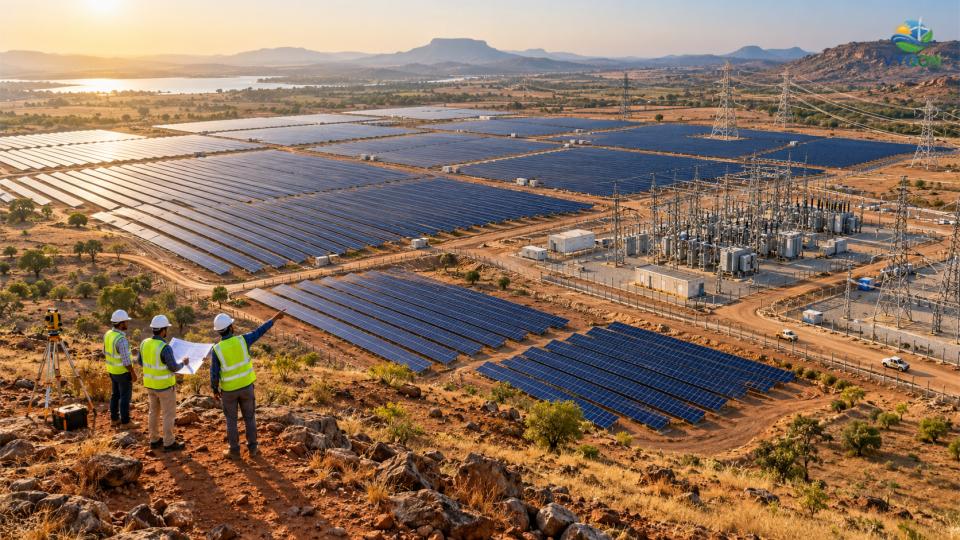
The land-inclusive EPC package covers two proposed 300 MW solar blocks, dedicated 220 kV transmission infrastructure and land arrangements for an associated battery storage project, with bids closing on 13 November 2026.
NTPC Renewable Energy Limited (NTPC REL), a wholly owned subsidiary of NTPC Limited, has invited bids for an Engineering, Procurement and Construction (EPC) package with land for the development of up to 600 MW of Interstate Transmission System (ISTS)-connected ground-mounted solar photovoltaic capacity near its Dhule Solar Project in Maharashtra. The tender, issued on 16 October 2026, covers two proposed solar blocks of 300 MW each, together with land arrangements, electrical infrastructure, power evacuation facilities and associated construction responsibilities.
The procurement has been issued under reference NRE-CS-5848-004(EPC)-9, with tender search code NTPCREL-2026-TN000043. NTPC REL will select contractors through a domestic competitive bidding process using a single-stage, two-envelope system comprising techno-commercial and financial bids. According to the official Invitation for Bids (IFB), the deadline for submission is 13 November 2026 at 3:00 PM, with techno-commercial bid opening scheduled for 3:30 PM on the same day.
An important feature of the package is that the selected contractor must arrange land not only for the proposed solar installations but also for an owner’s Battery Energy Storage System (BESS) project. The published scope does not establish a battery power or energy rating and should not be interpreted as an award for BESS equipment installation. The announcement represents a new procurement stage rather than a completed solar power project, with actual commissioning dependent on successful bidding, land acquisition, infrastructure development and construction.
Land-Inclusive EPC Scope and Two 300 MW Solar Blocks
The proposed development will be implemented through two blocks, each with a rated capacity of 300 MW. The official tender requires contractors to identify suitable land, secure the necessary acquisition or leasing arrangements and transfer the relevant ownership or lease interests to NTPC REL. The land must be free from encumbrances and suitable for the intended solar and associated infrastructure development.
Combining land arrangements with EPC responsibilities can support more coordinated planning of site selection, plant layout and construction. For utility-scale solar projects, land availability is an important development consideration because unsuitable terrain, access limitations or delayed approvals can increase construction costs and affect implementation schedules.
Prospective contractors will need to assess land suitability based on topography, soil conditions, drainage, environmental constraints, transportation access and proximity to the identified electricity evacuation infrastructure. The proposed site must accommodate photovoltaic modules, mounting structures, inverter stations, internal electrical networks, roads and related facilities while allowing sufficient space for safe construction and maintenance activities.
The package also includes land arrangements for a planned BESS facility. Battery storage can provide operational flexibility by charging during suitable periods and discharging electricity when required. However, the October tender does not disclose the intended battery capacity, storage duration or final operating configuration. These details should be distinguished from the confirmed 600 MW solar EPC scope.
The division into two 300 MW blocks also allows bidders to evaluate the project through defined construction and electrical infrastructure requirements. However, the proposed capacity remains subject to final contractual arrangements, site readiness and project implementation.
Solar Technology, Grid Connectivity and Power Evacuation Requirements
A significant component of the tender involves developing electricity evacuation infrastructure to connect the proposed solar plants with NTPC REL’s existing Dhule project infrastructure and the wider ISTS network.
The official specifications require the development of dedicated 220 kV transmission line infrastructure, including the necessary right-of-way arrangements and terminal line bays at NTPC REL’s Dhule Solar Project pooling substations. Depending on the final approved electrical configuration, the evacuation system may use a common pooling arrangement or separate infrastructure for the two solar blocks.
The tender also includes the installation of new 220 kV terminal bays, with bus extensions where required. These facilities are important because electricity generated from photovoltaic modules must be converted, collected and transferred through appropriately rated electrical equipment before it can enter the transmission network.
According to the salient technical specifications, the proposed solar plants will use crystalline silicon bifacial photovoltaic modules. Both the modules and the solar cells must be selected from the applicable Approved List of Models and Manufacturers (ALMM), covering List-I for modules and List-II for cells, subject to the applicable revisions.
Bifacial photovoltaic modules can generate electricity from both their front and rear surfaces, allowing additional energy collection from reflected sunlight under suitable installation conditions. Actual energy gains depend on ground reflectance, module mounting height, row spacing, shading and operating conditions. Their contribution must therefore be evaluated using site-specific generation estimates rather than a fixed assumed percentage.
The technical specifications identify 33 kV switchgear as the performance-guarantee metering point for the respective solar plants. They also provide for 220/33 kV power transformers, with each block assigned two 125 MVA transformers and one 100 MVA transformer in the published arrangement.
The project must incorporate appropriate protection equipment, communication systems, telemetry, CCTV and measures addressing power-quality and grid-compliance requirements, including reactive power compensation and harmonics.
These requirements highlight the importance of integrating photovoltaic generation with electrical infrastructure from the beginning of project design. Even after modules and inverters are installed, commercial electricity export depends on successful testing, protection coordination, metering arrangements and grid readiness.
Tender Conditions, Contractor Eligibility and Project Execution
NTPC REL has established a structured bidding timetable for the proposed EPC package. Tender documents became available on 16 October 2026, with the document availability period scheduled to close on 26 October 2026 at 5:00 PM. The pre-bid conference and deadline for receiving bidder queries are scheduled for 28 October 2026, allowing prospective contractors to seek clarification before submitting their offers.
The Invitation for Bids specifies technical and financial eligibility requirements intended to assess bidders’ ability to execute large-scale photovoltaic and electrical infrastructure projects.
Under the solar experience route, bidders must demonstrate qualifying experience in grid-connected solar photovoltaic projects with a cumulative installed capacity of at least 40 MWp, including at least one project of 10 MWp or higher that satisfies the prescribed operating-experience requirement. Alternative qualifying routes are also available under the detailed tender provisions.
The package covers engineering, manufacturing, equipment supply, transportation, installation, testing and commissioning. It also includes performance testing to demonstrate guaranteed electricity generation at the specified metering point, along with the supply of mandatory spare parts.
Importantly, the contractor will be responsible for operation and maintenance of the completed solar plants and associated evacuation infrastructure for three years from commissioning. This extends the package beyond construction and creates responsibilities involving plant reliability, routine inspections, preventive maintenance and operational performance during the initial operating period.
For contractors, combining land, EPC, transmission infrastructure and maintenance creates a broad delivery obligation. Bids must therefore consider site-related uncertainties, equipment availability, civil construction, electrical integration and coordination with the existing transmission infrastructure.
NTPC REL has indicated that the project package is intended to be financed through its own resources and borrowings. However, the tender announcement does not constitute a final EPC award or confirm expenditure already incurred on construction.
Significance for Maharashtra’s Solar Development and India’s Supply Chain
The latest Dhule tender highlights continued procurement activity in India’s utility-scale solar sector, where timely land arrangements and grid connectivity remain important to successful project development.
Large ground-mounted photovoltaic projects require significant coordination between equipment suppliers, engineering contractors, civil construction specialists and transmission infrastructure providers. A development of up to 600 MW could create substantial demand for solar modules, inverters, mounting structures, transformers, cables, protection systems and associated services once a contract is awarded and construction proceeds.
Maharashtra offers opportunities for utility-scale renewable energy development, supported by its electricity demand and existing power infrastructure. However, the technical and commercial viability of individual projects will depend on site selection, available grid capacity, project financing and effective construction management.
The October tender should also be interpreted alongside earlier NTPC REL procurement activity related to solar development in the Dhule region. Earlier notices have covered land and power evacuation arrangements and EPC work for projects with similar headline capacities. Without confirmation of how these packages relate to one another, their capacities should not be automatically added together as separate new generating assets.
The next important milestones will include completion of bidding, contractor selection, finalisation of land arrangements, construction of photovoltaic and transmission infrastructure, electrical testing and commercial commissioning. Only completed and commissioned capacity should be included in operational generation figures.
Conclusion
NTPC Renewable Energy’s EPC tender for up to 600 MW of solar capacity near Dhule represents a significant procurement opportunity involving land arrangements, large-scale photovoltaic development and dedicated transmission infrastructure.
The inclusion of land for a planned BESS facility also reflects the importance of considering future energy storage requirements during renewable infrastructure planning. Successful execution will depend on suitable land, timely grid connectivity, qualified contractors and completion of the necessary construction and commissioning activities.
1. Official NTPC sources
Download Official NTPC Invitation for Bids (PDF)
Download Official Salient Technical Specifications (PDF)
Open Official NTPC Tender Listing
2. Verified tender details
| Particular | Official details |
|---|---|
| Organisation | NTPC Renewable Energy Limited |
| Project location | Near Dhule Solar Project, Maharashtra |
| Proposed capacity | Up to 600 MW |
| Configuration | 2 × 300 MW solar blocks |
| Project technology | Ground-mounted solar PV |
| Grid connectivity | Interstate Transmission System (ISTS) |
| Tender number | NRE-CS-5848-004(EPC)-9 |
| Tender search code | NTPCREL-2026-TN000043 |
| Issue date | 16 October 2026 |
| Tender document closing | 26 October 2026, 5:00 PM |
| Pre-bid conference | 28 October 2026 |
| Bid submission deadline | 13 November 2026, 3:00 PM |
| Bid opening | 13 November 2026, |
Leave a Comment