
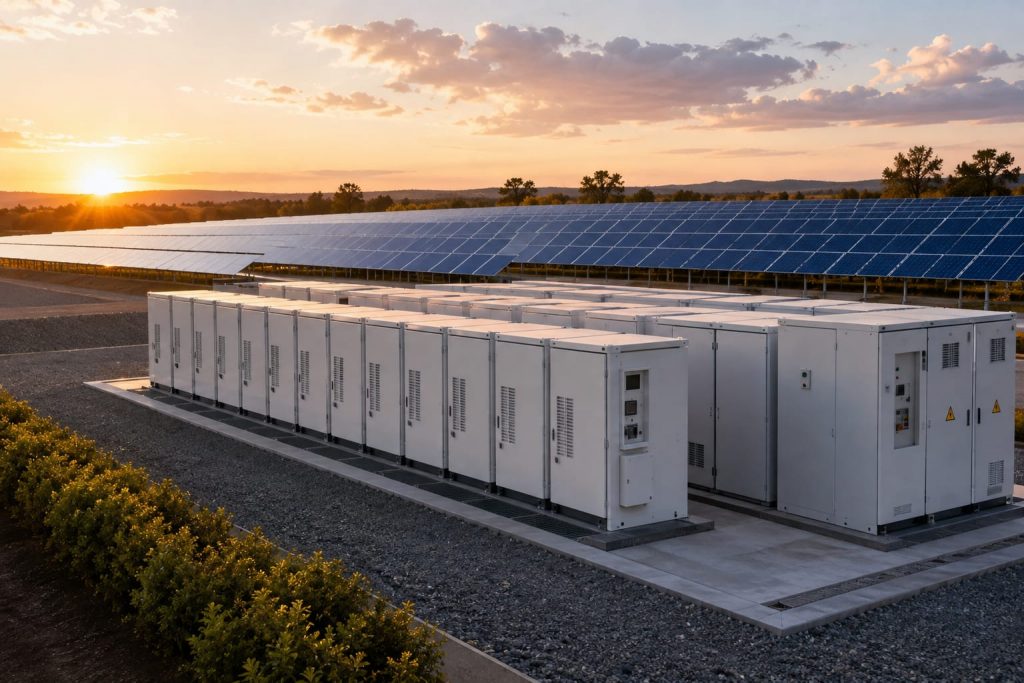
The Central Transmission Utility of India Limited (CTUIL) has put in place a procedure that allows battery energy storage system (BESS) projects already holding connectivity to the inter-State transmission system (ISTS) to increase their energy storage capacity in megawatt-hours (MWh) without enlarging their approved charging and discharging capacity in megawatts (MW). The advisory, dated 14 September 2026 and published on CTUIL’s website, specifies how such requests are to be filed, which connectivity bank guarantees apply, and how approvals will be expedited. The first projects have already begun adding storage capacity on existing grid connections under the new route.
What the Advisory Permits
Under the advisory, a BESS developer seeking a higher MWh rating while keeping the MW rating unchanged must submit an application under Regulation 5.2 of the Central Electricity Regulatory Commission (Connectivity and General Network Access to the inter-State Transmission System) Regulations, 2022, commonly referred to as the GNA Regulations. The application must show the additional MW capacity as “Nil” and state the proposed enhancement in energy storage capacity (MWh) separately.
Because the power exchanged with the grid at any instant remains within the connectivity quantum already granted, the change is effectively one of storage duration. A project connected at 100 MW with two hours of storage, for example, could move towards a four-hour configuration on the same interconnection, without seeking fresh transmission capacity.
Treatment of Connectivity Bank Guarantees
CTUIL has clarified that the connectivity bank guarantees prescribed under Regulation 5.2(e) of the GNA Regulations, namely Conn-BG1 and Conn-BG3, remain applicable to such applications. However, Conn-BG3 is defined at ₹2 lakh per MW, which raises a question of applicability where only the MWh rating increases and the MW capacity does not. CTUIL has therefore stated that it will approach CERC for clarity on this point.
Pending CERC’s direction, no Conn-BG3 is being sought at present. Applicants, however, remain liable to submit whatever Conn-BG3 the Commission may eventually specify. If they fail to do so, the approval for the additional MWh capacity will be revoked and Conn-BG1 will be encashed.
Faster Processing of Applications
To speed up approvals, CTUIL will issue the intimation incorporating the enhanced MWh capacity once all applicable regulatory compliances have been received, without waiting for the matter to be discussed in the respective CMETS meeting, the forum through which connectivity cases are ordinarily taken up. Such cases will be placed before the concerned CMETS meeting afterwards only for information and noting.
The advisory also has retrospective effect: any request for MWh enhancement received before its issuance will be processed under these same modalities.
Obligations That Continue to Apply
The relaxation is limited to the MW connectivity quantum. Developers must still meet all requirements corresponding to the enhanced storage capacity, including:
- Land and financial closure milestones as per the GNA Regulations;
- Commissioning within the Scheduled Commercial Operation Date (SCOD); and
- Any other regulatory provisions and guidelines issued from time to time.
Early Uptake by Developers
The route is already being used. Juniper Green Energy Limited, through its subsidiary Juniper Green Cosmic Private Limited, commissioned 100.64 MWh of BESS capacity under its Bikaner Phase II project in Rajasthan on 29 September 2026, according to the company’s stock-exchange disclosure. This doubled the subsidiary’s commissioned storage from 100.64 MWh to 201.28 MWh. The company has stated that the addition was made using the project’s existing grid connectivity, citing the recent clarity from CTUIL. With this addition, the group’s operational portfolio stands at about 2,725 MWp of renewable capacity and around 600 MWh of BESS.
Why the Clarification Matters
India’s storage planning increasingly points towards longer-duration systems. According to the Central Electricity Authority’s National Electricity Plan, as cited by the Ministry of New and Renewable Energy, BESS requirement is projected at 8.68 GW / 34.72 GWh for 2026-27, rising to 47.24 GW / 236.22 GWh by 2031-32. On these figures, average storage duration rises from four hours to about five hours. Total energy storage requirement, including pumped storage, is projected at 411.4 GWh by 2031-32.
Allowing storage depth to be increased behind an existing connection lets developers make fuller use of transmission infrastructure already allocated to them, rather than applying for fresh connectivity. For merchant and arbitrage-oriented projects, a longer discharge window also improves the ability to serve evening and night-time peak demand, which is central to the Ministry of Power’s National Framework for Promoting Energy Storage Systems.
The process change is equally significant. By de-linking these approvals from the CMETS cycle, CTUIL has reduced a procedural step that could otherwise delay capacity additions that place no additional MW burden on the transmission network.
The Pending Question
The main open item is CERC’s position on Conn-BG3. Since developers remain liable for any guarantee the Commission may later prescribe, and non-compliance would lead to revocation and encashment of Conn-BG1, project financing for MWh additions will need to account for this contingency until the matter is settled.
Conclusion
CTUIL’s advisory provides a clear regulatory pathway for BESS projects to deepen storage on existing ISTS connections, with defined filing requirements, an interim position on bank guarantees and a faster approval process. With early commissioning already reported and national plans pointing towards longer-duration storage, the measure is likely to see wider use as more connected BESS projects reach operation.
Official References
- Central Transmission Utility of India Limited (CTUIL) – Advisory on Modalities for Enhancement of Energy Storage Capacity (MWh) of BESS Projects already granted Connectivity (14.09.2026): https://ctuil.in/uploads/assets/178937941914Advisory-BESS%20MWHR%20enhancement%20-%20Final.pdf
- CTUIL – Detailed Procedure for Grant of Connectivity & GNA to the ISTS (10.04.2026): https://ctuil.in/uploads/assets/178351887768Detailed%20Procedure%20for%20Grant%20of%20Connectivity%20&%20GNA(10.04.2026).pdf
- CTUIL – Regulations and Procedures (CERC GNA Regulations, 2022 and amendments): https://ctuil.in/regulation_procedures
- Ministry of New and Renewable Energy (MNRE) – Energy Storage Systems (ESS) Overview: https://mnre.gov.in/energy-storage-systemsess-overview/
- Ministry of Power, Government of India – National Framework for Promoting Energy Storage Systems: https://www.mea.gov.in/Images/CPV/National-Framewk-Energy.pdf
Leave a Comment