
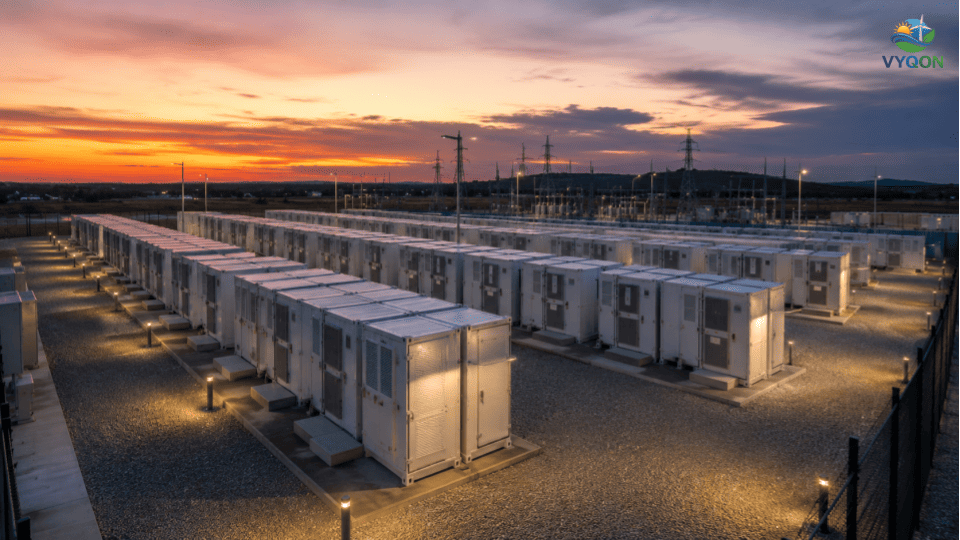
The Gujarat Electricity Regulatory Commission (GERC) has finalised the Gujarat Electricity Regulatory Commission (Grid Interactive Battery Energy Storage System) Regulations, 2026, putting in place a dedicated legal framework for how battery energy storage systems (BESS) are procured, registered, connected, scheduled and decommissioned in the state. The final regulations conclude a consultation process that began earlier this year and arrive as Gujarat’s fast-growing solar and wind capacity increasingly needs flexible resources that can store surplus generation and return it to the grid when demand peaks.
From Consultancy Tender to Final Regulations
GERC began the exercise in January 2026, when it invited consultancy firms to support the drafting and finalisation of the regulations, with bids due by 16 January. The Commission published the draft regulations on 12 May 2026, invited stakeholder comments within 30 days and held a public hearing on 15 June 2026. The finalised text records the Commission’s decisions on procurement, registration, operating models, charging arrangements and grid control, and the regulations take effect on publication in the Gujarat Official Gazette.
The regulations define a BESS as an electrochemical system that draws electricity from the grid or a generating source, stores it as chemical energy and discharges it back to the network when required. They apply to installations connected to the intra-state transmission or distribution network across Gujarat.
Competitive Bidding as the Default Procurement Route
Distribution licensees and other applicable licensees must procure BESS capacity primarily through competitive bidding under Section 63 of the Electricity Act, 2003, a route intended to ensure transparent and cost-effective tariff discovery. Cost-plus procurement under Section 62 will be permitted only in exceptional cases, with prior approval of the Commission and adequate techno-commercial justification. Tariffs under the framework are discovered as availability-based fixed charges, giving storage developers a predictable revenue stream linked to the capacity they keep available to the grid.
Registration and Minimum Project Size
All grid-connected BESS projects must register with the Gujarat Energy Development Agency (GEDA). For standalone installations, the minimum individual project size is above 1 MW of power capacity with an energy storage duration of at least two hours, and such projects must connect to the network at 11 kV or above. Smaller systems at the distribution transformer level and consumer-owned installations sit outside these utility-scale thresholds, so the size criteria do not restrict behind-the-meter storage.
Recognised Business Models
The regulations recognise four broad deployment models:
- Co-located BESS: installed alongside renewable or conventional generating stations.
- Standalone BESS: independent grid assets that can earn revenue from energy arbitrage, ancillary services, peak demand management and congestion relief.
- Network-embedded BESS: deployed within transmission or distribution systems for congestion management and network support.
- Consumer and prosumer systems: installed under net metering and virtual net metering arrangements.
A key decision in the final text concerns co-located storage, which must be charged exclusively from the associated renewable energy plant. The Commission has adopted this restriction to avoid complications in energy accounting and in verifying Renewable Purchase Obligation (RPO) compliance.
Grid Operation and the Role of SLDC
The State Load Despatch Centre (SLDC) is responsible for scheduling and dispatch of grid-connected BESS, with charging treated as drawal from the grid and discharging as injection. The SLDC also retains overriding authority to issue dispatch instructions to all grid-connected BESS during grid disturbances. Storage assets can provide fast-response services including frequency regulation, ramping support, reserves and voltage support.
Safety, Cybersecurity and End-of-Life Responsibility
Projects must comply with Central Electricity Authority (CEA) technical and safety standards and applicable cybersecurity protocols. Responsibility for end-of-life disposal and recycling rests with the BESS owner, in line with the Battery Waste Management Rules, 2022, notified by the Ministry of Environment, Forest and Climate Change, which cover energy storage system batteries. Consumer billing disputes are handled by the Consumer Grievance Redressal Forum, while other disputes fall to the Commission.
Link with the Energy Storage Obligation
The regulations support compliance with the Energy Storage Obligation (ESO) under the Ministry of Power’s July 2022 trajectory, which requires obligated entities to meet a rising share of their consumption through stored renewable energy: 1% in 2023-24, increasing by 0.5 percentage points each year to 4% in 2029-30. The obligation is treated as fulfilled only when at least 85% of the energy stored annually comes from renewable sources.
Part of a Wider Regulatory Overhaul
The BESS regulations are part of a broader set of GERC reforms in 2026. The draft GERC (Grid Interactive Distributed Renewable Energy Sources) Regulations, 2026, issued on 15 May, state that BESS deployed with distributed renewable systems will be governed by the dedicated storage regulations. The draft also proposes that consumers with contract demand above 100 kW who install renewable capacity beyond that demand must pair the excess with storage of at least two hours covering 50% of the excess capacity. Earlier this month, GERC also notified the Gujarat Electricity Grid Code, 2026, replacing the 2013 code.
Outlook
By setting clear rules on procurement, registration, sizing, charging and dispatch, the finalised regulations give developers, utilities and investors the regulatory certainty needed for long-term storage investment. With procurement anchored in competitive bidding and real-time control vested in the SLDC, Gujarat now has a complete framework to scale battery storage alongside its expanding renewable energy fleet.
Official References
- Gujarat Electricity Regulatory Commission – Renewable Energy Regulations: https://www.gercin.org/regulations/re_regulations
- GERC – Draft GERC (Grid Interactive Distributed Renewable Energy Sources) Regulations, 2026: https://gercin.org/wp-content/uploads/2026/05/Draft_-GERC-Grid-Interactive-Distributed-Renewable-Energy-Sources-Regulations-2026_1.pdf
- Central Electricity Authority – Report on Mechanism for Sale of Storage Power (ESO trajectory): https://cea.nic.in/api/dashboardReports/view-pdf/en/8b61ca73-c066-40a2-a3a5-9b160daf51c7
- MoEFCC / CPCB – Battery Waste Management Rules, 2022: http://www.eprbatterycpcb.in/upload/adminDoc/Battery-WasteManagementRules-2022.pdf
- Gujarat Energy Development Agency (GEDA): https://geda.gujarat.gov.in/
- State Load Despatch Centre, Gujarat: https://www.sldcguj.com/
Leave a Comment