
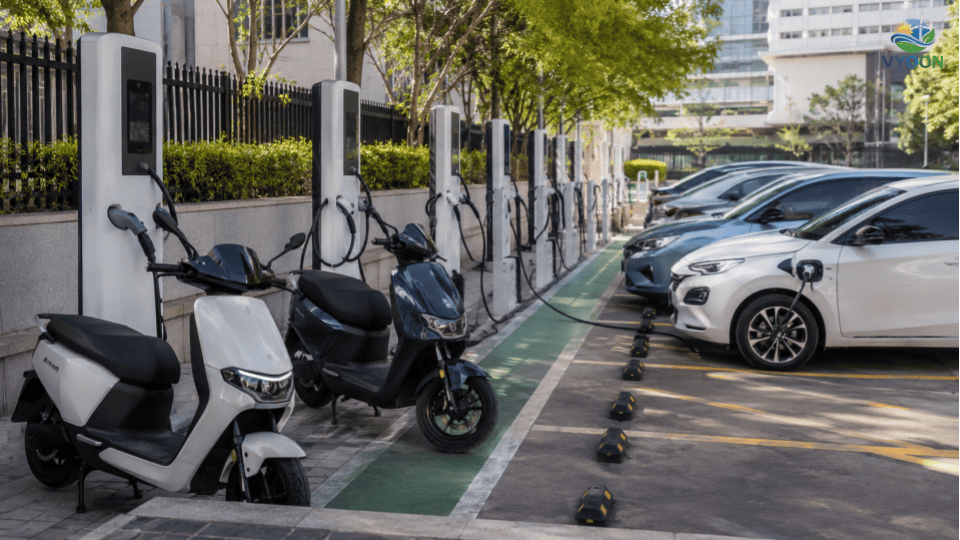
India’s electric vehicle (EV) market recorded its strongest quarter so far in July–September 2026, with EVs accounting for about 13% of all new vehicle registrations in the country. Registration data from the VAHAN portal of the Ministry of Road Transport and Highways (MoRTH) shows that around 9.5 lakh EVs were registered during the quarter, an increase of roughly 64% over the 5.79 lakh units registered in the same period of 2025. With this addition, the total number of registered EVs in India has crossed 1.04 crore.
A Record-Setting Quarter
Each month of the quarter recorded more than 2.9 lakh EV registrations. July opened the quarter at about 3.3 lakh units, a monthly record at that time. Registrations eased to just under 3 lakh units in August before rising again in September to about 3.33 lakh units, the highest monthly total recorded in India so far. The September increase came ahead of the festive season, when vehicle purchases traditionally pick up.
Segment-wise Performance
Electric two-wheelers (e-2Ws) remained the largest category, with close to six lakh units registered during the quarter. Monthly e-2W registrations stood at about 2.06 lakh in July, 1.83 lakh in August and 2.07 lakh in September. Their share of total two-wheeler registrations rose from 10.7% in August to 11.6% in September.
Electric three-wheelers, including e-rickshaws, e-carts and L5 category vehicles, continue to be the most electrified segment. The majority of new three-wheelers registered in the country are now electric, reflecting their strong position in last-mile passenger and goods transport.
Electric passenger cars posted the fastest growth among the major categories. About 35,000 electric cars were registered in September alone, nearly double the volume of September 2025, taking quarterly registrations to around one lakh units. Maharashtra, Telangana, Tamil Nadu, Kerala and Gujarat were the leading states for electric car registrations in September. Among the smaller categories, e-bus registrations rose from 575 units in July to 908 in August, while electric goods carrier registrations increased from 3,057 to 3,773 units.
PM E-DRIVE: The Central Demand Incentive
The main central support for EV demand is the PM Electric Drive Revolution in Innovative Vehicle Enhancement (PM E-DRIVE) Scheme of the Ministry of Heavy Industries (MHI), notified on 29 September 2024. Originally approved for two years with an outlay of ₹10,900 crore, the scheme has been extended to 31 March 2028, and its outlay has been raised to ₹11,900 crore.
Under the scheme, registered e-2Ws receive an incentive of ₹2,500 per kWh, capped at ₹5,000 per vehicle, for models priced up to ₹1.5 lakh ex-factory, with a total allocation of ₹2,767 crore for this segment. The target for the L5 e-3W sub-component was met and the segment was closed on 26 December 2025, while support for e-rickshaws and e-carts continues until March 2028. Incentives are passed to buyers as an upfront price reduction through e-vouchers, and MHI later reimburses the manufacturers. As of 30 June 2026, 26.59 lakh EVs had been sold under the scheme, against a target of about 28.30 lakh vehicles.
Electric Buses and Charging Infrastructure
PM E-DRIVE has allocated ₹4,391 crore for the deployment of 14,028 e-buses, of which 14,000 have already been allocated. Of these, 13,800 e-buses have gone to seven cities: Delhi, Bengaluru, Hyderabad, Mumbai, Ahmedabad, Pune and Surat. Separately, the PM e-Bus Sewa–Payment Security Mechanism Scheme, with an outlay of ₹3,435.33 crore, provides payment security to e-bus operators and aims to support more than 38,000 buses. As of 10 July 2026, it covered 27,555 e-buses.
For charging, ₹2,000 crore has been earmarked under PM E-DRIVE for public charging stations across the country. As of 28 September 2026, ₹851 crore had been approved for the deployment of 8,147 chargers by three oil marketing companies and 10 states. According to MHI, 67,657 EV chargers were installed across states and union territories as of 7 August 2026, including 1,139 battery swapping station chargers.
Manufacturing and Fiscal Support
On the supply side, the Production Linked Incentive (PLI) Scheme for Advanced Chemistry Cell (ACC) Battery Storage, with an outlay of ₹18,100 crore, targets 50 GWh of domestic cell manufacturing capacity, of which 40 GWh has been awarded to four companies. The PLI Scheme for Automobile and Auto Components, with an outlay of ₹25,938 crore, had supported the sale of about 21.30 lakh EVs up to 31 March 2026. The Phased Manufacturing Programme under PM E-DRIVE requires manufacturers to localise key components, including battery packs, in stages, and ₹780 crore has been allocated to upgrade vehicle testing agencies.
Fiscal and regulatory measures also support adoption. GST on EVs and on chargers and charging stations has been reduced to 5%. MoRTH has provided green licence plates and permit exemptions for battery-operated vehicles and has advised states to waive road tax on EVs.
Outlook
The third-quarter figures show that electric mobility in India is expanding across most vehicle categories, led by two- and three-wheelers and supported by fast growth in electric cars. Electric cars still form a single-digit share of the passenger vehicle market, so the pace of growth in this segment, along with the rollout of public charging, will shape overall penetration in the coming quarters. With PM E-DRIVE now extended to March 2028 and large e-bus deployments under way in major cities, policy support is expected to remain in place as the market enters the festive season and the final quarter of 2026.
Official Sources
- VAHAN Dashboard – Ministry of Road Transport and Highways
- PIB Factsheet: PM E-DRIVE Scheme (1 October 2026)
- PIB, Ministry of Heavy Industries: Progress in Electric Vehicle Adoption and Charging Infrastructure (12 August 2026)
- PM E-DRIVE Portal – Ministry of Heavy Industries
- MHI Gazette Notification on Enhancement of PM E-DRIVE Outlay to ₹11,900 Crore
- Ministry of Heavy Industries
Leave a Comment