
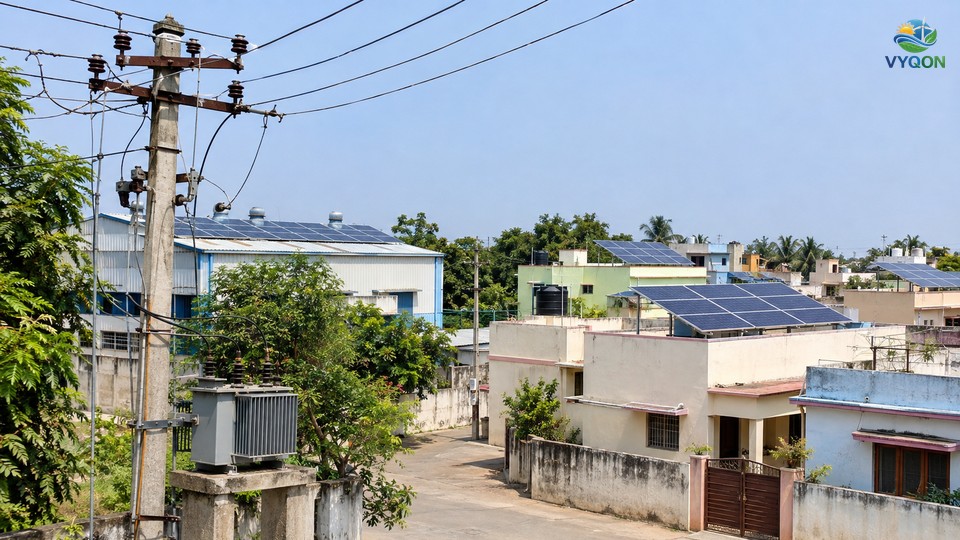
The Gujarat Electricity Regulatory Commission (GERC) has notified the Gujarat Electricity Regulatory Commission (Grid Interactive Distributed Renewable Energy Sources) Regulations, 2026, through Notification No. 11 of 2026 (GERC/2026/11/Tech/2270), posted on the Commission’s website on 30 October 2026. The Regulations extend to the whole of Gujarat and repeal the GERC Net Metering Rooftop Solar PV Grid Interactive Systems Regulations, 2016, along with their subsequent amendments. They come into force from the date of their notification in the Official Gazette and apply to distributed renewable energy systems (DRES) commissioned on or after notification.
Five arrangements instead of one
The new Regulations cover any renewable energy system, with or without battery storage, connected to the distribution network. Five metering arrangements are available: Net Metering, Net Billing, Group Net Metering, Virtual Net Metering and Gross Metering. Consumers of all categories are eligible, and a consumer can use only one arrangement for the same service connection.
Capacity limits differ by arrangement. Net Metering and Net Billing allow systems from 1 kW (AC) up to 1,000 kW AC, equal to 1,250 kWp on the DC side. Gross Metering allows 6 kW AC to 4,000 kW AC. Group Net Metering starts at 6 kW AC and is capped at 1,000 kW AC (1,250 kWp DC); its service connections must carry the same name and tariff category within one distribution licensee’s area. Virtual Net Metering allows 10 kW AC to 4,000 kW AC, with participating consumers drawn from the same licensee and tariff category, and the plant may sit away from their premises.
How energy is accounted
Under Net Metering, energy exported in a billing period is set off against energy imported in the same cycle, and the net import is billed at the applicable retail tariff. For residential prosumers, the entire exported energy is eligible for adjustment without banking charges. Any residual surplus is treated as a deemed purchase by the distribution licensee at Rs 2.25 per kWh, or such rate as the Commission specifies from time to time, and a credit balance left at the end of a financial year must be paid into the consumer’s bank account within 30 days.
For other categories, adjustment is allowed up to 30% of the energy drawn from the licensee in the billing period, on payment of banking charges under the GERC Green Energy Open Access Regulations; excess exports beyond that limit are treated as lapsed energy. Under time-of-day tariffs, off-peak exports can offset only off-peak consumption, while peak-hour exports can offset both. Exported units cannot offset fixed charges, demand charges or government levies.
Under Net Billing, imported energy is valued at the retail tariff and exported energy at the generic tariff the Commission determines for the relevant renewable source, and the export value is deducted from the import value. Under Gross Metering, all generation is accounted at that generic tariff and all consumption at the retail tariff.
Third-party ownership and storage
The Regulations explicitly permit ownership by renewable energy service companies (RESCOs) and other third parties. The RESCO-consumer contract is private; the distribution licensee is not a party to it and cannot disconnect a consumer over a dispute with the RESCO. Participants served by RESCO-owned group or virtual systems pay wheeling charges, banking charges, Cross Subsidy Surcharge and Additional Surcharge, but residential participants allocated up to 3 kW each are exempt from the last two.
A battery requirement applies to larger prosumers. Where a consumer with contract demand above 100 kW installs DRES capacity beyond that contract demand, the excess is allowed only if the project includes battery storage able to run at least two hours per charge-discharge cycle per day for at least 50% of the excess capacity.
Connection process and costs
Applications for systems up to 10 kW that are complete in all respects are deemed accepted without a technical feasibility study. For capacity above 6 kW, state-owned discoms and Torrent Power recover system-strengthening charges at 25% of the per-kW new-load charge for low-tension consumers (up to 150 kW) or 25% of the per-kVA charge for high-tension consumers. Strengthening costs up to 6 kW go into the licensee’s Annual Revenue Requirement. Consumers with pending undisputed arrears are not eligible.
The Regulations fix timelines. The Gujarat Energy Development Agency (GEDA) issues registration within 5 days, the Chief Electrical Inspector approves diagrams within 10 days, and applicants get 6 months to complete the project after the connectivity agreement. A licensee that delays without just cause must pay compensation of not less than Rs 500 per day. Systems under the PM Surya Ghar: Muft Bijli Yojana need no separate written connectivity agreement.
Distribution licensees must get detailed procedures approved by the Commission and set up a web portal for applications within three months of notification, and submit a standard operating procedure for software-based energy accounting within five months.
What it means for India’s clean-energy sector
The move from a rooftop-only net-metering text to a technology-neutral framework gives commercial and industrial buyers more routes to on-site and off-site renewable power, including third-party-owned projects of up to 4 MW. The battery condition for oversized systems, and the mention of storage within the DRES definition, links rooftop solar with distribution-level storage. Execution now depends on the discoms’ procedures, portals and energy-accounting systems, due within the periods above.
Official references
1. Gujarat Electricity Regulatory Commission, Notification No. 11 of 2026, GERC (Grid Interactive Distributed Renewable Energy Sources) Regulations, 2026: https://www.gercin.org/viewdocument/TmV3TmV3c18xNDRfMTc5MzM2NDQyMg==
2. Gujarat Electricity Regulatory Commission, Statement of Reasons: https://www.gercin.org/viewdocument/TmV3TmV3c18xNDVfMTc5MzM2NDQyMg==
3. Gujarat Electricity Regulatory Commission website: https://www.gercin.org/
Leave a Comment