
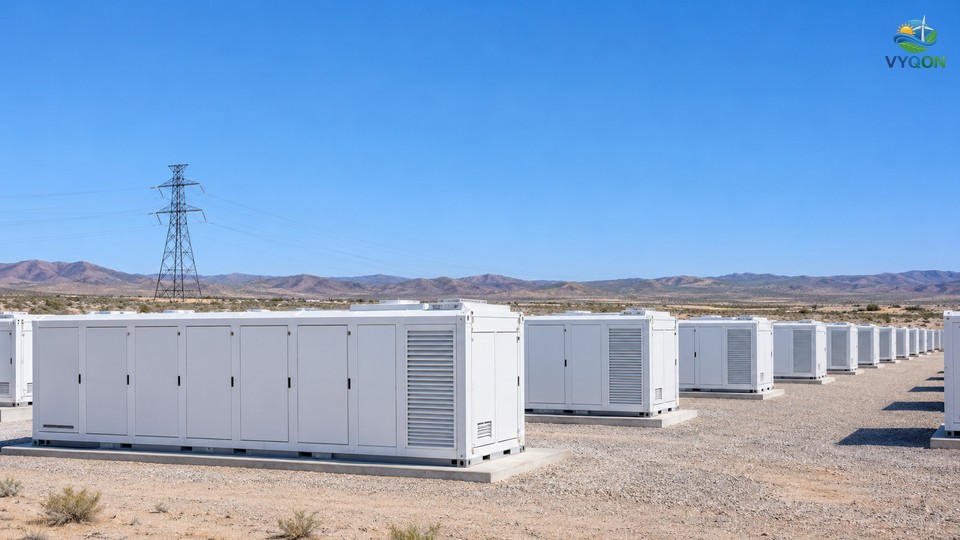
The Solar Energy Corporation of India Limited (SECI) has invited bids to select developers for 4,000 MW / 16,000 MWh of standalone battery energy storage systems (BESS) in Rajasthan and Gujarat. The request for selection (RfS) is numbered SECI/C&P/IPP/15/0013/26-27 and is dated 28 October 2026. Online bids are due by 19 November 2026 at 18:00, and the tender carries central financial assistance of Rs 15 lakh per MWh of storage. This SECI 16,000 MWh BESS tender is being run as the ESS-V round.
Scope: two packages, Rajasthan and Gujarat
SECI is selecting Battery Energy Storage System Developers (BESSDs) to supply energy from standalone BESS for “on demand” use, under tariff-based competitive bidding. The projects will be built on a build-own-operate (BOO) basis. The RfS is technology agnostic: any battery technology is acceptable as long as it meets the BESS definition and the performance criteria in the RfS and the power purchase agreement (PPA).
The total quantum is split into two packages. Package I is 2.5 GW / 10 GWh in Rajasthan. Package II is 1.5 GW / 6 GWh in Gujarat. A bidder may bid for either package or for both.
Each bid must quote capacity as “X” MW and “4X” MWh, so every system is rated for four hours of charging and four hours of discharging in one cycle. A bidder, together with its parent, affiliates and group companies, must submit a single bid for each package. The minimum cumulative project capacity is 50 MW / 200 MWh per package. The maximum is 625 MW / 2,500 MWh in Package I (Rajasthan) and 375 MW / 1,500 MWh in Package II (Gujarat).
Central financial assistance and local content
The RfS states that central financial assistance of Rs 15 lakh per MWh of BESS is envisaged for the projects selected, which works out to Rs 2,400 crore for the full 16 GWh. The RfS also requires compliance with the government’s Make in India orders, including the Ministry of Power order dated 24 December 2025. Developers must submit a certificate from a statutory or cost auditor stating the local content percentage.
Charging, delivery and PPA terms
The BESSD must arrange the charging power, and at least 51% of the energy used to charge the BESS must come from renewable energy sources. Discharging is under the scope of the buying entity. By default, the delivery point is an inter-state transmission system (ISTS) substation. It can be a state transmission utility or intra-state substation only if both the BESSD and the buying entity agree.
The PPA will be valid for 20 years from the scheduled commencement of supply date (SCD) of the project or the date of full commissioning, whichever is later. The SCD for the full capacity is 12 months from the effective date of the PPA. SECI allows a maximum of a further six months beyond the SCD, subject to liquidated damages, for commissioning the full project capacity. Part-commissioning is permitted, with the first part at 50 MW, and early commissioning is allowed at the developer’s risk.
Fees and guarantees
The cost of the RfS document is Rs 50,000 plus applicable GST; the SECI tender page lists it as Rs 59,000. The bid processing fee is Rs 20,000 per MW plus GST for the quoted capacity, capped at Rs 20 lakh plus GST, and a separate fee applies to each package.
The earnest money deposit (EMD) is Rs 7,18,400 per MW for each package, in the form of a bank guarantee valid for 12 months from the last date of bid submission. A selected bidder must submit a performance bank guarantee of Rs 17,96,000 per MW for each package before signing the PPA.
Bidding process and key dates
The RfS uses a single-stage, two-envelope bidding procedure followed by an e-reverse auction. Bidders must register on the e-tender portal named in the RfS. The date and time of the e-reverse auction will be intimated to eligible bidders by email. The tender is listed on SECI’s website as Tender ID SECI000296.
- Tender published: 28 October 2026
- Pre-bid meeting: 6 November 2026 at 14:30
- Online bid submission deadline: 19 November 2026 at 18:00
- Offline bid submission deadline: 23 November 2026 at 18:00
- Bid opening: 24 November 2026 at 10:00
What it means for India’s clean-energy sector
The tender splits 16 GWh between two western states that are major solar and wind locations. Standalone batteries can store power when generation is high and supply it when it is needed, and the requirement that at least 51% of charging energy comes from renewable sources links the storage directly to clean generation.
For developers, central assistance of Rs 15 lakh per MWh lowers the capital burden, while the local-content certificate and Make in India compliance will shape equipment sourcing. A bidder near the 625 MW limit in Rajasthan must be ready to provide large bank guarantees, and with a 12-month commissioning schedule from the PPA’s effective date, execution speed will matter as much as the discovered tariff, which will be known only after the e-reverse auction.
Leave a Comment