
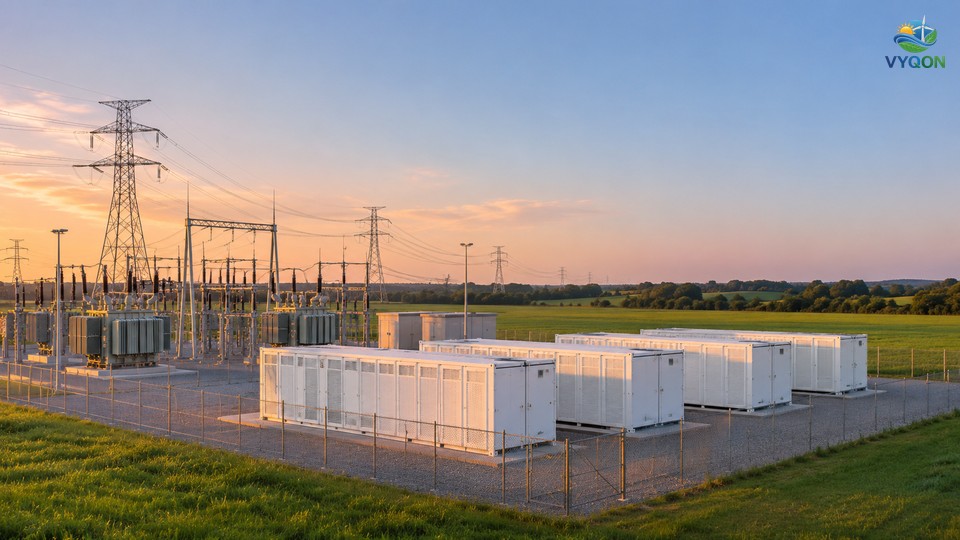
The Solar Energy Corporation of India Limited (SECI) has invited bids to select developers for 800 MW / 3,200 MWh of standalone battery energy storage systems (BESS) connected to the inter-state transmission system (ISTS). The request for selection (RfS), numbered SECI/C&P/IPP/15/0010/26-27, was issued on 1 October 2026 as the SECI-ESS-IV round. Online bids are due by 25 November 2026 at 18:00, and the SECI 3,200 MWh BESS tender has already been amended twice, on 31 October and 3 November 2026.
What SECI is procuring
SECI is selecting Battery Energy Storage System Developers (BESSDs) to supply energy from standalone BESS for “on demand” use under tariff-based competitive bidding. The aggregate storage capacity is 3,200 MWh, which is 800 MW for four hours. The projects will be set up on a build-own-operate (BOO) basis.
SECI has issued the RfS as an “Intermediary Procurer” under the Ministry of Power’s guidelines for BESS procurement. The selected developers will sign a power purchase agreement (PPA) for the supply of energy, and the energy will be supplied to buying entities.
Bid structure and capacity limits
A bidder, together with its parent, affiliates and group companies, must submit a single bid. The minimum cumulative project capacity is 50 MW / 200 MWh and the maximum is 800 MW / 3,200 MWh, quoted in whole numbers. Capacity must be quoted as “X” MW and “4X” MWh, so each system is rated for four hours of charging and four hours of discharging in one cycle.
The RfS follows a single-stage, two-envelope bidding procedure, followed by an e-reverse auction. The date and time of the e-reverse auction will be intimated to eligible bidders by email.
The RfS states that no separate central financial assistance is envisaged for the projects selected under this round.
Charging, delivery and PPA terms
The BESSD must arrange the charging power, and at least 51% of the energy used to charge the BESS must come from renewable energy sources. Discharging is under the scope of the buying entity. By default, the delivery point is an ISTS substation. It can be a state transmission utility or intra-state substation only if both the BESSD and the buying entity agree.
The PPA will be valid for 20 years from the scheduled commencement of supply date (SCD) of the project or the date of full commissioning, whichever is later. Part-commissioning is accepted without liquidated damages, with a minimum first part of 50 MW and no more than three instalments in total. The SCD does not change because of part-commissioning.
Fees and guarantees
The cost of the RfS document is Rs 50,000 plus applicable GST; the SECI tender page lists it as Rs 59,000. The bid processing fee is Rs 20,000 per MW plus GST for the quoted capacity, capped at Rs 20 lakh plus GST.
The earnest money deposit (EMD) is Rs 7,18,400 per MW, in the form of a bank guarantee valid for 12 months from the last date of bid submission. A selected bidder must submit a performance bank guarantee of Rs 17,96,000 per MW before signing the PPA. These figures are from the RfS as issued on 1 October 2026; bidders should check the two amendments for any changes.
Key dates on the SECI tender page
- Tender published: 1 October 2026
- First pre-bid meeting: 9 October 2026; a second pre-bid meeting notice was uploaded on 15 October 2026
- Amendment-01: 31 October 2026; Amendment-02: 3 November 2026
- Online bid submission deadline: 25 November 2026 at 18:00
- Offline bid submission deadline: 27 November 2026 at 18:00
- Bid opening: 30 November 2026 at 10:00
The tender is listed as Tender ID SECI000286.
Background: why storage tenders matter
The RfS explains that, with more renewable energy entering the grid, further capacity addition is expected to face problems because of the variable nature of generation and supply-demand mismatch. It points to integrating energy storage with renewable capacity as the next step.
The RfS cites the Central Electricity Authority’s report on the optimal generation capacity mix for 2029-30 (Version 2.0, April 2023), which envisages 41,650 MW / 208,250 MWh of battery energy storage and 18,986 MW of pumped hydro storage in installed capacity in 2029-30. It links this to India’s target of 500 GW of non-fossil capacity by 2030.
What it means for India’s clean-energy sector
At 3,200 MWh, this round is small next to the CEA’s 208,250 MWh battery figure, but it adds to the pipeline of standalone storage that SECI is putting out for developers. Because the round does not carry central financial assistance, developers will have to rely on the tariff they discover in the e-reverse auction and on their own financing.
The 51% renewable-charging condition keeps the storage tied to clean generation, and the single-bid structure, with a cap of 800 MW per bidder group, means one developer can in principle bid for the entire quantum. The tariff will be known only after the e-reverse auction.
Leave a Comment