
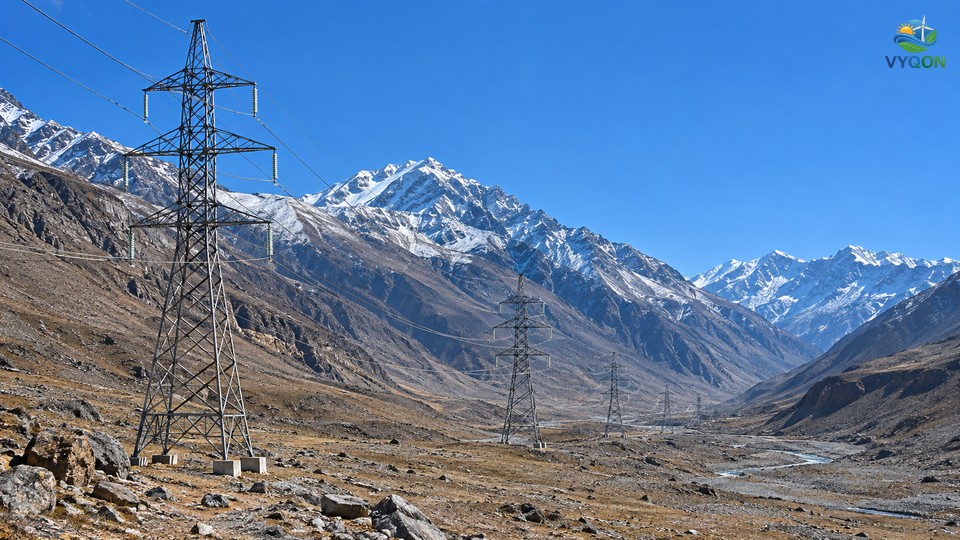
The National Committee on Transmission (NCT) has recommended a modified Ladakh 7.5 GW transmission system, estimated at about Rs 31,427.54 crore, to bring renewable power from Leh to the northern grid. The decision was taken at the committee’s 44th meeting, held on 29 October 2026 in New Delhi, according to the minutes issued by the Central Electricity Authority (CEA). The scheme will be built by POWERGRID under the Regulated Tariff Mechanism (RTM). It uses 400 kV high-voltage alternating current (HVAC) lines in place of the high-voltage direct current (HVDC) link planned earlier.
Why the HVDC plan was dropped
The Cabinet approved the Ladakh evacuation scheme in 2023 under Green Energy Corridor Phase-II. It covered 13 GW of renewable capacity (9 GW solar and 4 GW wind) with 12 GWh of battery energy storage, at an estimated cost of Rs 20,773.70 crore, under RTM by POWERGRID. The plan was built around a 5 GW VSC-based HVDC system from Pang in Ladakh to Kaithal in Haryana.
The minutes record that equipment makers raised technical, design and contractual challenges during the bidding process. Pang is at about 4,700 m altitude, with temperatures as low as -35 degrees Celsius. Weak grid conditions and transport constraints were also cited. The HVDC scheme could not be progressed.
A Cabinet Secretariat meeting on 30 September 2025 directed that HVAC options be explored. CEA, CTUIL and Grid-India then evolved an HVAC corridor that can evacuate 3.75 GW round the clock. The revised proposal, comprising 3.75 GW of solar capacity and 3.75 GW x 4 hours of battery storage, was presented at the Cabinet Secretariat on 13 October 2026, where it was decided that POWERGRID may initiate implementation.
Ladakh 7.5 GW transmission system: two parts
The scheme will be taken up in two parts.
- Part I: 2,000 MW of evacuation capacity, Rs 25,225.87 crore, 48 months from the date of award
- Part II: a further 1,750 MW (3,750 MW in total), Rs 6,201.67 crore, 60 months from the date of award
Part I includes a 400/220 kV, 8 x 315 MVA gas-insulated pooling station at Pang with four synchronous condenser units, and a 400 kV gas-insulated switching station near Sundar Nagar. The two are joined by a 273 km, 400 kV 2xD/c quad line. A 130 km, 400 kV D/c line will run from Sundar Nagar to the Mohali substation of Punjab State Transmission Corporation Limited (PSTCL). The 400 kV Parbati pool (Banala)-Nallagarh line will be looped in and out at Sundar Nagar through a 15 km section. Part I also lists a 220 kV Pang-Leh (Phyang) single-circuit line of about 149 km on double-circuit towers, which gives Leh an additional interconnection.
Part II adds five more 315 MVA transformers and five more synchronous condenser units at Pang, taking the total to nine. It also adds fixed series compensation (FSC) of 45% on each circuit of the Pang-Sundar Nagar line, and a 75 km loop-in loop-out of both circuits of the 400 kV Wangtoo-Panchkula line at Sundar Nagar.
The links to the Parbati and Wangtoo hydro stations are meant to give short-circuit power support and stabilise the grid. They also connect Sundar Nagar to the load centres at Panchkula in Haryana and Nallagarh in Himachal Pradesh.
Grid-forming inverters made mandatory
Renewable generators will now connect at 220 kV at the Pang pooling station, instead of at 400 kV as planned earlier. Because of this, the 400/220 kV transformers that were in the developers’ scope move into the inter-state transmission system scope. Based on inputs from SECI, 12 bays of 220 kV are provided at Pang for renewable projects.
To maintain the short-circuit level and limit the number of synchronous condensers, the solar and battery capacity must be built with 100% grid-forming inverters. Only inverters equal to 3.75 GW may be connected to the grid at any point in time.
SECI is preparing a related project in the same area, covered earlier by VYQON: 1,000 MW solar with 1,000 MW/4,000 MWh storage at Pang, Leh.
Concerns recorded in the minutes
Expert Member S. R. Narasimhan and the Grid-India representative said the system is connected purely radially over 273 km. With synchronous condensers and FSCs present, they said, there may be issues of sub-synchronous resonance. They suggested detailed studies, especially before Part II.
Grid-India added that operational experience with FSC installations in India has not been satisfactory, and proposed examining modular and relocatable FSC arrangements.
CTUIL said Punjab had asked for the Mohali interconnection on air-insulated switchgear, but right-of-way constraints are expected in that area. The NCT recommended that the Mohali interconnection may be considered in gas-insulated switchgear, with multi-circuit and monopole towers on certain sections of the Sundar Nagar-Mohali line, in consultation with PSTCL. Part II will be reviewed again by the NCT after six months.
What it means for India’s clean-energy sector
The recommendation gives Ladakh’s renewable programme a revised transmission plan after the HVDC route stalled. It also resizes the programme, from 13 GW in the 2023 approval to 7.5 GW served by a 3.75 GW corridor used in both solar and non-solar hours.
For developers and equipment suppliers, the conditions are specific: 100% grid-forming inverters, a 220 kV connection at Pang, and a limit on the inverter capacity connected at any time. The minutes do not give a commissioning date; the timelines of 48 and 60 months run from the date of award.
Leave a Comment