
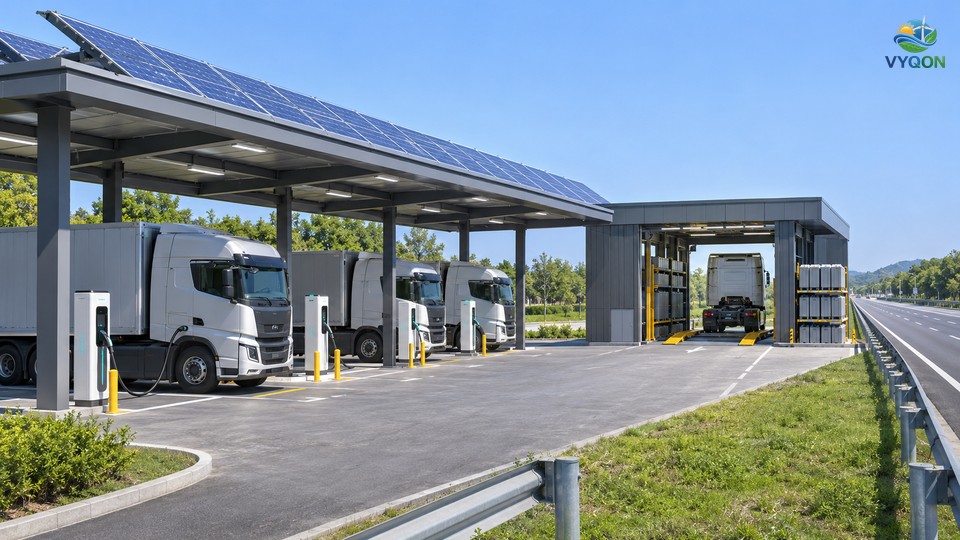
Ravindra Energy Limited is evaluating strategic options, including Ravindra Energy solar monetisation, for its operating and under-construction solar projects, so that the equity released can help grow its electric heavy-truck business, Energy in Motion (EIM), without raising external capital. Senior management said this on the company’s second quarter and first half FY27 earnings call, which was reported on 9 November 2026. It is not a decided sale: no buyer, value, list of projects or timetable has been disclosed.
What management said about solar asset monetisation
Chief Executive Officer Shantanu Lath said the company does not intend to bid for new government solar tenders. For the existing capacity he said the company is “evaluating strategic options like monetization” and believes there is a strong market for monetisation of its operating and under-construction projects. The equity released, he said, would help grow the EIM network manifold without any external capital.
Vice Chairman Narendra Murkumbi said the solar portfolio is largely tied up under long-term power purchase agreements (PPAs). That is why the assets cannot simply be used to supply the charging network directly. The company has not announced a sale, and any firm decision is to be disclosed when it is finalised.
Solar outlook for the year
Management expects about Rs 600 crore of engineering, procurement and construction (EPC) revenue for the full year, on about 200 MW of capacity addition, of which about Rs 200 crore was booked in the first half. Electricity sales are expected at Rs 141 crore to Rs 150 crore for the full year, against Rs 89 crore in the last financial year. These figures cover the existing solar business and do not include any effect of a possible monetisation.
How solar links to the charging network
The company also spoke about connecting renewable power to EIM’s charging and battery-swapping stations. Management said a single swapping station can absorb about 2 MW to 2.5 MW of solar power during the day. Adding 100 swapping stations over the next 18 months could therefore need 200 MW to 300 MW of solar capacity. Management said it does not plan to supply all of this from its own balance sheet, and that it may use open-access power and work with state-level suppliers.
The two businesses are also due to come closer. The merger of EIM with Ravindra Energy, announced in September, is expected to be completed around September 2027, subject to regulatory and National Company Law Tribunal approvals.
Background on Ravindra Energy
According to the investor presentation that Ravindra Energy filed with the stock exchanges on 27 January 2026, the company is listed on BSE (scrip code 504341) and NSE (RELTD), and its registered office is in Belgaum, Karnataka. The presentation describes two businesses: electric mobility through Energy in Motion, and distributed solar power generation.
On the electric mobility side, the presentation shows that Ravindra Energy holds 49.5% of EIM, Golden Green Innovations Private Limited, a J M Baxi group company, holds 49.5%, and management holds 1.0%. EIM supplies heavy-duty electric tractors (the presentation’s term for heavy electric trucks) with a battery-as-a-service option. As of December 2025, the company had sold 125 units and had an order book of 263 units, and it was planning a Pune facility with a capacity of 5,000 units a year.
On the solar side, the presentation lists rural feeder solarisation, including under the KUSUM scheme, along with open access for commercial and industrial customers and rooftop solar. Its operational solar capacity was 187 MWp in December 2025, with a plan to reach 476 MWp by FY27, in Maharashtra and Karnataka. These are January 2026 figures, and the company has since given newer targets on its earnings call.
What this means for India’s clean-energy sector
The announcement shows a developer of distributed solar choosing to put its capital into electric heavy transport and to treat its operating solar projects as assets that could be sold to fund it. For the solar sector, a sale of contracted operating projects would be one more example of developers recycling capital, and it could attract buyers looking for assets with long-term PPAs. That remains a possibility only, because management has not named any assets or buyers.
For electric mobility, the plan links two sectors: battery-swapping stations that need large amounts of daytime power, and the solar projects that could supply them. Whether the 200 MW to 300 MW figure turns into real projects will depend on how fast the charging network is built. VYQON will report when the company discloses a firm decision.
VYQON has earlier reported on EIM’s partnership with Drivn to deploy 1,000 heavy-duty electric trucks across India.
Official references
- Ravindra Energy Limited, corporate presentation filed with BSE and NSE on 27 January 2026: https://www.bseindia.com/xml-data/corpfiling/AttachHis/471d1eec-8907-4556-93ec-782db51ac8c0.pdf
- Ravindra Energy Limited, Investors page (financial results): https://www.ravindraenergy.com/?page_id=66
Leave a Comment