
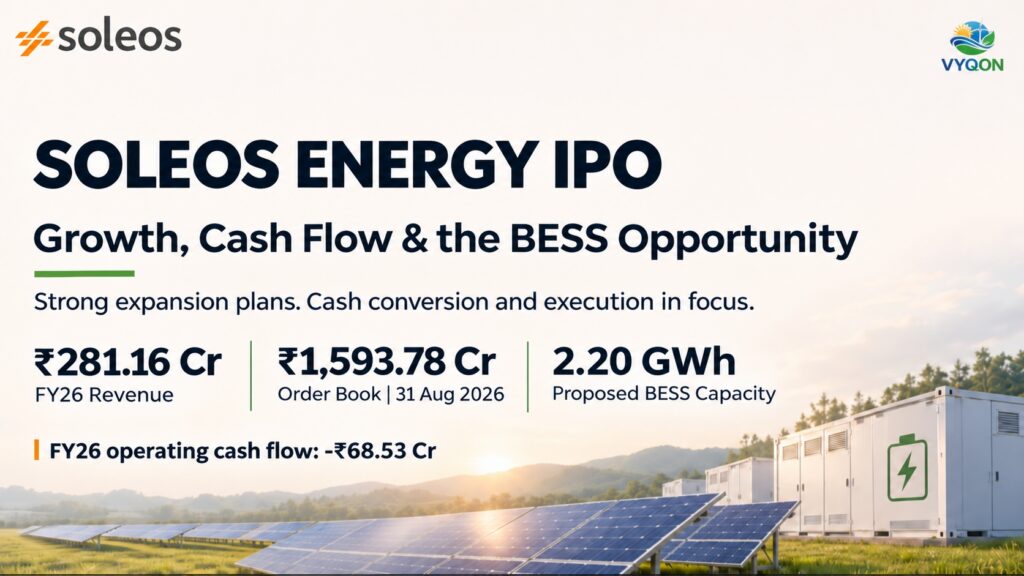
By VYQON Research Team
Soleos Energy’s proposed public offering brings together two different funding needs: investment in a new battery storage manufacturing operation and the capital required to sustain a growing project business. Its disclosures show a company that has expanded sales rapidly, but is still working to convert that expansion into operating cash.
The September 30, 2026 Draft Red Herring Prospectus outlines ₹113.60 crore of proposed investment from IPO proceeds into a battery energy storage systems facility. Alongside that plan, the company reported ₹168.12 crore of trade receivables at the end of FY26 and negative operating cash flow for a third consecutive year. These figures make the relationship between expansion, collections and borrowing a central part of the IPO story.
This article draws on the DRHP and the October 17, 2026 addendum. Financial figures are rounded to ₹ crore unless otherwise specified. FY24, FY25 and FY26 denote the years ended March 31, 2024, 2025 and 2026.
A Public Offering With Two Components
The proposed offer comprises up to 2 crore equity shares: up to 1.10 crore newly issued shares and up to 90 lakh shares offered for sale by existing shareholders. The face value is ₹5 per share, with a proposed listing on BSE and NSE.
Fresh issue proceeds provide funding to Soleos, after the relevant offer expenses. Money raised through the offer for sale goes to the selling shareholders. The distinction is important when considering how much of an IPO actually finances the company’s next stage of development.
In addition to the ₹113.60 crore proposed for the battery storage facility, the company intends to allocate ₹20 crore towards repayment or prepayment of certain borrowings. General corporate purposes form another proposed use, with the amount to be determined in the offer documents. The reviewed DRHP does not specify a final price band or monetary offer size.
The Proposed Factory Changes the Scope of the Business
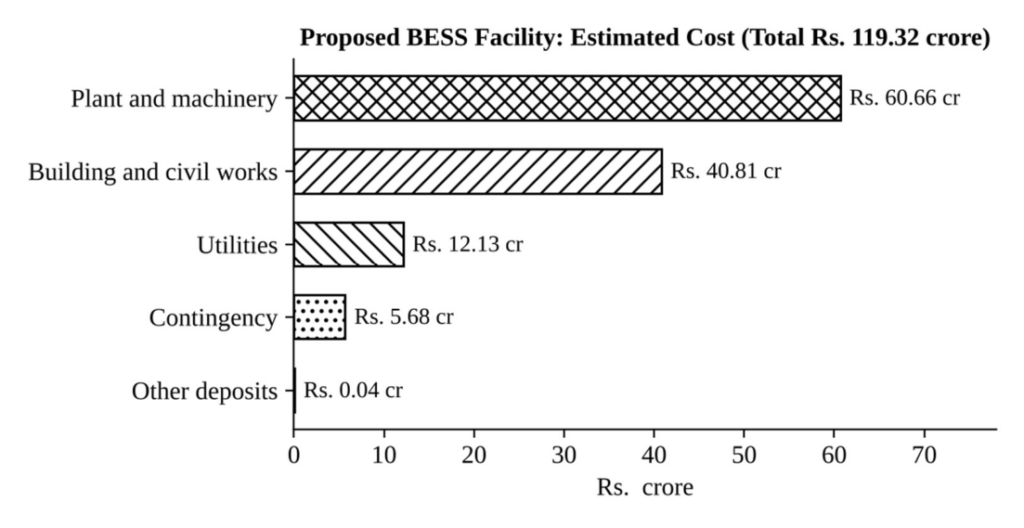
The planned facility at Suraj in Mehsana district, Gujarat, has a stated capacity of 2.20 GWh and an estimated total project cost of ₹119.32 crore. This would extend Soleos’s activities from delivering renewable energy projects into manufacturing battery packs and storage systems.
The facility is intended to use LFP prismatic cells, with cell-to-pack and surface mount technology capabilities. It should therefore be understood as a battery pack and system manufacturing project, rather than a lithium-ion cell manufacturing plant. Procurement of cells, integration, control electronics and final product performance will shape its operating requirements.
Soleos already discloses a 100 MWh pilot-scale facility. That provides context for its entry into the segment, but a pilot operation does not establish the commercial economics of a much larger manufacturing business. The proposed 2.20 GWh capacity is a plan, not a statement of current output or confirmed sales.
Solar EPC Still Determines the Current Earnings Base
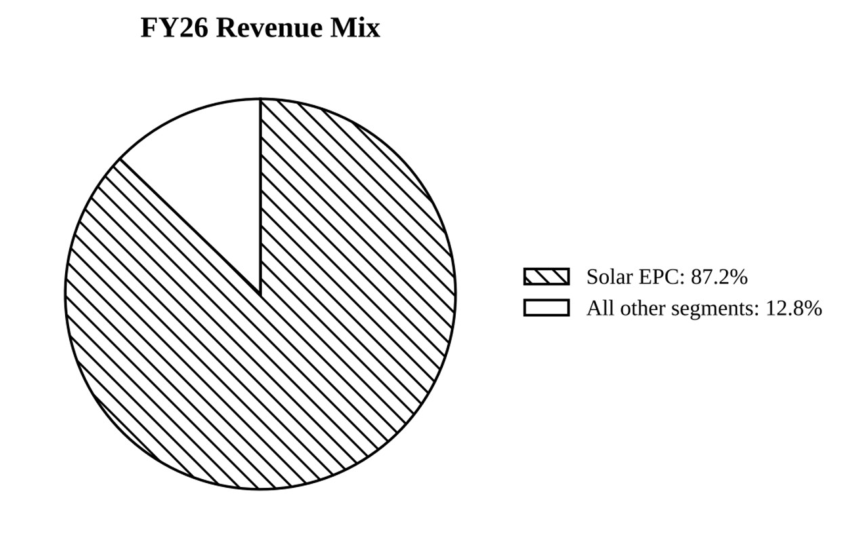
For now, the company remains predominantly a solar engineering, procurement and construction business. Solar EPC accounted for approximately 87.20% of FY26 revenue. Its wider activities include development and consultancy, asset management, equipment sales and power generation.
The customer count rose from 58 in FY24 to 506 in FY26. However, a broader customer list does not automatically mean revenue is evenly distributed. Large accounts and individual project schedules can continue to have a substantial influence on reported results.
This operating mix matters when assessing the proposed manufacturing expansion. EPC earnings depend heavily on contract execution and payment milestones, while manufacturing adds requirements for production quality, certifications, supplier coordination and warranty management.
The Financial Record Shows Growth With a Mixed Earnings Trend
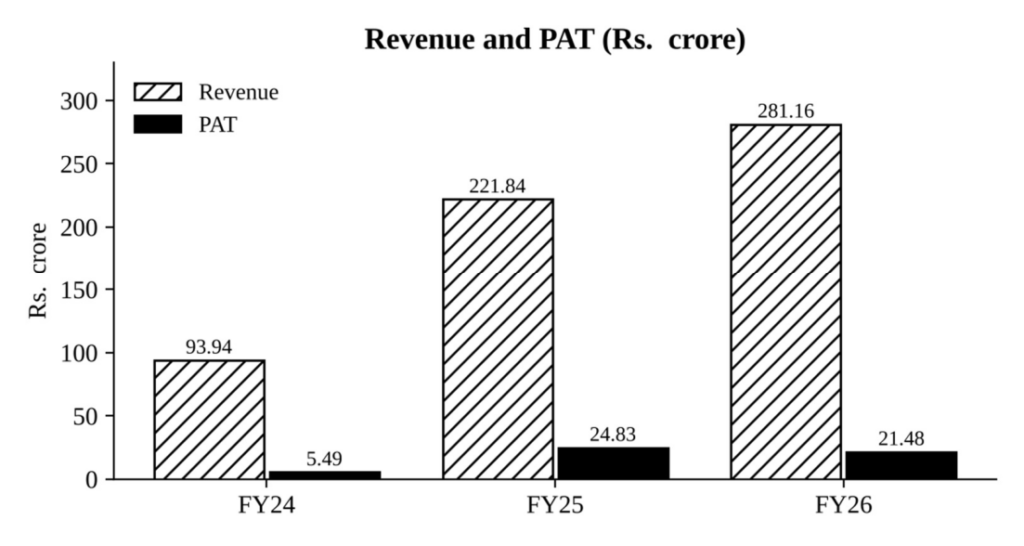
Revenue from operations increased from ₹93.94 crore in FY24 to ₹281.16 crore in FY26, a compound annual growth rate of approximately 73.01%. The latest year was less straightforward: revenue grew approximately 26.74%, while profit after tax declined approximately 13.51%.
| Metric in ₹ crore | FY24 | FY25 | FY26 |
|---|---|---|---|
| Revenue from operations | 93.94 | 221.84 | 281.16 |
| Profit after tax | 5.49 | 24.83 | 21.48 |
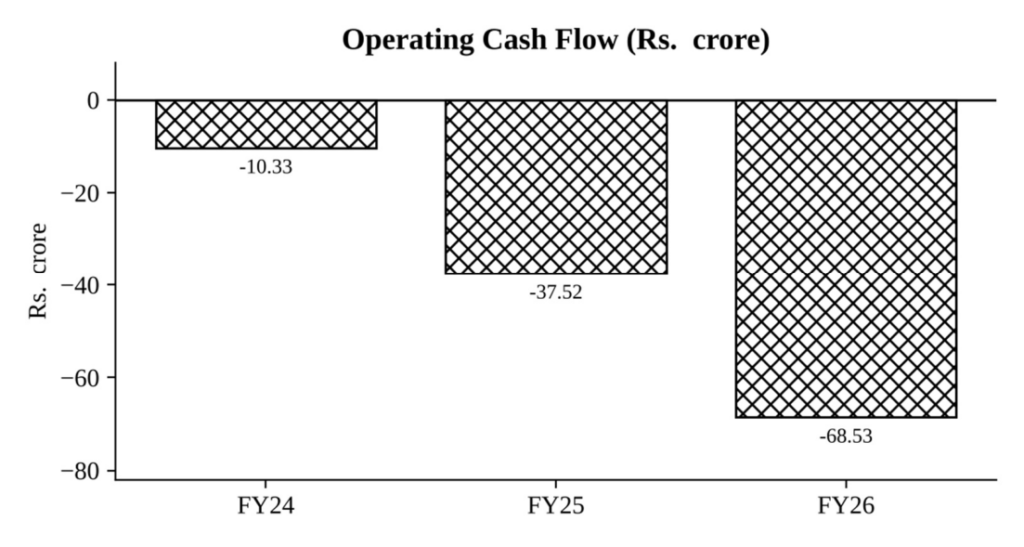
| Operating cash flow | -10.33 | -37.52 | -68.53 |
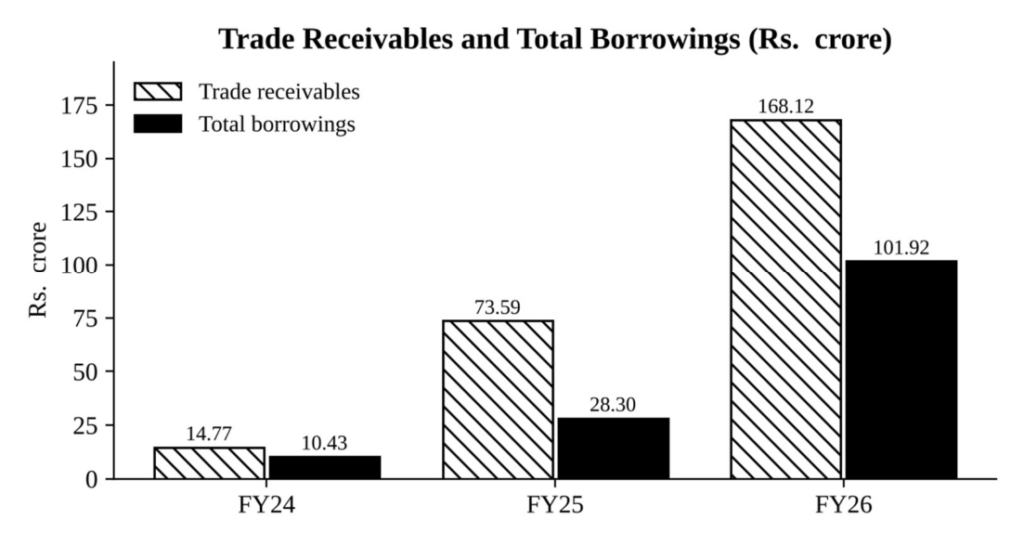
| Trade receivables | 14.77 | 73.59 | 168.12 |
| Borrowings at financial year end | 10.43 | 28.30 | 101.92 |
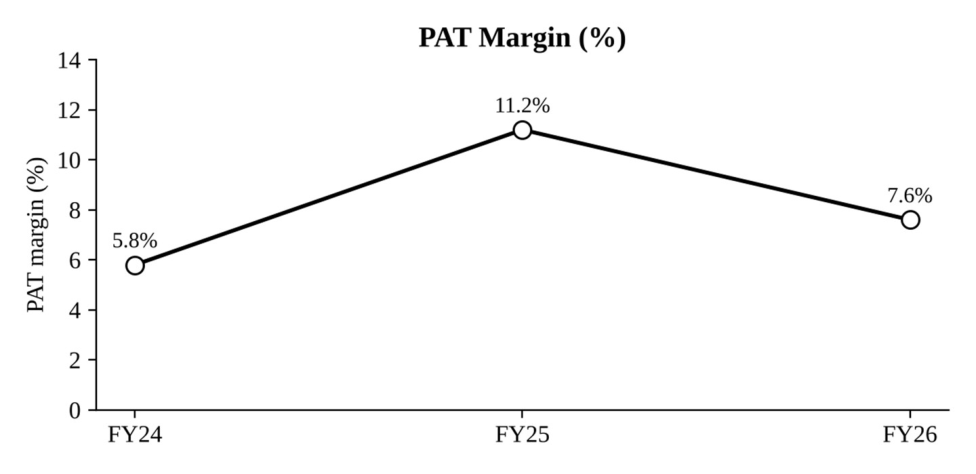
The PAT margin improved from approximately 5.85% in FY24 to 11.19% in FY25, then eased to 7.64% in FY26. The sequence illustrates why the strongest year’s profitability should not simply be extrapolated into future forecasts. The causes of the margin movement require examination of project mix, costs and other items in the detailed accounts.
Customer Payments Are a Key Funding Variable
Across FY24 to FY26, the company used approximately ₹116.39 crore of cash in operating activities. FY26 accounted for ₹68.53 crore of that outflow. This contrasts with the positive accounting profits reported during the same period.
The distinction arises because recording revenue and receiving payment are different events. An EPC contractor may need to fund equipment, subcontractors and staff while waiting for customer payments. A larger business can therefore consume more cash if collections do not keep pace with execution.
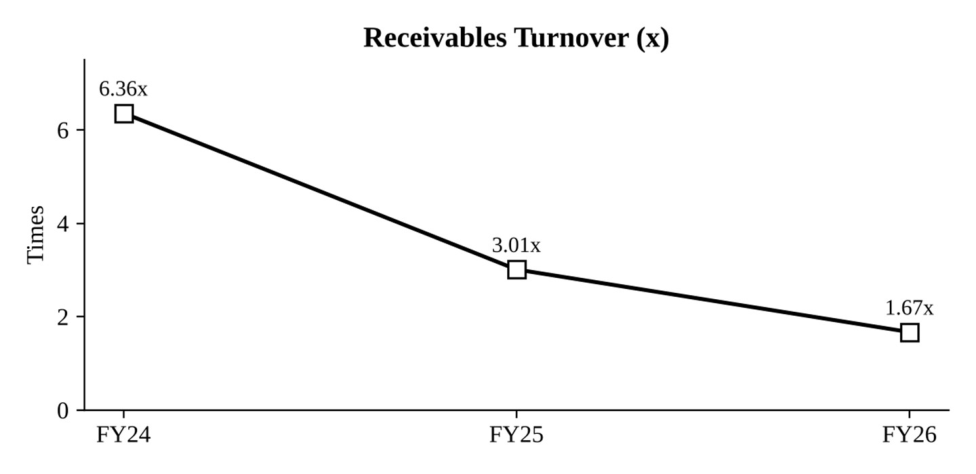
Trade receivables reached ₹168.12 crore at the end of FY26, compared with ₹14.77 crore in FY24. The disclosed receivables turnover ratio fell from 6.36 times to 1.67 times. These movements make receivables ageing, overdue balances and subsequent collections relevant to understanding the quality of reported growth.
Borrowings also need to be read with their reporting dates. The FY26 year-end balance was ₹101.92 crore; a later disclosure puts outstanding borrowings at ₹147.23 crore on August 31, 2026. The proposed ₹20 crore debt repayment addresses part of that funding position, while future debt requirements will depend on collections and new project commitments.
A Large Backlog Depends Heavily on One Overseas Project
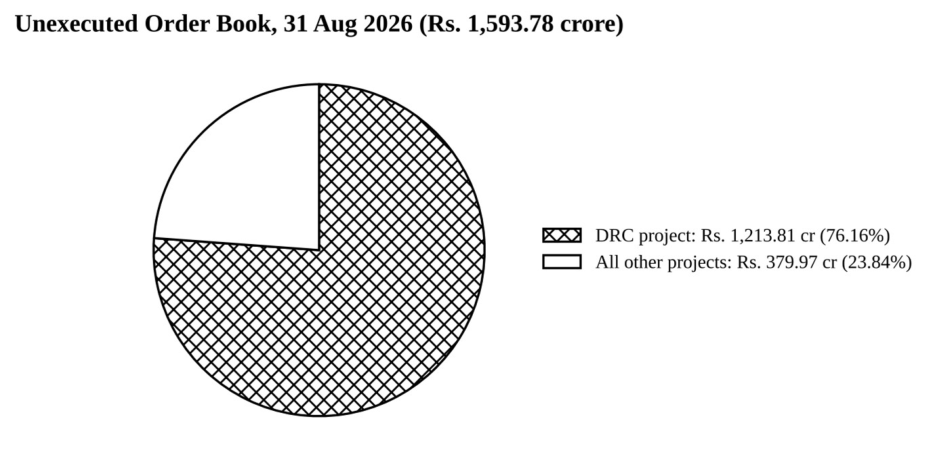
The unexecuted order book stood at ₹1,593.78 crore on August 31, 2026, equivalent to approximately 5.67 times FY26 revenue. It was ₹1,632.76 crore at March 31, 2026. Such a pipeline indicates substantial contracted work, but the timing of revenue and cash receipts depends on delivery under the underlying agreements.
Approximately ₹1,213.81 crore of the August order book related to a single project in the Democratic Republic of Congo, representing 76.16% of the total. The DRHP identifies the counterparty, Gujarat DRC SA, as a related party and former subsidiary. Revenue recognised against the project up to August 31, 2026 was approximately ₹0.45 crore.
Soleos disclosed limited experience with the DRC’s regulatory, logistics and business environment and no previous project execution in that country. This concentration makes project financing, site readiness, approvals, payment security and execution milestones important factors in assessing how the backlog may develop into recognised revenue.
The concentration does not establish that the project will fail. It means that a large share of the company’s prospective activity is exposed to the progress of one contract. The related party connection also warrants scrutiny of commercial terms and payment obligations.
Revenue Relationships Need to Be Read Alongside Customer Numbers
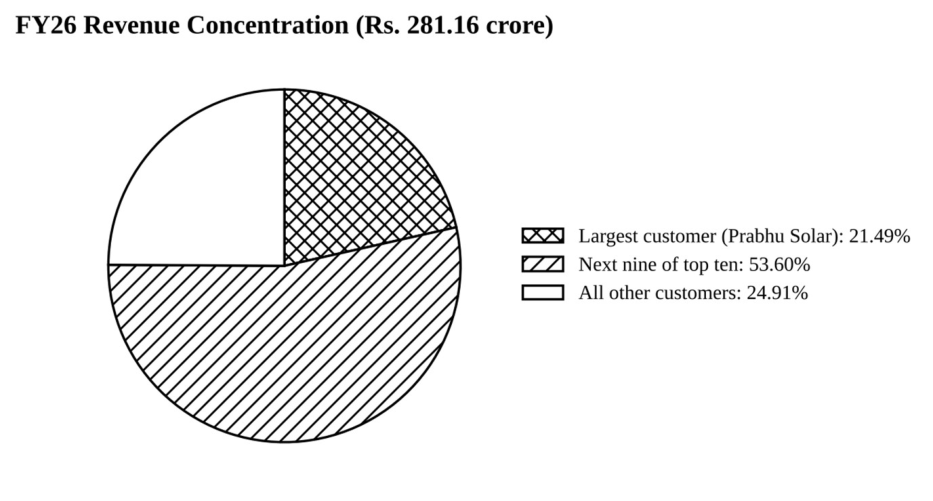
The DRHP reports that the top ten customers contributed 75.09% of FY26 revenue. Prabhu Solar Venture Private Limited, the largest customer and an identified associate and related party, contributed approximately ₹60.42 crore, or 21.49%.
Separately, aggregate related party transactions were approximately ₹129.31 crore in FY26. This amount covers different categories of transactions and should not be described as related party sales. The useful questions concern transaction types, outstanding balances, pricing and the applicable approval process.
For the business to demonstrate a more diversified earnings base, customer expansion would need to translate into a broader distribution of revenue and reliable collections. The number of customers alone cannot establish either outcome.
Manufacturing Progress Will Need Evidence Beyond Capacity
The BESS investment introduces an additional set of milestones: equipment procurement, commissioning, certification, production yields, utilisation and customer acceptance. The DRHP indicated that orders for the majority of the proposed capital expenditure requirements had not yet been placed.
Product reliability and warranty obligations will matter after production begins. Cell supply arrangements, control systems, safety compliance and the ability to deliver consistent quality will influence whether the proposed facility generates sustainable returns.
A ratio sometimes useful for comparing project scope is estimated capital expenditure divided by stated manufacturing capacity. Using the DRHP’s ₹11,932.31 lakh estimated cost and 2.20 million kWh of capacity gives approximately ₹542.38 per kWh of nameplate capacity. This calculation describes investment relative to capacity; it is not the cost of manufacturing a battery or the selling price of a storage system.
The Addendum Forms Part of the Disclosure Record
The October 17, 2026 addendum supplements litigation disclosures, including matters involving certain promoters and directors. It states that certain matters had inadvertently not been included in the original disclosures and provides an updated litigation summary.
The notice should be read together with the DRHP. Pending cases and allegations are not findings of guilt. Their significance depends on the individual proceedings, their status and any potential implications for the company or management.
What Will Determine the Next Stage
Soleos’s IPO disclosures describe a business pursuing a larger role across solar projects and battery storage. Its existing EPC relationships may offer a route to customers for integrated solar and storage solutions. Turning that possibility into commercial results will require evidence of demand, reliable manufacturing and disciplined project delivery.
The operating indicators to follow are concrete: cash collected against receivables, borrowing requirements, progress on the DRC project and the commissioning and utilisation of the BESS facility. Together, these will show whether the expansion is improving cash generation or increasing the funding needed to sustain growth.
A separate question is valuation. The reviewed DRHP does not provide the final IPO price band, so it does not support a conclusion that the offer is attractively priced. Final offer terms, earnings quality and appropriate peer comparisons will be needed for that assessment.
The central issue is how successfully Soleos can fund and execute its transition. Revenue and backlog demonstrate scale; collections, project completion and manufacturing performance will determine what that scale delivers.
Download the Detailed Research Report
Soleos Energy IPO Analysis — Detailed Report
Disclaimer
This article is for information and educational purposes only. It is not a recommendation to subscribe to or avoid the IPO and does not constitute investment advice or a valuation opinion.
Official Sources
- Full DRHP dated September 30 2026 from the company investor page
- SEBI official DRHP filing page
- Draft Abridged Prospectus hosted by SEBI
- Addendum cum Corrigendum from the company investor page
- Related Party Transaction Policy from the company investor page
- Soleos Investor Centre for disclosures and updates
Leave a Comment