
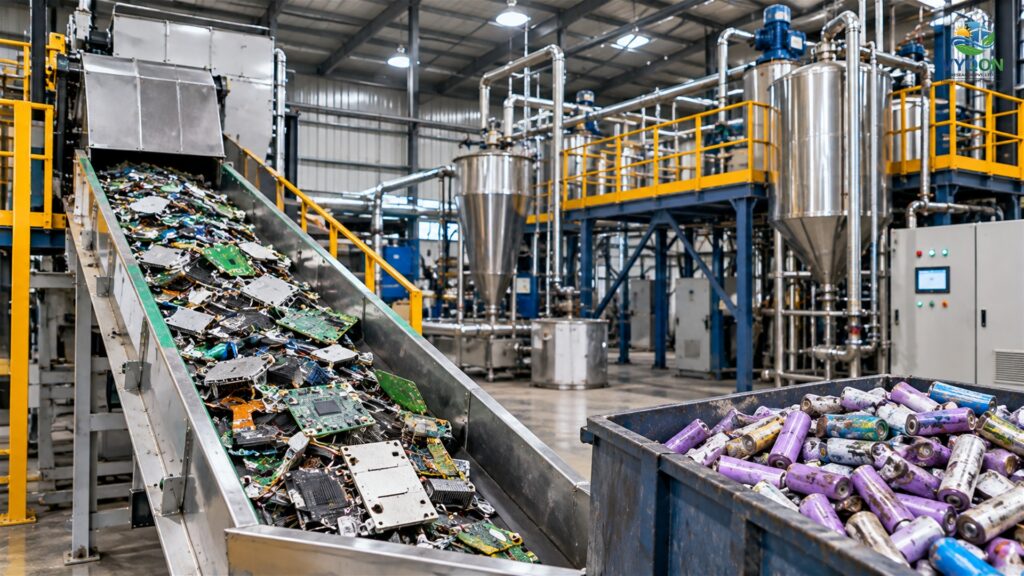
The Technology Development Board (TDB) under the Department of Science and Technology (DST) has signed an agreement with Hyderabad-based Neo Seekermetals Private Limited to support a ₹20 crore project to recover critical metals from e-waste and lithium-ion battery waste. Of the project cost, ₹10 crore has been approved under the Research, Development and Innovation (RDI) Fund, the Ministry of Science & Technology said on 16 November 2026. The assistance will be given as optionally convertible debt.
Key Details
The government release sets out the following terms of the agreement:
- Beneficiary: M/s Neo Seekermetals Private Limited, Hyderabad, Telangana
- Project title: “Extraction of Critical Metals by Recycling of E-Waste and Lithium-Ion Battery Waste”
- Total project cost: ₹20 crore
- Support approved: ₹10 crore under the RDI Fund
- Instrument: optionally convertible debt (OCD)
- Technology goal: advance from Technology Readiness Level (TRL) 5 to TRL 9
According to the release, Neo Seekermetals uses an integrated and patented process designed to handle both e-waste and lithium-ion battery waste. The process seeks to recover valuable metals and battery materials from these waste streams. The release says the project is designed to support the recovery of a range of materials and to build a more resilient domestic supply of critical minerals and metals.
The release does not name the specific metals to be recovered, the planned plant capacity, the project site or a timeline for reaching commercial scale. It also does not disclose the terms of the optionally convertible debt, such as the interest rate or conversion conditions.
What the Officials Said
Rajesh Kumar Pathak, Secretary of the Technology Development Board, said India’s move towards clean energy and advanced technologies will need secure and sustainable access to critical minerals. He said building domestic capability to recover these resources from e-waste and end-of-life batteries is an important part of that effort. Pathak added that TDB is using the RDI Fund to back technologies that combine innovation with strategic relevance.
An authorised representative of Neo Seekermetals said the support will help the company take its technology forward towards commercial deployment. The representative said the company’s focus is an efficient and sustainable process for recovering critical and valuable materials from e-waste and lithium-ion battery waste.
The RDI Scheme
The Union Cabinet approved the RDI Scheme on 1 July 2025 with a corpus of ₹1 lakh crore. The scheme aims to provide long-term financing or refinancing, with long tenors at low or nil interest rates, to spur private sector investment in research and innovation. One of its stated objectives is to finance transformative projects at higher technology readiness levels. Another is to support the acquisition of technologies that are critical or of high strategic importance.
The scheme has a two-tier structure. A Special Purpose Fund within the Anusandhan National Research Foundation (ANRF) acts as custodian, and allocates money to second-level fund managers. These managers fund research and development projects, normally through long-term loans at low or nil interest rates. The ANRF Governing Board, chaired by the Prime Minister, provides overall strategic direction.
Policy Backdrop: Critical Mineral Recycling and Processing
The agreement comes alongside two Cabinet-approved schemes aimed at critical mineral supply chains. On 3 September 2025, the Union Cabinet approved a ₹1,500 crore incentive scheme to develop recycling capacity for producing critical minerals from secondary sources. The scheme runs from FY 2025-26 to FY 2030-31 and forms part of the National Critical Mineral Mission (NCMM).
Eligible feedstock under that scheme includes e-waste, lithium-ion battery scrap and other scrap such as catalytic converters from end-of-life vehicles. One-third of the outlay is earmarked for small, new recyclers, including start-ups. The government expects the scheme to develop at least 270 kilotonnes of annual recycling capacity and around 40 kilotonnes of annual critical mineral production. It also expects about ₹8,000 crore of investment and close to 70,000 direct and indirect jobs.
On 4 November 2026, the Cabinet approved a separate capex support scheme of ₹2,814 crore for lithium and nickel processing, running from FY 2026-27 to 2030-31. It offers a capital subsidy of 30% of eligible investment for four plants: two lithium processing plants of at least 30 kilotonnes each and two nickel plants of at least 50 kilotonnes each. Support is capped at ₹500 crore per lithium beneficiary and ₹900 crore per nickel beneficiary. Cobalt is expected to be recovered as a by-product of nickel processing.
Import Dependence
The release frames the national challenge as securing strategic resources sustainably while dealing with the rising volume of electronic and end-of-life battery waste. It links the project to India’s growing use of electric mobility, clean energy, electronics and advanced manufacturing, which it says will raise demand for critical minerals. The processing scheme notes that India depends substantially on imports for refined intermediates and high-purity materials, including lithium, nickel and cobalt.
Outlook
The next milestone is the company’s progress up the technology readiness scale set out in the agreement. TDB has not given a schedule for disbursement of the ₹10 crore, and the release does not say when the company expects to begin commercial operations. Further RDI Fund agreements by TDB and the selection of beneficiaries under the lithium and nickel processing scheme are the next policy markers to watch.
Official Sources
- Press Information Bureau (Ministry of Science & Technology) – TDB-DST Signs Agreement with NeoSeeker Metals under RDI Fund to Advance Indigenous Critical Minerals Recovery Technology (16 November 2026): https://www.pib.gov.in/PressReleasePage.aspx?PRID=2336782
- Press Information Bureau (Cabinet) – Cabinet Approves Research Development and Innovation (RDI) Scheme (1 July 2025): https://www.pib.gov.in/PressReleasePage.aspx?PRID=2141130
- Prime Minister’s Office – Cabinet approves Rs.1,500 crore Incentive Scheme to promote Critical Mineral Recycling in the country: https://www.pmindia.gov.in/en/news_updates/cabinet-approves-rs-1500-crore-incentive-scheme-to-promote-critical-mineral-recycling-in-the-country/
- All India Radio News – Cabinet Approves Incentive Scheme to Promote Critical Mineral Recycling (3 September 2025): https://www.newsonair.gov.in/cabinet-approves-incentive-scheme-to-promote-critical-mineral-recycling
- Prime Minister’s Office – Cabinet Approves Capex Support Scheme to Promote Critical Mineral Processing with an Outlay of Rs.2,814 Crore for Lithium and Nickel processing: https://www.pmindia.gov.in/en/news_updates/cabinet-approves-capex-support-scheme-to-promote-critical-mineral-processing-with-an-outlay-of-rs-2814-crore-for-lithium-and-nickel-processing/
- DD News – Cabinet Approves Rs 2,814 Crore Scheme to Boost Domestic Lithium, Nickel Processing (4 November 2026): https://ddindia.co.in/2026/11/cabinet-approves-rs-2814-crore-scheme-to-boost-domestic-lithium-nickel-processing/
Leave a Comment