
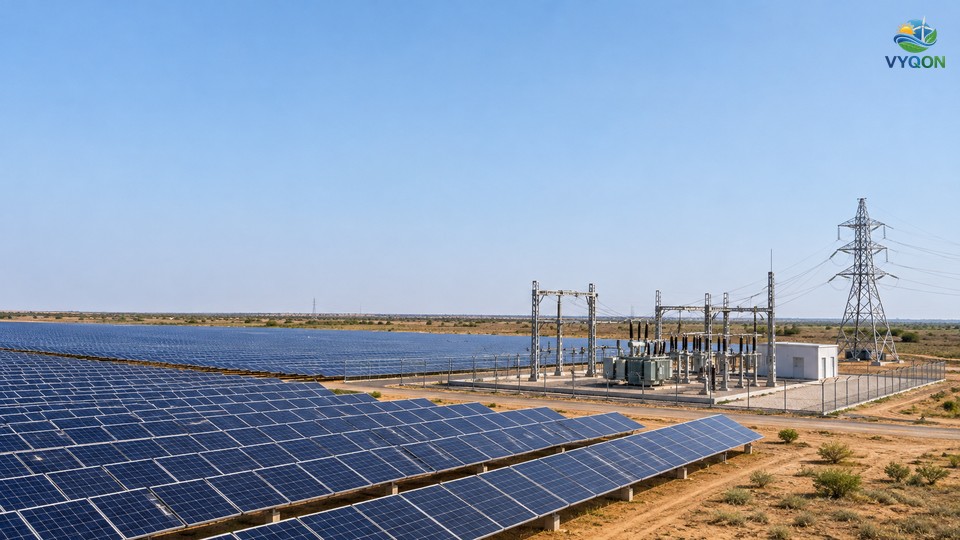
The Central Electricity Regulatory Commission (CERC) has ruled that Avaada Inclean Private Limited’s 50 MW solar project in Kutch, Gujarat, remains eligible for a waiver of inter-state transmission system (ISTS) charges. In an order dated 9 November 2026 in Petition No. 176/MP/2026, the Commission extended the project’s Scheduled Commercial Operation Date (SCOD) from 30 June 2025 to 24 February 2026, the date on which the project achieved commercial operation. The order, which carries CERC Website S. No. 568/2026, makes the Avaada 50 MW solar ISTS waiver available “as if the project had achieved COD on or before 30.06.2025”.
What the petition sought
The petition was filed by Avaada Inclean Private Limited, based in Noida, Uttar Pradesh, under Section 79(1)(c) of the Electricity Act, 2003, read with Regulation 13(2)(h) of the CERC (Sharing of Inter-State Transmission Charges and Losses) Regulations, 2020. The respondents were the Central Transmission Utility of India Limited (CTUIL) and WRSS XXI(A) Transco Ltd, the transmission service provider whose address is given as Adani Corporate House, Ahmedabad.
The project is being developed at Village Rampar in Kutch through Avaada GJ Lakadiya Pvt Ltd, which was formerly a wholly owned subsidiary of the petitioner. In affidavits dated 20 and 21 May 2026, the petitioner told the Commission that both the project company and the petitioner are now wholly owned subsidiaries of Avaada Energy Private Limited.
Connectivity and the transmission delay
According to the order, the petitioner applied to CTUIL on 21 April 2023 for connectivity at the 220 kV Lakadiya ISTS pooling sub-station. CTUIL issued an in-principle grant of connectivity on 6 November 2023 with a start date of 30 June 2025. The final grant followed on 27 August 2024, with a connectivity start date of 16 August 2025 that could be advanced to 30 June 2025 if the related transmission augmentation was commissioned on a best-effort basis.
That augmentation comprised a 220 kV switchyard at the 765/400 kV Lakadiya pooling station and two 500 MVA, 400/220 kV inter-connecting transformers (ICTs), within the scope of WRSS XXI(A) Transco Ltd. The petitioner said the completion timelines were pushed back at Joint Coordination Committee meetings on 28 March 2025 and 24 June 2025.
The Central Electricity Authority issued an “Approval for Energization” for the petitioner’s infrastructure on 30 June 2025. CTUIL later told the Commission that the augmentation, together with the 220 kV line bay for terminating the project’s dedicated line, was declared under commercial operation with effect from 10 February 2026, and the 50 MW connectivity was made effective from 28 March 2026.
Committee reports and timeline
The petitioner applied to the Committee constituted under the Sharing Regulations on 23 September 2025 for an extension. In its report dated 26 November 2025, the Committee found that the initial delay was not attributable to the petitioner and recommended a first extension of six months from 30 June 2025, or until commissioning of the transmission augmentation, whichever was earlier.
As the augmentation was still incomplete at the end of 2025, the petitioner made a further representation on 3 February 2026. In its report dated 11 March 2026, the Committee recommended a second six-month extension from 31 December 2025, up to 30 June 2026, or until the transmission system was operationalised, whichever was earlier. It also supported a commissioning-preparation period of up to 60 days from the transmission system’s operationalisation, subject to the 30 June 2026 cap.
The project’s trial run was completed on 19 February 2026 and commercial operation of the full 50 MW was declared on 24 February 2026.
The Commission’s reasoning
The Commission set out the three conditions that Regulation 13(2)(h) places on a wind, solar or hybrid project seeking the waiver: its SCOD must be on or before 30 June 2025; the delay in commercial operation must arise from a force majeure event, including non-availability of the transmission system, or from reasons not attributable to the project; and the project must achieve COD on or before the extended date.
CERC noted that the Committee had concluded the project’s SCOD was 30 June 2025, and that the Committee’s recommendation allowed commercial operation up to 10 February 2026 plus 60 days. Because the transmission system was declared commercial from 10 February 2026 and the project reached COD on 24 February 2026, the Commission held that the petitioner’s SCOD “stands extended to 24.2.2026, only for the purpose of Regulation 13(2)(h)” of the Sharing Regulations “and not otherwise”. The petition was disposed of on that basis.
What it means for India’s clean-energy sector
The order shows how Regulation 13(2)(h) works in practice: the Committee examines whether the delay lay with the developer or with the transmission system, and the Commission then confirms the extension. Here, the record points to the transmission augmentation as the factor that held back commercial operation.
For developers, the ruling confirms that a project whose own works were ready can keep the ISTS charges waiver when the grid connection is not available, provided it meets the regulation’s three conditions and achieves COD within the extended period. For transmission planners, the case is a reminder that timely commissioning of common transmission augmentation affects whether generators can reach commercial operation on schedule.
Official references
- Central Electricity Regulatory Commission, Order in Petition No. 176/MP/2026 dated 9 November 2026 (CERC Website S. No. 568/2026): https://cercind.gov.in/2026/Orders/176-MP-2026.pdf
Leave a Comment