
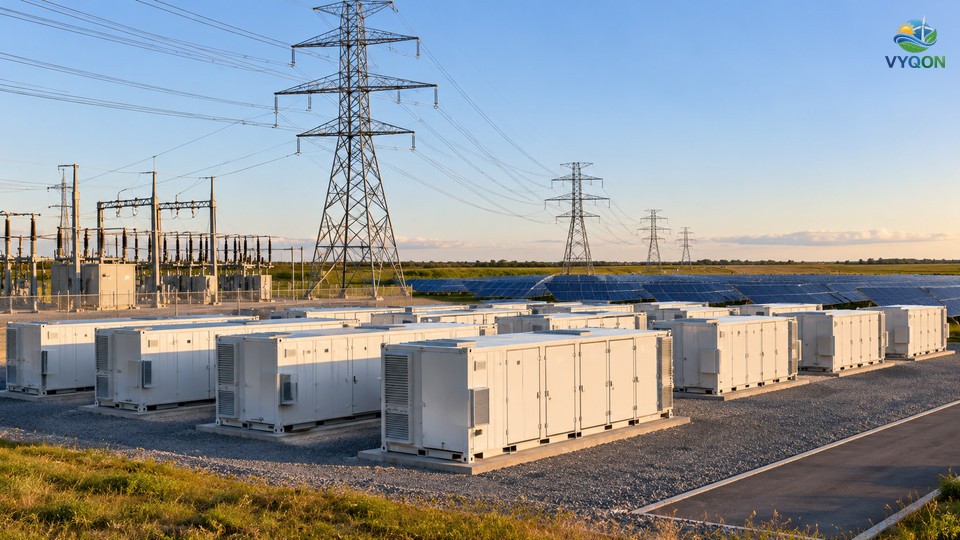
ICRA has said that India’s renewable energy growth is backed by policy, but that its viability now hinges on battery costs and on execution. The rating agency makes the point in a thematic report dated 19 November 2026 titled “Growth backed by policy; viability hinges on battery costs and execution”. The ICRA renewable energy report says strong storage demand and a sizeable tender pipeline support growth, while execution remains the key monitorable for the sector.
ICRA renewable energy report: the main findings
According to the ICRA summary page, India’s rapid renewable capacity addition continues to outpace transmission augmentation. This is most visible in resource-rich states such as Rajasthan and Gujarat. The mismatch is increasing grid congestion and the need for storage, which can absorb surplus generation, shift supply to non-solar hours and ease network constraints.
ICRA also notes that operational battery energy storage system (BESS) capacity is rising, which it reads as progress from tendering to deployment. The agency adds that the Government of India’s viability gap funding (VGF) schemes announced in 2023, 2025 and 2026 cover 135.8 GWh and provide a significant source of capital support for storage projects.
Share of renewables in India’s electricity generation
ICRA estimates that the share of renewable energy plus hydro in all-India electricity generation will rise to about 42 per cent by 2032 from 26 per cent in FY2026. It attributes this to large renewable capacity additions and to the fact that the coal power segment may see relatively lower capacity addition.
The National Electricity Plan (NEP), approved by the Government of India, expects the share of renewable energy plus hydro to rise to 35 per cent by FY2027 and to 44 per cent by FY2032. The plan prepared by the Central Electricity Authority (CEA) for 2030 estimates the share at 41 per cent. ICRA assumes electricity demand growth of 5 to 9 per cent between FY2027 and FY2032.
Why grid and storage matter
ICRA says that reaching such a high renewable share would require stronger grid infrastructure and the development of energy storage systems to manage the intermittency of wind and solar power. Storage also supports grid stability, ancillary services and peak load shifting. Additions in storage capacity are expected to come mainly from BESS and pumped storage projects (PSP).
For developers, the practical meaning is that a commissioned renewable project does not automatically translate into electricity that can be sold without interruption. Where evacuation lines lag behind generation, congestion and curtailment risks grow. Storage located close to such projects is one way to reduce that risk.
Battery costs and project viability
The report title points to battery costs as a central factor in whether storage projects remain viable. Recent reports on the study say that a rebound in battery prices is one of the pressures on storage project economics, along with the need for timely execution of awarded projects. These reports also say that the growing number of tenders will need to be converted into commissioned capacity to make a difference to the grid.
What it means for India’s clean-energy sector
The report shifts the conversation from how much solar and wind capacity India can add to how well that capacity can be integrated into the grid. For transmission planners, it underlines the need to keep pace with generation in states such as Rajasthan and Gujarat. For storage developers and buyers, it highlights the value of government VGF support, and the importance of delivering projects on time and at viable costs.
ICRA is a rating and research agency, and the findings above are its own assessment as published on its website. The agency’s full report is available to subscribers only, so this article relies on the public summary page.
Not disclosed
Detailed figures from inside the full report, such as year-wise capacity additions, transmission line lengths, the BESS project pipeline and project-level return estimates, are not on the public summary page. They are therefore not included here.
Leave a Comment