
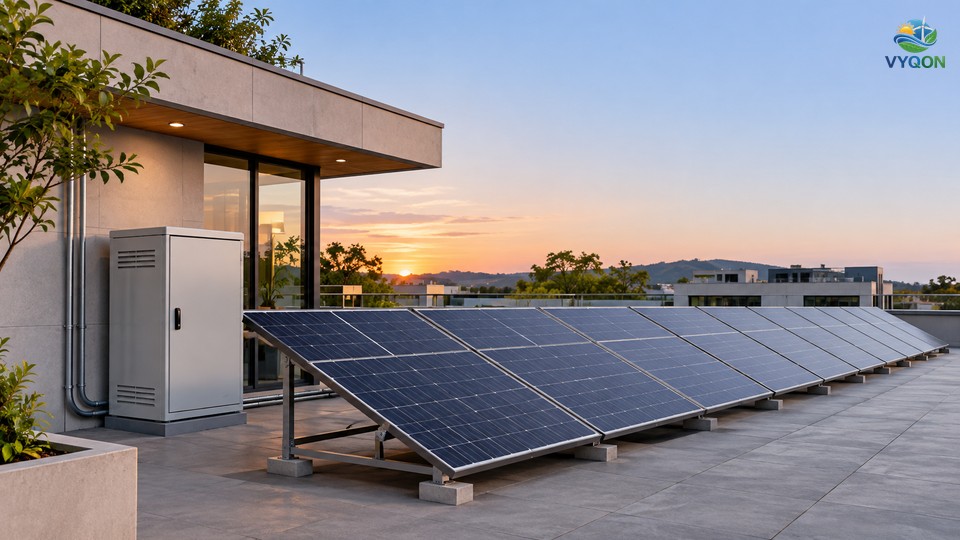
The Ministry of Power has issued a revised draft of the Electricity Rights of Consumers Amendment Rules, 2026, and has invited comments from states, regulators, distribution companies and industry until 23 December 2026. The draft was issued on 23 November 2026. It proposes that State Electricity Regulatory Commissions could require rooftop solar prosumers to install energy storage and could allow net-metering charges beyond a capacity threshold. The draft is open for comments and is not final. If notified as drafted, the Electricity (Rights of Consumers) Amendment Rules would come into force on 1 April 2027.
What the Rights of Consumers Amendment Rules propose for rooftop solar and storage
The draft amends the Electricity (Rights of Consumers) Rules, 2020, which the Ministry notified on 31 December 2020 and last amended on 22 February 2024. Its most closely watched part for the solar sector is a new sub-rule on energy storage. Where the installed capacity of a renewable energy generating system exceeds a threshold set by the State Commission, the Commission may require the prosumer to install an energy storage system. The storage capacity would be at least 20 per cent of the total energy the system generates in a day, or another proportion of daily generation that the Commission specifies.
If a State Commission does not fix a capacity threshold, the requirement would apply to systems above 10 kW. This storage proviso would take effect later than the rest of the rules, on 1 April 2028, to give time for regulatory and investment arrangements.
Net-metering charges and larger rooftop systems
The draft also changes how net metering can be charged. State Commissions would be allowed to permit net metering subject to charges that they specify. No such charges would be levied up to a solar capacity threshold that the Commission decides. Beyond that threshold, charges may be set after considering the imputed cost of energy storage and adjustments for network losses.
The Ministry’s explanatory note says consumers billed on net consumption may not fully contribute to the fixed costs of distribution companies, increasing cross-subsidisation. It adds that, under the current rules, net metering is permitted up to 500 kW where a State Commission has not prescribed a limit. The draft proposes to let each Commission determine the applicable limits and charges based on conditions in its state.
Another change would let consumers, including commercial, industrial and MSME users, install rooftop solar capacity above their sanctioned load, subject to limits set by the Commission. However, a prosumer could inject power into the distribution system only up to the sanctioned load unless the distribution company authorises more. Electricity injected beyond that limit without authorisation would not earn payment or compensation and could attract a penalty.
Other changes in the draft
The proposals go beyond rooftop solar. The Ministry’s explanatory note says they follow the work of a Group of Ministers set up to examine the financial viability of distribution companies, along with inputs from the discoms. The main additional proposals are:
- Connection timelines: municipal corporation areas would be brought under the three-day timeline for new or modified connections that already applies to metropolitan areas. Other municipal areas would keep seven days and rural areas fifteen days, with thirty days for hilly rural areas.
- Time-of-day tariffs: consumers with a maximum demand above 10 kW would get time-of-day tariffs by 1 April 2028, and other non-agricultural consumers by 1 April 2029.
- Billing safeguards: a bill above five times or below one-fifth of the average of the previous six cycles would be reviewed within 30 days, with no disconnection while the consumer pays the average amount.
- Grievance redressal: consumer forums would run at a minimum of two levels, company and district or municipality, and grievances would be decided within 30 days, in any case within 45 days.
- Demand response: State Commissions would specify a framework for demand response programmes.
Why the Ministry says storage now makes sense
The explanatory note gives a reason for the storage proposal. It says the cost of battery energy storage systems has fallen substantially over the past two years because of economies of scale, technological innovation and stronger competition. That decline, according to the note, has made such systems economically viable and offers a way to strengthen grid stability while integrating renewable energy into a grid that is still mostly thermal.
Storage at the consumer’s premises can shift surplus solar power to evening hours and reduce operational stress on discoms. For commercial and industrial users, the note adds, it can give greater energy independence and cost savings.
What it means for India’s clean-energy sector
For rooftop solar developers, solar EPC companies and battery suppliers, the draft points to a future in which rooftop solar and storage may be sold together in states that choose to use the new powers. Because thresholds, charges and storage proportions are left to State Commissions, outcomes could differ from state to state, and installers would need to track each regulator’s rules.
Net-metering charges above a threshold, together with storage requirements, could change the payback calculation for larger rooftop systems, while the exemption up to a threshold keeps small systems protected.
Comments are due on 23 December 2026, the rules would start on 1 April 2027 and the storage requirement on 1 April 2028. The draft may change after comments.
Official references
1. Ministry of Power, Government of India, notice: Seeking comments on the revised Draft Electricity (Rights of Consumers) Amendment Rules, 2026 (PDF): https://powermin.gov.in/static/uploads/2026/11/91cbea9d2d77a3f233f8cfce17c3329a.pdf
2. Ministry of Power, Orders and Notices page: https://www.powermin.gov.in/documents/orders-and-notices
Leave a Comment