
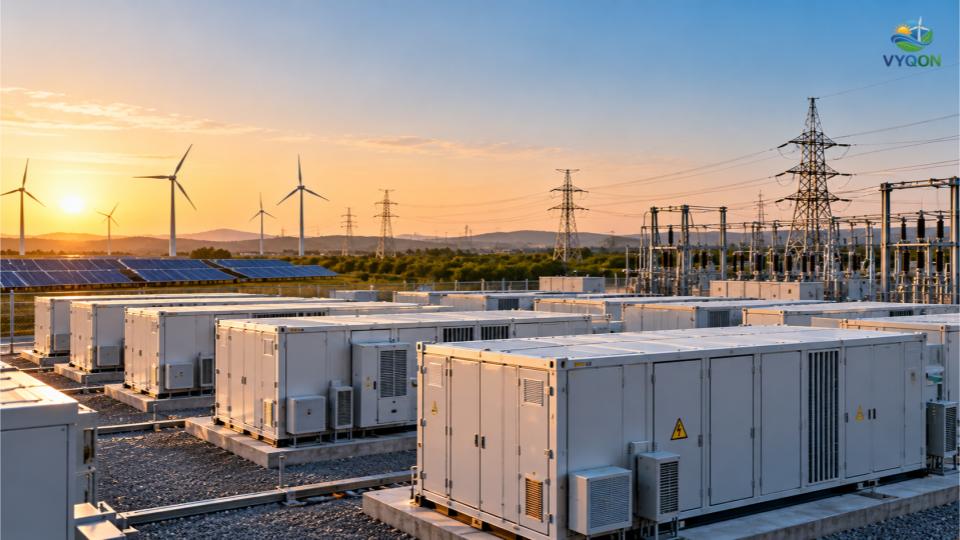
The Union Cabinet, chaired by Prime Minister Narendra Modi, approved the Green Energy Corridor Phase-III (GEC-III) scheme on 30 September 2026. Of the scheme’s total Central Financial Support of ₹54,082 crore, ₹6,000 crore has been set aside as Viability Gap Funding (VGF) for deploying 50 GWh of Battery Energy Storage Systems (BESS) by FY 2032-33, as per the breakdown presented at the Cabinet briefing. The storage component sits alongside a large expansion of Intra-State Transmission Systems (InSTS) designed to evacuate up to 135 GW of renewable energy across States and Union Territories.
Scheme at a Glance
GEC-III has a total project outlay of ₹1,86,405 crore, comprising ₹1,36,378 crore for intra-state transmission and ₹50,000 crore for 50 GWh of BESS. According to details shared at the Cabinet briefing, the scheme will add 51,126 circuit kilometres (ckm) of transmission lines and 2,28,903 MVA of transformation capacity by FY 2032-33. The central support is distributed as follows:
| Component of Central Financial Support | Amount (₹ crore) |
| Intra-State Transmission Systems (InSTS) | 45,005 |
| Viability Gap Funding for 50 GWh BESS | 6,000 |
| Committed liabilities of earlier GEC phases | 3,050 |
| Programme management and grid studies | 27 |
| Total | 54,082 |
The government has stated that the Central Financial Assistance will help offset intra-state transmission charges, keeping power costs down for end consumers. As per the briefing, the Ministry of New and Renewable Energy (MNRE) expects the central support to leverage around ₹1.32 lakh crore of transmission investment and enable an estimated ₹4.6 lakh crore of investment in the associated 135 GW of renewable capacity.
Where the Batteries Will Be Deployed
As per the official release, the 50 GWh of BESS will be installed at the renewable energy developer or generator end, or at any other location of importance for grid flexibility. The objective is to address intermittency, transmission congestion and peak-hour curtailment, and to meet electricity demand during non-solar hours. Speaking at the Cabinet briefing, Union Minister Ashwini Vaishnaw noted that storage smooths out supply fluctuations, while the wider scheme also covers improvements to the grid, transmission systems and load dispatch centres.
What ₹6,000 Crore Means per MWh
The headline numbers imply a project cost of roughly ₹1 crore per MWh (₹50,000 crore for 50,000 MWh). On that basis, the ₹6,000 crore VGF works out to about ₹12 lakh per MWh, or nearly 12 percent of the BESS outlay, with the remaining capital to be mobilised through the implementing entities and developers.
This is lower than the support offered under earlier schemes. The first VGF scheme for BESS, approved by the Cabinet in September 2023 with budgetary support of ₹3,760 crore, was originally designed for 4,000 MWh at up to 40 percent of capital cost; according to the Ministry of New and Renewable Energy, it now supports 13,220 MWh at ₹27 lakh per MWh. In June 2025, the Government approved another VGF scheme for 30 GWh, funded with ₹5,400 crore from the Power System Development Fund at ₹18 lakh per MWh. Detailed guidelines on bidding, eligibility and disbursement of the storage VGF are yet to be notified.
Why Transmission Must Come First
A government presentation on the scheme highlighted a timing gap: transmission infrastructure takes about four years to build, while a renewable energy project takes about two. MNRE has framed the guiding principle as transmission preceding generation. Other drivers include avoiding curtailment, helping States meet their Renewable Consumption Obligation (RCO), and the fact that the waiver of Inter-State Transmission System (ISTS) charges will no longer be available after June 2028, which raises the importance of strong intra-state networks.
The scale is a sharp step up from earlier phases. Intra-State GEC Phase-I, approved in 2015, covered about 9,700 ckm of lines and 22,600 MVA of substations across eight States at a cost of ₹10,141.68 crore. Phase-II, approved in January 2022, targeted about 10,750 ckm and 27,500 MVA in seven States at ₹12,031.33 crore. Phase-III plans roughly two and a half times the combined line length of both phases.
Implementation and Monitoring
All greenfield InSTS projects will be awarded through Tariff Based Competitive Bidding (TBCB), with Transmission Service Providers operating on a Build-Own-Operate-Maintain (BOOM) model. Brownfield upgradation and network strengthening will be executed on a cost-plus basis. State Transmission Utilities will be the overall implementing agencies.
Funds will be allocated through a challenge mode, giving priority to States that demonstrate readiness, including adherence to their RCO trajectory, a renewable energy policy, a land compensation mechanism, assessment of renewable potential, and advance right-of-way and forest clearances. Central assistance will be released only on achievement of defined milestones, tracked by a dedicated project monitoring unit through an online dashboard, with half-yearly reviews chaired by the Cabinet Secretary. The Cabinet has also permitted reallocation of projects within and across States, and MNRE has indicated that the scheme aims to extend renewable development to newer regions, including the North-East and Himalayan States.
Outlook
GEC-III is positioned as a key enabler of India’s target of 900 GW of installed non-fossil capacity by 2035. The government expects it to generate direct and indirect employment across the power, manufacturing and construction sectors, with BESS manufacturing and deployment adding jobs in the domestic energy storage industry, along with long-term skilled roles in operation, maintenance and grid management. For storage developers and equipment suppliers, the notification of the BESS guidelines and the bidding design will be the next milestones to watch.
Official Sources
- Press Information Bureau – Cabinet approves Green Energy Corridor Phase-III scheme for Development of Intra-State Transmission System with Battery Energy Storage Systems (30 September 2026): https://pib.gov.in/PressReleasePage.aspx?PRID=2316948
- Press Information Bureau (MNRE) – Government Takes Multi-Pronged Steps to Scale Up Energy Storage Capacity in the Country (3 February 2026): https://pib.gov.in/PressReleasePage.aspx?PRID=2222473
- Press Information Bureau – Cabinet approves Scheme for Viability Gap Funding for development of Battery Energy Storage Systems (6 September 2023): https://pib.gov.in/PressReleasePage.aspx?PRID=1955112
- Ministry of Power – Green Energy Corridor: https://powermin.gov.in/en/content/green-energy-corridor
- Ministry of New and Renewable Energy – Intra-State Green Energy Corridor Phase-I: https://mnre.gov.in/gec-1
Leave a Comment