
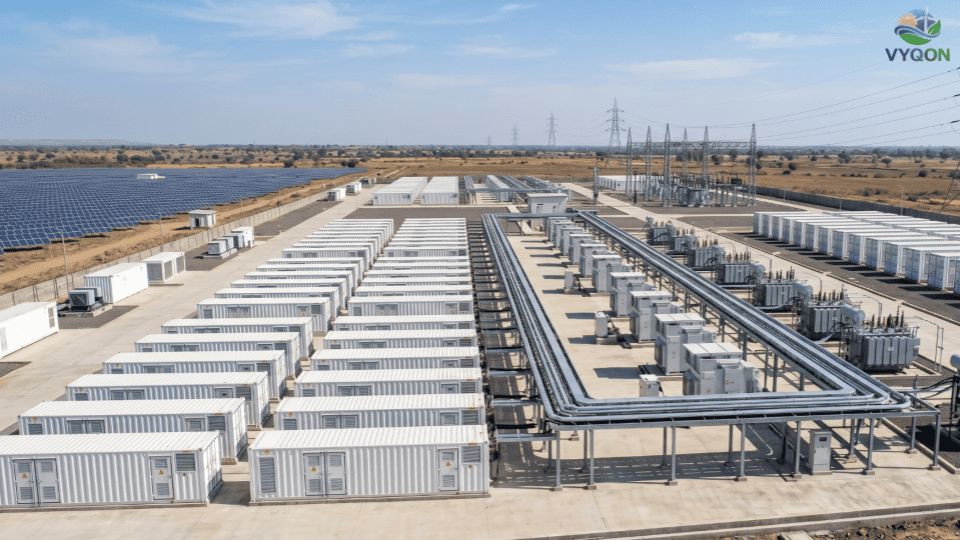
Regulatory Approval of Phase VIII BESS
The Gujarat Electricity Regulatory Commission (GERC) has issued a formal order, dated May 8, 2026, approving the adoption of tariffs for Gujarat Urja Vikas Nigam Limited’s (GUVNL) Phase VIII standalone Battery Energy Storage System (BESS) project. Under Petition No. 2641/2026, the Commission exercised its powers under Section 63 of the Electricity Act, 2003, to adopt the tariffs discovered through a transparent, competitive bidding process followed by an e-reverse auction. The approval covers a total project capacity of 335 MW / 670 MWh, structured as a two-hour cycle system to bolster the state’s grid resilience.
Approved Tariffs and Capacity Allocation
The auction, conducted in February 2026, utilized a “bucket filling” method to allocate the total capacity among three successful bidders. The discovered tariffs signify a notable improvement in battery storage economics within the Indian market, representing a 6–7% reduction from the initial quoted levels during the bidding process.
Approved Tariffs and Capacity Allocation
| Successful Bidder | Allocated Capacity (MW/MWh) | Approved Tariff (₹/MW/Month) |
| Advait Energy Transitions Limited | 150 MW / 300 MWh | ₹210,000 |
| Equentia Natural Resources DMCC | 65 MW / 130 MWh | ₹211,999 |
| Sun Drops Energia Private Limited (KPI Group) | 120 MW / 240 MWh | ₹212,000 |
Note: The final discovered tariffs for the awarded capacity range from ₹210,000/MW/month to ₹212,000/MW/month. The competitive discovery of these rates reflects a “sharp fall” in costs compared to earlier standalone storage tenders in the region, signaling a maturing market for utility-scale BESS.
Financial Support and Funding Mechanisms
The commercial viability of this standalone BESS framework is underpinned by Viability Gap Funding (VGF). This financial assistance is provided under the Power System Development Fund (PSDF) scheme as notified by the Union Ministry of Power.
The central government has authorized a grant amount of ₹1.8 million (₹18 lakh) per MWh of the awarded capacity. To ensure project discipline and long-term performance, the grant is disbursed in three distinct stages:
- Stage 1: Upon the achievement of financial closure.
- Stage 2: Upon reaching the Commercial Operation Date (COD).
- Stage 3: Following one year of successful project operation.
Project Scope and Technical Requirements
The Phase VIII projects are awarded on a build-own-operate (BOO) basis. The regulatory framework mandates a technology-agnostic approach, allowing developers to deploy any battery chemistry or solution provided it adheres to the specified performance and safety criteria. The scope and mandates for the selected developers include:
- Comprehensive Project Scope: Developers are responsible for the design, financing, supply, installation, testing, and commissioning, as well as the long-term Operations and Maintenance (O&M) of the facilities.
- Operational Cycles: The BESS must support two full operational charge-discharge cycles daily to assist in peak-shaving and RE smoothing.
- Grid Integration: All facilities must be connected to the Gujarat Energy Transmission Corporation (GETCO) network.
- Dispatch and Control: The BESS facilities will be operated based on demand requirements as directed by the State Load Dispatch Centre (SLDC) and GUVNL. Systems must be capable of discharging up to their rated capacity within any 15-minute time block.
- Localization and Compliance: The order prohibits the use of refurbished battery cells and mandates the use of indigenously developed energy management software, strict cybersecurity protocols, and adherence to international safety standards.
Project Objectives, Site Specifics, and Timeline
The primary objective of this 670 MWh project is to facilitate the seamless integration of Gujarat’s rapidly expanding solar and wind portfolios. By providing high-speed frequency response and energy shifting, these standalone systems help the state’s distribution companies meet their Energy Storage Obligation (ESO) and Renewable Purchase Obligation (RPO) targets.
Specific site locations have been identified for the Sun Drops Energia (KPI Group) allocation, which will be developed near two 220kV substations:
- Gariyadhar AIS Substation: 65 MW / 130 MWh
- Otha AIS Substation: 55 MW / 110 MWh
The regulatory order stipulates that the selected projects must be commissioned within 18 months. This initiative is a critical component of Gujarat’s strategic roadmap to deploy over 4,500 MW of energy storage capacity by 2030 to maintain long-term grid reliability.
Leave a Comment