
Executive News Summary
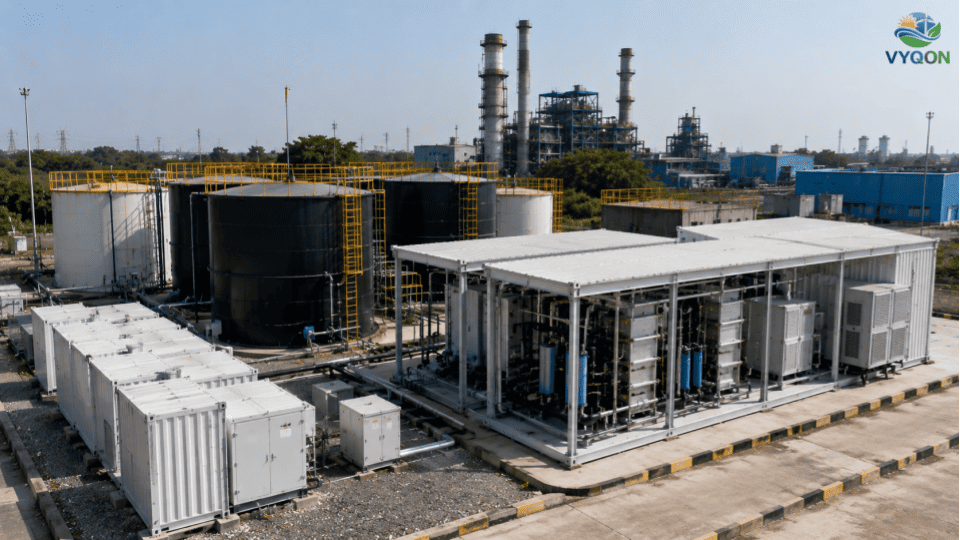
Gujarat Industries Power Company Limited (GIPCL) has announced a landmark tender for a 20 MW/120 MWh Battery Energy Storage System (BESS) based on Vanadium Redox Flow Battery (VRFB) technology. Backed by Gujarat Urja Vikas Nigam Limited (GUVNL) as a strategic pilot for grid-scale Long-Duration Energy Storage (LDES), the project is slated for GIPCL’s 165 MW Gas Power Plant Complex in Vadodara. From an infrastructure analyst’s perspective, the co-location of this LDES asset at a gas power complex represents a sophisticated brownfield utilization strategy, potentially providing firming capacity and hybrid peaking capabilities as Gujarat accelerates its renewable energy integration.
Project Scope and EPC Framework
The project will be delivered on a turnkey “Single-Point Engineering, Procurement, and Construction (EPC)” basis, ensuring the contractor maintains holistic responsibility from design through to long-term performance.
The comprehensive scope of work includes:
- Design and Engineering: Full system architecture and chemistry-agnostic integration.
- Manufacturing and Assembly: In-factory production of VRFB stacks and auxiliary components.
- Procurement and Supply: Sourcing of all electrical, mechanical, and civil systems, including transit insurance.
- Site Works: Civil and structural engineering, loading/unloading, and specialized internal handling of electrolyte tanks.
- Testing and Commissioning: Rigorous performance validation at both the manufacturer’s works and the Point of Injection (POI).
- Operations and Maintenance: A mandatory 10-year O&M contract. Critically, the O&M period commences at the earlier of successful completion of the Operational Acceptance Test (OAT) or 60 days from commissioning, a clause that tightens the liability window for the selected contractor.
Technical Parameters and Interconnection
While India’s initial foray into VRFBs was marked by the NTPC NETRA 3 MWh pilot, the GIPCL project represents the nation’s first true grid-scale deployment at 120 MWh.
- Technology: Vanadium Redox Flow Battery (VRFB).
- Rated Capacity: 20 MW / 120 MWh (6-hour storage duration).
- Point of Injection (POI): 132 kV GIPCL substation.
- Performance Metric: System performance and efficiency shall be strictly measured at the POI.
Technical Benefits of VRFB Technology VRFB technology is uniquely suited for LDES due to the independent scalability of power (via stack size) and energy (via electrolyte volume). Unlike lithium-ion counterparts, VRFBs support a 100% depth of discharge (DoD) without capacity degradation. Furthermore, the use of non-flammable, water-based electrolytes provides a superior safety profile for utility-scale installations, eliminating the risk of thermal runaway.
Operational Cycle and Indicative Schedule
The BESS is expected to operate at approximately 1.5 cycles per day. For VRFB systems, this cycling frequency highlights the technology’s durability; whereas lithium-ion batteries face significant degradation under high-cycle/long-duration use, VRFBs offer a 20-year lifespan with minimal capacity fade.
Indicative Operational Schedule
| Activity | Time Windows (IST) |
| Charging Schedule | 01:00–05:00 hrs and 09:00–16:00 hrs |
| Discharging Schedule | 06:00–09:00 hrs and 18:00–24:00 hrs |
Note: These schedules are indicative and subject to real-time revision by GUVNL based on grid stability and renewable supply fluctuations.
Bidding Timelines and Financial Requirements
Bidders must navigate a rigorous set of milestones and financial guarantees designed to mitigate the risks associated with deploying emerging LDES technologies.
Critical Milestones
- Original Tender Upload: May 21, 2026.
- Site Visit: June 05, 2026 (Govt. ID proof submission required by May 28).
- Pre-bid Meeting: June 15, 2026 (11:30 Hrs IST via MS Teams).
- Online Bid Submission Deadline: June 25, 2026 (17:00 hrs IST).
- Physical Bid Receipt Deadline: July 01, 2026 (15:00 hrs IST).
- Project Completion: 18 months from the date of Letter of Intent (LoI).
Financial Obligations
- Tender Fee: ₹5,900 (₹5,000 + 18% GST).
- Earnest Money Deposit (EMD): ₹1.1 Crore.
- Security Deposit/Performance Bank Guarantee (PBG): 10% of Contract Value.
- O&M cum Equipment Performance Guarantee (EPG): A specialized 5% guarantee of the EPC contract price (excluding O&M). To reflect the operational stabilization of the asset, the EPG value reduces by 2.5% at the end of each completed year after Year 2, provided performance remains satisfactory.
Submission and Compliance Instructions
All bids must be submitted through the n-procure portal. Bidders are required to handle the dual submission process with precision:
- Physical Documentation: Hard copies of the Technical Bid, EMD, and Tender Fee must be sent to the Vadodara corporate office addressed to Shri J. A. Shah (Addl. General Manager-RE Projects & Business Development).
- Strict Delivery Rule: Documents must be sent via Registered Post A.D. or Speed Post only. GIPCL has explicitly forbidden courier services for this tender.
- Price Bid: Must be submitted online only. Physical submission of price bids will result in immediate disqualification.
- Digital Requirements: Electronic signatures must utilize a legally valid Class III Digital Certificate.
Market Context: Long-Duration Energy Storage (LDES) in India
As India pursues its 500 GW non-fossil fuel capacity target by 2030, the limitations of the 4-hour lithium-ion threshold have become apparent. VRFBs are emerging as the preferred “round-the-clock” (RTC) renewable supply solution. Gujarat is strategically positioned for this pilot, given the state’s emerging status as a hub for stack assembly, with local capacities currently estimated between 50-100 MW.
Observed Bottlenecks and Emerging Models
- CAPEX and the Electrolyte-Lease Model: Since vanadium electrolyte can account for 30-40% of total system CAPEX, the industry is shifting toward “electrolyte-leasing” to improve the Levelized Cost of Storage (LCOS).
- Vanadium Price Volatility: Exposure to global vanadium pentoxide (V₂O₅) price swings remains a primary risk for project bankability.
- Supply Chain Concentration: Reliance on specialized membranes and domestic stack manufacturing still requires scaling to meet “Make in India” preferences.
This GIPCL tender marks a decisive shift from laboratory-scale testing to industrial application, setting the stage for VRFB technology to underpin the next phase of India’s energy transition.
Leave a Comment