
JSW Energy Limited reported a consolidated net profit of ₹533 crore for the first quarter of FY 2027, a 36% year-on-year decline despite total revenue remaining flattish at ₹5,437 crore. While the bottom line was weighed down by higher finance costs and depreciation—the predictable accounting byproduct of an aggressive capital expenditure cycle—the company achieved a significant operational landmark. JSW Energy added 1,081 MW to its operational capacity in the first 100 days of the fiscal year, signaling a rapid transition toward its goal of becoming a renewable-heavy power producer.
Financial Performance Analysis
Consolidated Earnings and Equity Dilution
For Q1 FY 2027, JSW Energy reported a Consolidated Net Profit (PAT) of ₹533 crore, down from ₹836 crore in the year-ago period. A deeper dive into the numbers reveals a sharper 46% decline in Reported EPS (₹2.6 vs ₹4.8). This divergence between PAT and EPS is primarily a result of significant equity dilution following the ₹4,000 crore Qualified Institutional Placement (QIP) and the promoter preferential allotment. Conversely, the company’s Cash PAT remained robust at ₹1,464 crore, a metric management is highlighting to demonstrate that underlying cash generation remains sufficient to fuel its Strategy 3.0 growth plans.
Revenue and Operating Profit
Total revenue from operations stood at ₹5,437 crore, essentially flat compared to Q1 FY 2026. Despite the stagnant revenue, EBITDA rose by 2% to ₹3,103 crore, yielding a high-quality EBITDA margin of 57%. This operational resilience was supported by a firming merchant power market, where Day-ahead market prices rose 16% YoY to average ₹5.10/unit. JSW Energy continues to leverage this backdrop by maintaining merchant optionality, keeping residual open capacity at under 4%.
Strategic Cost Drivers
The company’s bottom-line contraction reflects the “investment phase” of its lifecycle:
- Depreciation: Rose to ₹890 crore (from ₹739 crore) as new assets were capitalized.
- Finance Costs: Increased to ₹1,519 crore (from ₹1,306 crore) due to incremental borrowings for capacity expansion. Notably, the weighted average cost of debt was optimized to 8.36%, down from 8.87% a year earlier.
Operational Highlights & Generation Mix
Capacity Milestones
JSW Energy reached a total installed capacity of 14,535 MW. The 1,081 MW added between April 1 and July 8, 2026, accounts for 36% of the company’s 3 GW target for FY 2027. A key highlight was the 150 MW Tidong Hydro project, which was commissioned well ahead of its October 2026 schedule to capture the peak hydro season.
Portfolio Breakdown
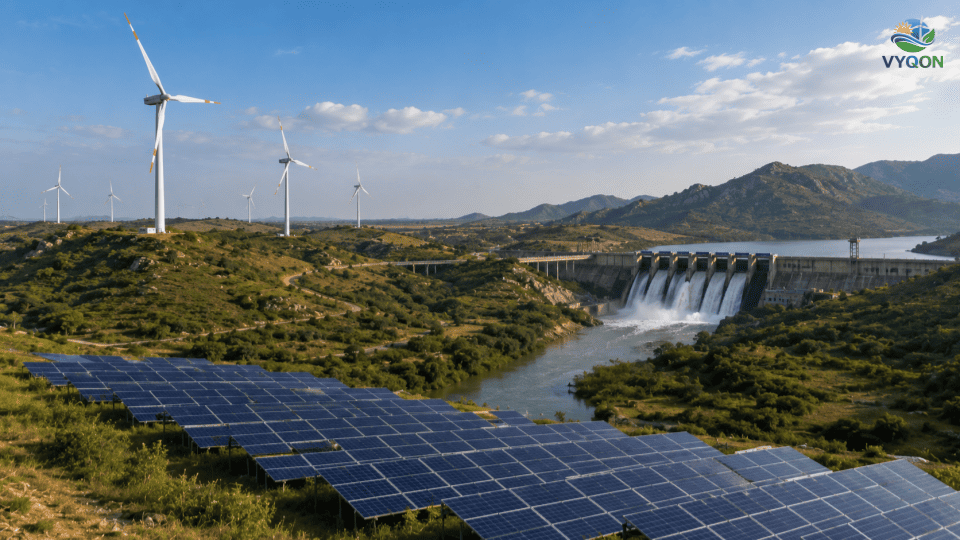
Renewables now comprise 61% of the total portfolio, reflecting the company’s pivot away from thermal dominance.
| Installed Capacity by Source | Capacity (MW) |
| Thermal | 5,658 |
| Wind | 3,125 |
| Solar | 2,275 |
| Hydro | 1,781 |
| Hybrid | 1,696 |
| Total Installed Capacity | 14,535 |
Generation Performance
Total power sales volume declined by 5% YoY to 12.9 BUs. This was due to localized operational and hydrological challenges:
- Thermal: Generation fell 6% to 8.0 BUs, largely due to a one-off 17-day transmission evacuation issue at the Mahanadi plant following storm damage.
- Hydro: A 26% decline (1,423 MUs) was driven by weak hydrology in the Sutlej and Ravi basins, which saw inflows drop 39% and 24% respectively. However, capacity charges remained protected under current tariff structures.
- Solar & Wind: Solar generation jumped 29% and Wind rose 3%, partially mitigating the hydro shortfall.
Strategic Growth & Backward Integration
Capital Raising and Inorganic Growth
The company executed a massive ₹10,150 crore growth capital raise, comprising the ₹4,000 crore QIP, a ₹3,150 crore JSW Steel stake sale, and a ₹3,000 crore promoter allotment. On the inorganic front, JSW signed a definitive agreement to acquire the 300 MW Maruti Clean Coal & Power plant for an enterprise value of ₹1,410 crore.
Supply Chain De-risking
In a move to “fully de-risk” its thermal expansion, JSW Energy increased its stake in the Toshiba JSW Power Systems JV to 10.7% and is finalizing the acquisition of GE Power’s boiler business. These moves are designed to secure equipment sourcing for the 800 MW thermal units currently under execution at Salboni and Mahanadi. Further backward integration was achieved via the Halol wind blade facility (450 blades/annum capacity).
Energy Storage
The company’s energy storage vertical secured its first external order for a 200 MW/400 MWh battery assembly system, valued at ₹443.74 crore.
Balance Sheet & Debt Position
Leverage and Liquidity
The balance sheet remains healthy despite the heavy capex. Net Debt to EBITDA (operational) improved to 4.95x from 5.2x in FY 2026. The company maintains a massive liquidity cushion with cash and cash equivalents of ₹12,881 crore.
Receivables
Day Sales Outstanding (DSO) increased to 65 days from 58 days. Management clarified that this increase is a function of the portfolio mix—reflecting a higher share of long-term Power Purchase Agreements (PPAs)—rather than a deterioration in collection efficiency.
Key Financial Summary
| Metric | Q1 FY 2027 | Q1 FY 2026 | YoY Change (%) |
| Total Revenue | ₹5,437 Cr | ₹5,437 Cr | Flattish (<1%) |
| EBITDA | ₹3,103 Cr | ₹3,057 Cr | +2% |
| PAT (Consolidated) | ₹533 Cr | ₹836 Cr | -36% |
| Cash PAT | ₹1,464 Cr | ₹1,570 Cr | -7% |
| Reported EPS | ₹2.6 | ₹4.8 | -46% |
| Installed Capacity (MW) | 14,535 | 13,458 | +8% |
Official Sources
- JSW Energy Limited, “Consolidated and Standalone Financial Results for the quarter ended 30th June 2026” (Regulatory Filing to BSE/NSE), 22nd July 2026. View Filing at JSW.in,
- JSW Energy Limited, “Media Release: JSW Energy Reports its Highest-Ever Quarterly Organic Capacity Addition; Fund Raise Strengthens Balance Sheet”, 22nd July 2026. View Media Release
Leave a Comment