
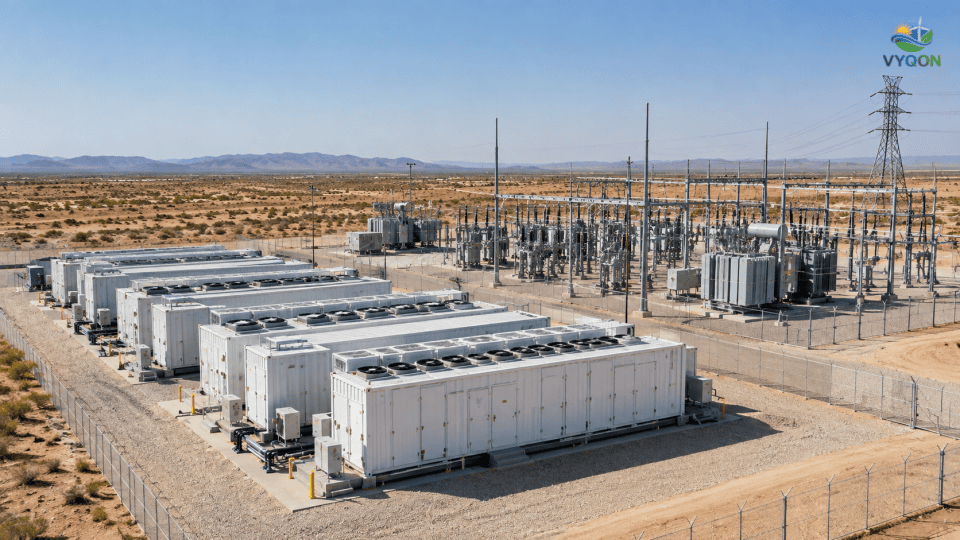
Larsen & Toubro’s (L&T) Renewables division has secured a landmark turnkey EPC mandate for three utility-scale battery energy storage system (BESS) projects in Saudi Arabia. Representing a massive 6 gigawatt-hour (GWh) aggregate capacity with a four-hour discharge duration, the contract is classified as a “Major Order” under L&T’s valuation scale, placing its value between ₹5,000 crore and ₹10,000 crore (approximately €450 million to €900 million).
Project Scope and Technical Specifications
The full-wrap EPC mandate encompasses the engineering, procurement, and construction of the storage facilities, alongside critical grid-interconnection infrastructure. This includes the design and delivery of pooling substations and high-voltage underground cabling necessary for system integration.
| Metric | Detail |
| Total Energy Capacity | 6 GWh |
| Aggregate Discharge Power | ~1.5 GW |
| Storage Duration | 4 Hours |
| Cooling Technology | Liquid-Cooled |
| Infrastructure Scope | Turnkey Pooling Substations & Underground Cabling |
Strategic Location and Project Identification
These projects are part of Saudi Arabia’s “Group 1” BESS program, a strategic procurement initiative overseen by the Saudi Power Procurement Company (SPPC). The Group 1 program represents a total investment of approximately $1.16 billion (SR 4.35 billion). L&T will execute the EPC works for a consortium operating under the Independent Storage Provider (ISP) framework, led by ACWA Power, Saudi Energy, and Al-Sharif Contracting & Commercial Development Company.
The works will be performed at three strategic sites:
- Al-Muwyah BESS (Mecca region)
- Haden BESS (Mecca region)
- Al-Kahafa BESS (Hail region)
Operational Function: Shifting Load for Summer Cooling Peaks
The 6 GWh portfolio is designed to mitigate the intermittency of the Kingdom’s expanding solar and wind fleet. By absorbing surplus clean energy during off-peak daylight hours and discharging it during periods of system stress, the facilities address specific regional load drivers, including extreme summer cooling peaks and heavy petrochemical industrial loads.
The operational benefits are categorized as follows:
- Grid Stabilization: Managing the rapid ramp-rate variability inherent in high-penetration solar environments.
- Peak Shaving: Reducing the burden on conventional gas-fired generation during intensive evening demand periods.
- Renewable Integration: Minimizing the curtailment of renewable resources by capturing energy that would otherwise be wasted during low-demand windows.
Technical Analysis: Liquid Cooling and Thermal Management
To ensure operational resilience in dusty desert environments and high ambient temperatures, L&T has opted for liquid-cooled BESS technology. Unlike traditional air-cooled systems, which are susceptible to “water ingress” and condensation in humid coastal regions or high-temperature deltas, liquid cooling utilizes a closed-loop coolant system.
Technical advantages of this selection include:
- Higher Power Density: Allowing for more energy capacity in a smaller physical footprint.
- Precision Thermal Uniformity: Maintaining cell temperatures within a 2.5°C range, significantly reducing the risk of thermal runaway.
- Elimination of the “Discharging Barrel Effect”: Utilizing individual rack control and balanced temperature management to optimize usable capacity across the system’s life cycle.
- Efficiency Gains: Delivering up to a 40% reduction in auxiliary power consumption compared to conventional air-cooled energy storage.
Regional and Global Market Context
The award reflects a broader acceleration in the energy storage sector. According to the International Energy Agency (IEA), global battery storage growth reached 40% in 2025, with 108 GW of new capacity added. In the Middle East, additions more than tripled in 2025, exceeding 3 GW. This growth is increasingly defined by longer-duration (4+ hours) systems, which have become the industrial standard for utility-scale energy shifting and grid firming.
Company and Contractual Background
L&T’s “Major Order” classification covers contracts valued between ₹5,000 crore and ₹10,000 crore. This award further expands L&T’s established regional footprint, which includes the AMAALA utilities project—combining 250 MWp of solar with 750 MWh of storage—and the Yanbu Green Hydrogen Hub. These projects reinforce L&T’s position as a primary EPC partner in the Gulf Cooperation Council (GCC) power sector as regional grids transition toward a target of 50% renewable energy by 2030.
Official Sources & References
- Larsen & Toubro Limited (EPC Contractor) L&T Renewables Business Wins Major Order for BESS in the Middle East Official Corporate Press Release (25 August 2026) detailing the EPC mandate for 6 GWh four-hour liquid-cooled BESS facilities, pooling substations, and underground cabling.
- Sungrow Power Supply Co., Ltd. (Equipment OEM / Manufacturer) Liquid-Cooled PowerTitan 2.0 Battery Energy Storage System White Paper Official Technical White Paper (Sungrow Americas, 2024) outlining system architecture, liquid cooling safety features, NFPA compliance, and 92.5% round-trip efficiency.
- Global Academic Journal of Economics and Business (GAJRC) Grid-Scale Battery Energy Storage for Renewable Energy Integration and Peak Demand Management in Saudi Arabia Peer-Reviewed Research Article by Syed Saifuddin Quraishi (2026), Vol. 8(4), pp. 820–828, published via GAJRC.
- Dii Desert Energy (Clean Energy Industry Alliance) Renewables, Hydrogen and Energy Storage Developments in the MENA Region – MENA Energy Outlook 2026 Official Regional Outlook Report tracking utility-scale BESS pipelines, national renewable targets, and storage growth across Saudi Arabia and the wider MENA region.
- Sinovoltaics Group Limited (Technical Advisory) Cooling Technologies for BESS: Air or Liquid Cooling? Official Technical Guide comparing performance, safety compliance (UL 9540A, NFPA 855), and thermal management in extreme high-temperature environments.
Leave a Comment