
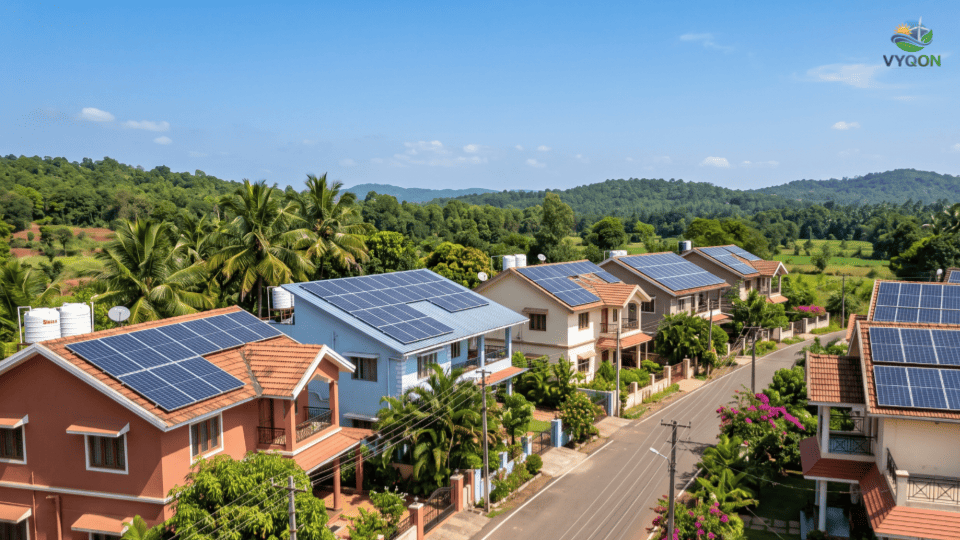
The Karnataka Electricity Regulatory Commission (KERC) has executed a strategic regulatory alignment, slashing generic tariffs for PM Surya Ghar rooftop solar projects for the FY 2027–FY 2029 control period. These revised rates, effective through June 30, 2029, capitalize on falling module prices and rationalized GST to ensure residential solar affordability remains consistent with current market dynamics.
Tariff Framework and Timeline
KERC has established this new tariff structure to provide long-term investor certainty, locking in rates through June 30, 2029. This validity period purposefully extends beyond the national scheme’s March 31, 2027, sunset, creating a critical regulatory buffer to stabilize Karnataka’s rooftop market and maintain deployment momentum.
The commission is effectively moving toward a cost-plus model where tariffs are a direct function of the “Revision of Benchmark Cost” protocol. This adjustment mechanism is designed to reflect “changed market trends” and fluctuations in “module supply prices.” By anchoring rates in updated benchmark costs and the recent GST rationalization, KERC ensures that the state’s solar economics reflect the real-time decline in capital expenditure, even as specific per-unit tariffs remain tied to evolving capital cost parameters.
Economic Drivers: GST Rationalization and Module Cost Reductions
The primary catalyst for this tariff revision is the GST Council’s decision to rationalise rates from 12% to 5% across the renewable energy value chain, effective September 22, 2025. This fiscal shift is the central mechanism allowing for the benchmark revision, as it significantly lowers the capital requirements for rooftop installations.
| Category | Previous Fiscal State | Revised Fiscal State |
| GST Rate | 12% | 5% |
| Module/Component Costs | Baseline | 3–4% Reduction |
| Typical 3 kW System Cost | Baseline | Reduction of ₹9,000–10,500 |
| Source: PIB Release, September 2025 |
This reduction does more than lower household costs; it is expected to free up ₹1–1.5 lakh crore in investment capacity nationally as India pursues its 300 GW renewable target. Furthermore, the GST cut eases the financial burden on distribution companies (DISCOMs), potentially yielding nationwide annual power procurement savings of ₹2,000–3,000 crore. This reform also bolsters the “Make in India” initiative, where every 1 GW of manufacturing capacity supports 5,000 jobs, targeting the creation of 5–7 lakh green jobs over the next decade.
PM Surya Ghar: Muft Bijli Yojana Integration
The revised tariff and subsidy framework is strictly integrated with the PM Surya Ghar: Muft Bijli Yojana. The Central Financial Assistance (CFA) structure for residential consumers is defined as follows:
- CFA for first 2 kWp: 60% of benchmark cost, capped at ₹30,000 per kWp.
- CFA for additional 1 kWp: 40% of benchmark cost, capped at ₹18,000 per kWp.
- Maximum CFA Cap: No additional financial assistance is provided for system capacity exceeding 3 kWp.
A mandatory condition for receiving this subsidy is the Domestic Content Requirement (DCR). To qualify for the CFA, projects must utilize domestically manufactured modules constructed from domestically manufactured cells, linking the subsidized rates directly to national manufacturing self-reliance.
Administrative and Eligibility Mandates
To operate under this tariff and subsidy regime, projects must comply with the following regulatory and administrative constraints:
- National Portal Integration: All applications must be processed exclusively through the official National Portal.
- Domestic Manufacturing Mandate: For subsidized projects, the use of domestically manufactured modules and cells is non-negotiable.
- “Give It Up” Nuance: Under Section 5p of the national guidelines, consumers may opt to forgo the CFA via the “Give It Up” option. In such cases, the DCR mandate is waived, allowing for the use of high-efficiency imported modules at the consumer’s expense.
- Residential Exclusivity: These specific generic tariffs and CFA benefits are restricted to the residential segment; commercial and industrial (C&I) sectors are excluded.
- Divergent Timelines: While the national implementation period for the PM Surya Ghar scheme is currently active through March 31, 2027, the KERC generic tariff framework remains valid through June 30, 2029, to ensure long-term market stability.
Official References & Citations
- Ministry of New and Renewable Energy (MNRE), Government of India
- Document: Operational Guidelines for PM-Surya Ghar: Muft Bijli Yojana – Central Financial Assistance to Residential Consumers
- Order Reference: Order No. 318/17/2024-Grid Connected Rooftop
- Issuing Authority: Ministry of New and Renewable Energy (MNRE), Government of India
- Summary: Official administrative mandate detailing the ₹75,021 crore scheme outlay, Central Financial Assistance (CFA) structure, benchmark costs, Domestic Content Requirements (DCR), and grid integration protocols.
- Press Information Bureau (PIB), Government of India
- Press Release: GST on Renewable Energy Devices Rationalised to 5% to Accelerate India’s Clean Energy Transition
- Release ID: 2167486
- Issuing Ministry: Ministry of New and Renewable Energy / GST Council, Government of India
- Summary: Official notification regarding the GST rate rationalisation from 12% to 5% across renewable energy equipment, reducing capital equipment and module procurement costs.
- Karnataka Electricity Regulatory Commission (KERC), Government of Karnataka
- Regulatory Body: Karnataka Electricity Regulatory Commission (KERC) Official Portal
- Tariff Mandate: Generic Tariff Determination for Distributed Solar Photovoltaic (DSPV) Projects (Control Period FY 2027–FY 2029)
- Issuing Authority: Statutory State Electricity Regulatory Commission (KERC)
- Summary: Official regulatory determination fixing generic levelised tariffs, grid feed-in rates for PM Surya Ghar subsidy beneficiaries, and 25-year Power Purchase Agreement (PPA) terms valid until June 30, 2029.
Leave a Comment