
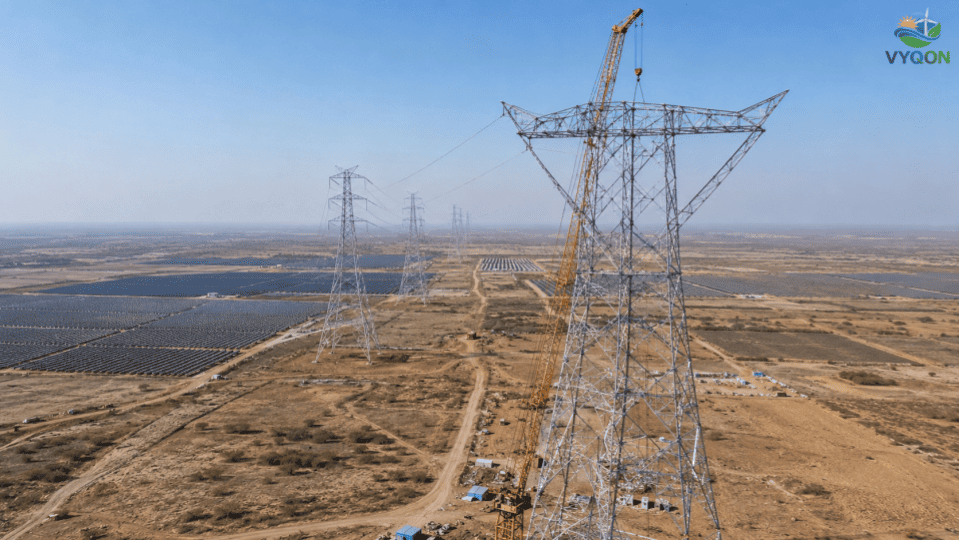
In February 2026, the National Committee on Transmission (NCT) recommended three interstate transmission schemes for Gujarat to facilitate the evacuation of 25.5 GW of renewable energy. The total capital outlay for these projects is estimated at ₹24,048 crore. The recommendations focus on infrastructure development in the Jam Khambhaliya, Jamnagar, and Lakadia geographic zones.
Financial and Regulatory Framework
The implementation of the recommended transmission schemes will proceed via the Tariff-Based Competitive Bidding (TBCB) mechanism. The Central Transmission Utility of India Limited (CTUIL) has been directed to initiate the TBCB processes for the following components:
- Scheme 1: Jam Khambhaliya REZ Phase II (5,500 MW) and Jamnagar Phase I (1,000 MW) – ₹7,688 crore.
- Scheme 2: Lakadia REZ Phase II (7,500 MW) – ₹7,506 crore.
- Scheme 3: Common Transmission System across the three zones – ₹8,854 crore. This component serves as the unifying infrastructure for the zones detailed in Schemes 1 and 2.
Technical Specifications and Capacity Allocation
The capacity figures for the newly identified components within the broader 25.5 GW evacuation plan are detailed below:
| Renewable Energy Zone (REZ) / Component | Capacity (MW) |
| Jam Khambhaliya REZ Phase II | 5,500 |
| Jamnagar Phase I | 1,000 |
| Lakadia REZ Phase II | 7,500 |
Note: The 14,000 MW listed represents the specific newly identified zone capacities contributing to the total 25.5 GW evacuation scheme.
Background Data and Deferral Analysis
The NCT has deferred transmission planning for Khavda REZ Phases VI and VII. This decision followed an assessment of confirmed off-take demand. While demand projections for green hydrogen and green ammonia were assumed to reach 9.25 GW by 2031, the NCT noted that only a single application of 0.575 GW from L&T at Kandla has been confirmed to date.
The NCT stated that transmission planning is increasingly tied to “real demand evidence” rather than “speculative industrial projections.” In its analysis, the committee identified a “circular challenge” for green hydrogen developers, who require transmission certainty to finalize investments, while transmission infrastructure is not authorized without confirmed demand.
These developments occur as the Ministry of New and Renewable Energy (MNRE) and the Ministry of Power (MoP) work toward the national target of 500 GW of renewable energy capacity by 2030.
Leave a Comment