Bridge Green Upcycle has inaugurated Tamil Nadu’s first dedicated lithium-ion battery recycling and upcycling plant in Gummidipoondi, near Chennai. The facility is designed to extract critical minerals from end-of-life batteries and manufacturing scrap, supporting a localized circular economy for the battery ecosystem. This launch signifies a strategic expansion of the “Battery Renaissance” and the “Battery Valley” ecosystem—initially centered in New York—into India’s industrial landscape. The facility provides an essential secondary source of raw materials, reducing reliance on resource-depleting mining and high-carbon manufacturing processes.
Operational Capacity and Feedstock Specification
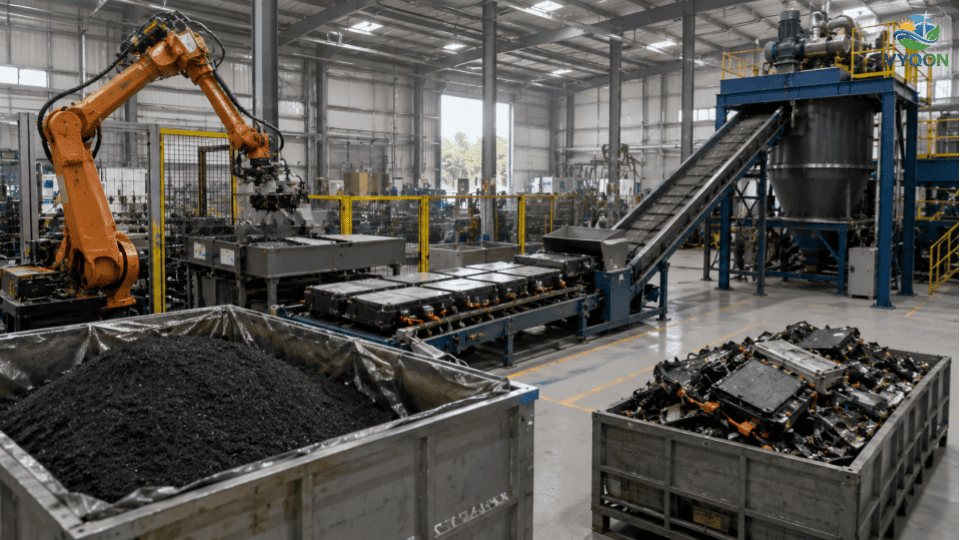
The facility operates at an industrial scale, designed to process high volumes of battery waste generated by the electric vehicle (EV), consumer electronics, and stationary energy storage sectors.
- Feedstock Diversity: The plant processes end-of-life lithium-ion batteries and manufacturing scrap.
- Chemistry Range: The facility is equipped to handle complex mixtures of cell chemistries, including Lithium Manganese Oxide (LMO), Lithium Nickel Manganese Cobalt Oxide (NMC), and Lithium Iron Phosphate (LFP).
- Scale of Operation: Supported by oversubscribed fundraising rounds and procurement of advanced equipment, the plant is positioned to ramp up production to meet the needs of the domestic supply chain.
Technical Process: The Infinity Lab Workflow
The plant utilizes the proprietary “Infinity Lab” upcycling process, which integrates advanced mechanochemistry with conventional hydrometallurgy. Moving beyond traditional “shred and bury” methods, the workflow follows a precise industrial sequence derived from cutting-edge research:
- Discharge: End-of-life batteries undergo a 24-hour salt bath to achieve full discharge, ensuring safety during mechanical handling.
- Mechanical Processing: Specialized shredders and hammer mills reduce materials to a uniform 2-millimeter size, facilitating the separation of steel casings, plastics, and foils.
- Primary Acid Leaching: A hydrometallurgical stage using sulfuric acid (H₂SO₄) and hydrogen peroxide (H₂O₂) to extract high-value transition metal ions (Li, Ni, Co, and Mn) from the black mass.
- Secondary Acid Leaching: A targeted leaching phase at higher acid concentrations (2.0 M) specifically designed to remove residual metallic impurities, such as aluminum and copper, that typically hinder direct reuse.
- Mild-Temperature Pyrolysis: An optimal thermal treatment at 800°C under a nitrogen (N₂) atmosphere. This stage is critical for the removal of polyvinylidene fluoride (PVDF) binders and the repair of structural defects in the recovered graphite.
The operation also features a proprietary digital technology stack. This AI-driven model monitors the state-of-health (SoH) and estimates the remaining useful life (RUL) of batteries, allowing the company to differentiate between units suitable for immediate upcycling and those viable for “second-life” refurbishment.
Critical Material Recovery and Purity Standards
The facility achieves a total recovery ratio of 91.0%, effectively addressing “critical gaps” in the industry—particularly in graphite recovery. While graphite is often overlooked in recycling due to impurity removal complexity, Bridge Green’s process achieves a graphite purity of 99.8%, matching battery-grade performance and significantly reducing the energy-intensive demand for virgin graphite production (which typically requires temperatures exceeding 2800°C).
| Recovered Material | Material Purity | Intended Applications |
| Lithium | ~99% | Battery manufacturing, industrial precursors |
| Cobalt | ~99% | Cathode precursors, specialized alloys |
| Nickel | ~99% | Cathode manufacturing, stainless steel production |
| Manganese | ~99% | Battery precursors, steel alloying |
| Copper | High-grade | Electrical wiring, pharmaceuticals, paints |
| Graphite | 99.8% | Battery anodes, industrial lubricants, carbon products |
Strategic Expansion and Second-Life Applications
Bridge Green Upcycle’s roadmap focuses on transitioning from the production of intermediate black mass to high-purity refined mineral salts and battery-grade precursor materials. For batteries that retain significant capacity, the company is developing second-life applications including:
- Energy Storage Systems (ESS): For industrial and residential use.
- Backup Power Solutions: Replacing traditional diesel generators.
- EV Charging Support: Grid-balancing and emergency power systems.
Funding, Partnerships, and Policy Alignment
The facility is a cornerstone of a cross-sector effort involving international investment and regional government support:
- Financial Backing: Supported by Launch NY’s Nonprofit Seed Fund and LP Fund II, including participation from NY Ventures (SSBCI-supported).
- Institutional Linkages: Active collaboration with the New Energy New York (NENY) coalition, the Koffman Southern Tier Incubator, and research faculty from Binghamton University.
- Government Alignment: The plant directly supports the Tamil Nadu Circular Economy Investment Policy 2026 and the Tamil Nadu Climate Change Mission.
- Global Regulatory Compliance: By establishing traceable, low-carbon material recovery, the facility helps regional manufacturers align with the EU Carbon Border Adjustment Mechanism (CBAM) and Digital Product Passport requirements.
- Policy Leadership: Vice President Ravindran R serves on the Recycling and Circular Economy Policy Team at Guidance Tamil Nadu, contributing to the state’s goal of becoming a $1-trillion economy by 2030 through forward-thinking sustainability frameworks.
Corporate Overview
Headquartered in Binghamton, New York, Bridge Green Upcycle maintains major operations in the United States and India. The company was founded by Chairman Balki Iyer, a Binghamton University alumnus and former GE renewable energy leader. The company’s mission is to bridge the gap between high-tech battery research and practical, scalable industrial solutions that complete the clean energy circle.
wat will be investment for this project in Coimbatore
Dear Sir,
Kindly email your inquiry at info@vyqon.in
Our team will take it from there.