
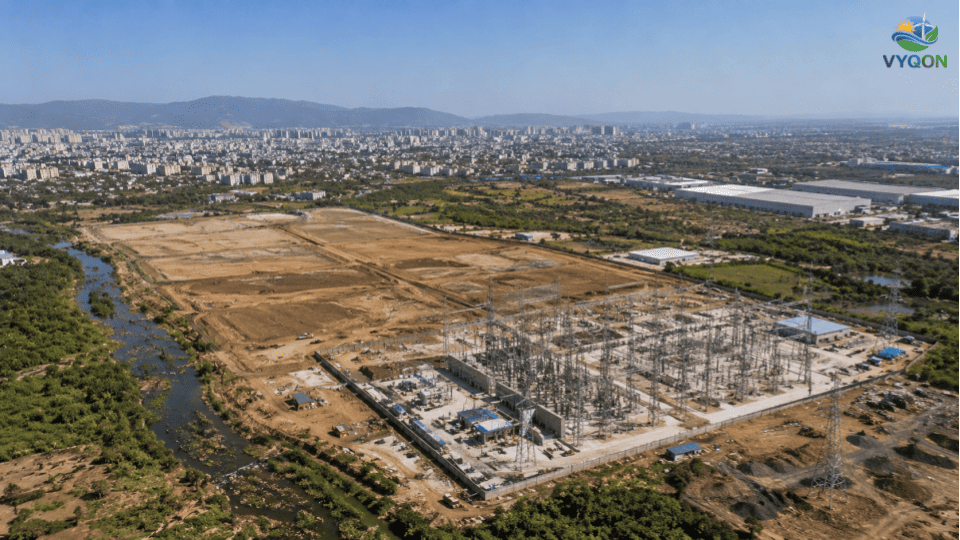
The Maharashtra Electricity Regulatory Commission (MERC) has granted formal approval for the development of a 400/220 kV Gas Insulated Switchgear (GIS) substation at Ambernath. This dedicated infrastructure is positioned as the primary grid interface for the “Green Integrated Data Centre Park” at Palava, a project involving a projected investment of ₹1.3 lakh crore. The ruling facilitates the high-capacity power connectivity required to meet an anticipated 3 GW demand in the Mumbai Metropolitan Region (MMR) by 2028.
The Core Regulatory Ruling and Technical Precedent
In its latest order, the Commission authorized the Maharashtra State Transmission Utility (STU) and the Maharashtra State Electricity Transmission Company Limited (MSETCL) to implement the Ambernath project through the Dedicated Distribution Facility (DDF) mechanism.
The selection of Gas Insulated Switchgear (GIS) technology was a deliberate technical requirement, chosen for its compact footprint and operational resilience. These attributes are considered critical for the land-constrained urban edges of the MMR and for meeting the stringent uptime requirements of Tier III and Tier IV data centre facilities. Beyond technical specifications, the ruling sets a significant regulatory precedent, providing a model that allows states to compete for large-scale digital investment by utilizing private capital to de-risk public grid expansion without distorting existing cross-subsidy structures.
The Catalyst: Addressing the Bidding Setback
The transition to a developer-funded DDF model followed the annulment of a Tariff-Based Competitive Bidding (TBCB) process in April 2026. The Commission noted that the discovered tariff in that process was “abnormally low” and “commercially unviable,” leading to the cancellation of the tender.
Following the setback, the STU argued that the DDF framework was the only viable path to provide the “regulatory clarity” needed to fast-track development. The utility maintained that further delays would “jeopardise” substantial investments scheduled to commence operations by 2028. By approving the DDF path, the regulator aimed to resolve a known infrastructure bottleneck while maintaining the targeted 2028 commissioning timeline.
The Financial Framework: Ring-Fencing and Asset Transfer
The approved framework utilizes a “Developer-Funded” model designed to protect the general body of transmission consumers. The Commission mandate includes the following operational and financial constraints:
- Capital Expenditure: Lodha Developers is responsible for 100% of the capital investment required for the substation and associated transmission infrastructure.
- Cost Ring-Fencing: Both capital costs and recurring operation and maintenance (O&M) expenses are strictly “ring-fenced.” This ensures that the infrastructure costs dedicated to the data centre park are not passed on to general retail consumers through electricity tariffs.
- O&M Reimbursement: The developer is required to reimburse all recurring O&M expenses to the state utility over the asset’s entire lifecycle.
- Asset Transfer Mandate: Under the mandated “Option 1” implementation path, Lodha Developers will construct the infrastructure under the technical supervision of MSETCL. Once completed, the assets will be transferred to the state utility free of cost, ensuring MSETCL retains full control of the grid interface.
Policy Drivers and Projected Demand
The strategic significance of the hub is reinforced by the “Green Integrated Data Centre Park Policy” of the Maharashtra government. This policy offers significant fiscal incentives to operators, which has contributed to the scale of the ₹1.3 lakh crore investment commitment.
The Ambernath substation is designed to handle a massive surge in power demand over the next two years:
- Current Grid Connectivity Granted: ~1,450 MW
- Demand Under Evaluation: ~1,500 MW
- Total Projected Load (by 2028): ~2,950 MW
Involved Stakeholders and Anchor Operators
The project involves a coordinated effort between state regulatory bodies, public utilities, and global technology leaders:
- Regulator: Maharashtra Electricity Regulatory Commission (MERC).
- Utilities: Maharashtra State Transmission Utility (STU) and Maharashtra State Electricity Transmission Company Limited (MSETCL).
- Developer: Lodha Developers.
- Anchor Operators: Amazon Web Services (AWS) and ST Telemedia Global Data Centres (STT), both of whom have already signed Memoranda of Understanding (MoUs) to occupy the hub.
Leave a Comment