
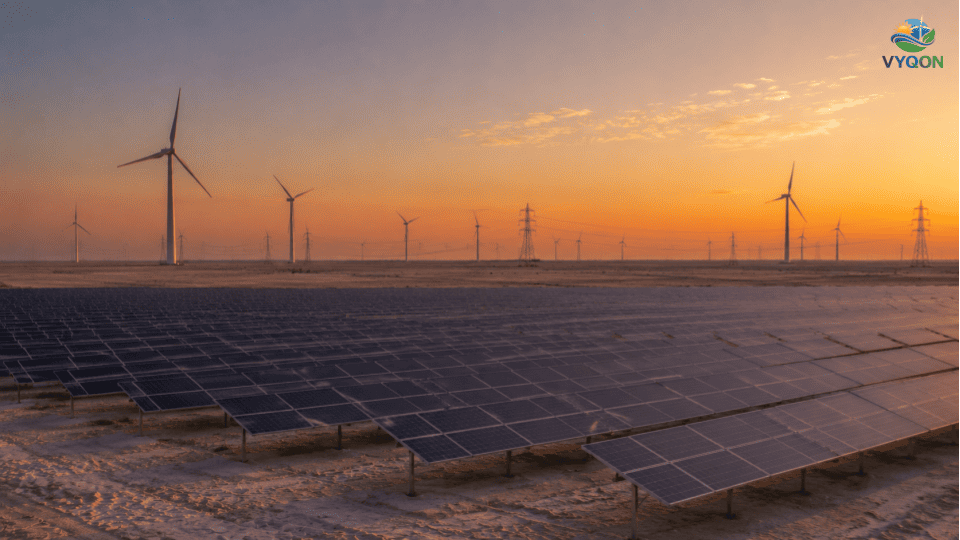
The Northern Regional Power Committee (NRPC) has concluded a technical review of the grid disturbance on May 13, 2026, which resulted in an 8,963 MW generation loss at the Khavda Renewable Energy (RE) complex. Characterized by GRID-INDIA as the “largest single-event outage in Indian grid history,” the event represents the culmination of a volatile period of instability following similar generation losses on April 13 (1,100 MW) and May 12 (1,500 MW). The primary findings identify widespread technical non-compliance regarding grid stability and ride-through capabilities among major developers, exposing a persistent pattern of failure that threatens regional grid reliability.
The May 13 Grid Disturbance: Parameters and Timeline
The sequence of disturbances began at 14:02 hrs, likely initiated by a fault on the 400 kV Indore-Asoj line. This initial fault triggered a voltage dip and low-frequency oscillations of 0.458 Hz within the complex between 14:02 and 14:06 hrs. The catastrophic generation loss occurred at 14:09 hrs following a subsequent voltage dip and the failure of RE plants to stabilize the system.
Technical parameters of the May 13 event include:
- Outage of Pooling Stations: Complete outage of KPS-1, KPS-2, and KPS-3, representing a total installed capacity of 15.9 GW (14.8 GW Variable Renewable Energy and 1.1 GW Battery Energy Storage Systems).
- Frequency Decline: The loss caused the grid frequency to plummet from 49.953 Hz to 49.398 Hz, a significant decline of 0.56 Hz.
- Transmission Impact: 17 Extra High Voltage (EHV) lines tripped within a 16-second window, including eight 765 kV lines and nine 400 kV lines.
The decline automatically triggered the Under Frequency Load Shedding (UFLS) Stage-1 at 49.40 Hz. However, the system achieved only 50% of the required relief.
| Metric | Power Quantity (Approximate) |
| Desired Relief Target | 12,000 MW |
| Actual Load Shed | 6,000 MW |
Technical Non-Compliance: Ride-Through Performance and Cited Entities
The scale of the outage was exacerbated by the failure of generating stations to adhere to Low Voltage Ride Through (LVRT) and High Voltage Ride Through (HVRT) standards. CEA Technical Standards mandate that plants remain connected during disturbances and restore 90% of pre-fault active power within one second of voltage restoration.
GRID-INDIA analysis revealed that instead of providing support, plants continued the continuous injection of reactive power following the voltage dip. This led to an over-voltage condition that triggered protection tripping via HVRT mechanisms, effectively disconnecting the plants when they were most needed for stability.
Cited Entities and Performance Gaps
A persistent pattern of non-compliance was observed across the spring 2026 disturbance window (April 13 and May 12 events), with the following entities cited by the NRLDC for failing to meet ride-through standards: Adani, Azure, ACME, NTPC, ReNew, SB Energy, Avaada, and AMP Energy.
For the May 13 Khavda event specifically, the NRPC has highlighted critical data gaps, noting that Adani Group, ACME Group, and Azure Power have failed to submit mandatory Root Cause Analysis (RCA) reports as directed.
Battery Energy Storage Systems (BESS) and IEGC 2023 Violations
The disturbance revealed a major failure in grid automation regarding BESS units. Under the Indian Electricity Grid Code (IEGC) 2023, BESS units operating in “charging mode” must disconnect automatically before the first stage of UFLS to provide immediate load relief.
Operational data confirmed that BESS units associated with the ACME and Juniper Green projects failed this automatic disconnection mandate. This failure of automatic load relief forced the grid to rely on manual intervention, a significant lapse in system reliability that contributed to the shortfall in the 12,000 MW relief target.
Directives and Remedial Actions from NRPC/NRLDC
The NRPC and NRLDC have issued mandatory directives for renewable developers, Original Equipment Manufacturers (OEMs), and Power Project Controller (PPC) suppliers to rectify systemic vulnerabilities:
- Granular Data Submission: Developers must submit inverter-level data with 1-millisecond resolution to allow for accurate technical forensics.
- Technical Capability Strengthening: Developers are required to coordinate with OEMs to build in-house technical capabilities for RCA, ending the current over-reliance on external suppliers.
- Mandatory GFM Deployment: To enhance system inertia, Grid Forming (GFM) inverters are now required in all new BESS projects (>50 MW) and must constitute at least 25% of the capacity in all new RE plants.
- Compliance Deadlines: Adani Group, ACME Group, and Azure Power must immediately submit all pending RCA reports for the May 13 disturbance.
Systemic Constraints: SCR and Grid Strength
Technical reviews highlight dangerously low system strength in the Khavda, Rajasthan, and Pachora RE complexes. Current grid health is characterized by:
- Short Circuit Ratio (SCR): Observed values range between 2 and 3, frequently dropping below 2 during contingencies. Critically, in planning scenarios for full RE integration, SCR is observed to approach unity levels (1.0), indicating an extremely fragile grid state.
- Low-Frequency Oscillations: Persistent 0.458 Hz oscillations were documented, attributed to low SCR and improper controller tuning at RE plants.
To address these constraints, the National Committee on Transmission (NCT) has ordered the expedited commissioning of Static Synchronous Compensators (STATCOMs) and Synchronous Condensers (SynCONs) to stabilize voltage profiles in these high-density renewable zones.
Official Sources and References
- Central Electricity Authority (CEA) – Minutes of the 41st Meeting of the National Committee on Transmission (NCT)
- Subject: Grid stability analysis, Khavda generation loss review, and mandate for Grid Forming (GFM) inverters.
- Official Website: cea.nic.in
- Southern Regional Power Committee (SRPC) – Minutes of the 238th Meeting of the Operation Coordination Sub-Committee (OCC)
- Subject: Review of regional grid disturbances, Under Frequency Load Shedding (UFLS) performance, and RE developer compliance.
- Official Website: srpc.kar.nic.in
- Central Electricity Authority (CEA) – Minutes of the 24th Meeting of the National Committee on Transmission (NCT)
- Subject: Analysis of renewable generation loss events in the Northern Region and technical standard non-compliance.
- Official Website: cea.nic.in
Leave a Comment