
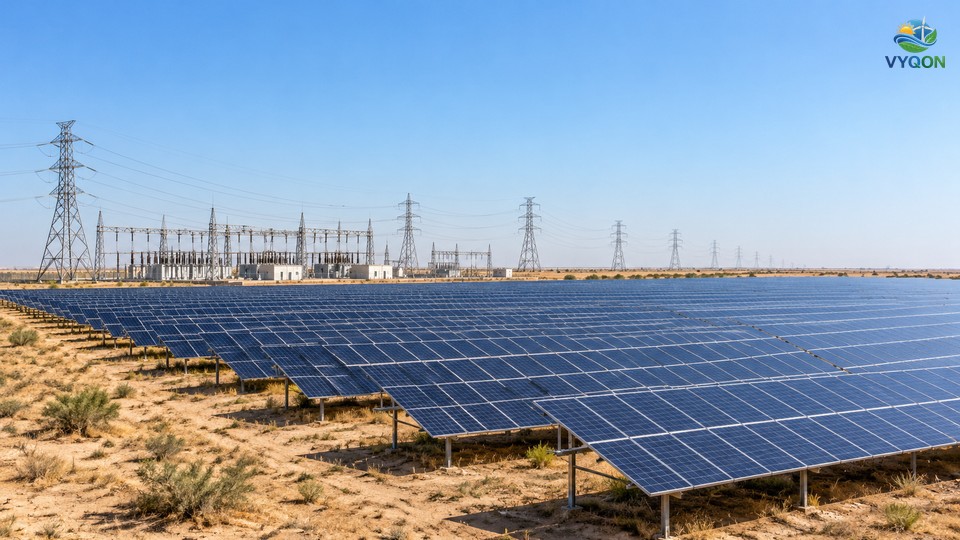
The Telangana Electricity Regulatory Commission (TGERC) on 29 October 2026 gave consent to the state’s two power distribution companies to buy 2,545 MW of solar power from NTPC, NHPC and the Solar Energy Corporation of India (SECI). It also approved the tariffs that the Central Electricity Regulatory Commission (CERC) had already adopted for these contracts. The order was passed in O.P. No. 21 of 2026 and I.A. No. 18 of 2026, filed by the Southern Power Distribution Company of Telangana Ltd. (TGSPDCL) and the Northern Power Distribution Company of Telangana Ltd. (TGNPDCL).
The capacity is made up of 1,045 MW from NTPC and NTPC REL, 500 MW from NHPC and 1,000 MW from SECI. The NTPC and NHPC capacity carries a usage charge of Rs 2.45 per kWh, while the SECI projects are priced at Rs 2.37-2.38 per kWh, with a separate trading margin of Rs 0.07 per kWh.
The three procurement routes
The NTPC share of 1,045 MW comes under the Central Public Sector Undertaking (CPSU) Scheme Phase-II, Tranche-III, under a Power Usage Agreement signed on 7 December 2021. It covers three 245 MW units, Nokh-I, Nokh-II and Nokh-III, at the Nokh Solar Park in Pokaran, Jaisalmer district, Rajasthan, and a 310 MW NTPC REL solar station at Khavda in Kutch, Gujarat. A supplementary agreement dated 17 March 2023 raised the usage charge in the contract from Rs 2.45 to Rs 2.57 per kWh after the GST rate on specified renewable energy devices was revised from 5% to 12%.
The 500 MW NHPC share is also under CPSU Scheme Phase-II, Tranche-III, with a Power Usage Agreement dated 28 March 2023. The plant is at Khavda, Taluka Bhuj, Kutch district, Gujarat, at Rs 2.45 per kWh.
The 1,000 MW SECI share is under ISTS Tranche-IX, through a Power Sale Agreement dated 17 February 2022. It is split among four developers: Ayana Renewable Power Three Private Limited (300 MW, Bikaner, Rajasthan, Rs 2.38 per kWh), Eden Renewable Energy Power Limited (300 MW, Barmer, Rajasthan, Rs 2.37), IB Vogt Solar Seven Private Limited (300 MW, Jaisalmer, Rajasthan, Rs 2.37) and AMP Energy Green Five Private Limited (100 MW, Jodhpur, Rajasthan, Rs 2.37). Each tariff is in addition to the Rs 0.07 per kWh trading margin.
How the approval was reached
TGERC had first given in-principle consent for the 2,545 MW on 26 October 2022 in O.P. No. 69 of 2022, and asked the distribution companies to return for tariff adoption once CERC had approved the tariffs. CERC adopted the Rs 2.45 per kWh usage charge for NTPC and NTPC REL’s 1,990 MW Tranche-III projects on 22 January 2025, and for NHPC’s 1,000 MW Tranche-III projects on 4 September 2024. The Telangana capacity is part of both. CERC orders of 8 March 2022 and 8 March 2023 cover the SECI 1,000 MW.
CERC left Change in Law relief for the GST revision to a separate proceeding, but allowed the compensation communicated by the Ministry of New and Renewable Energy to be charged on an interim, provisional basis. TGERC considers Rs 2.45 per kWh the applicable usage charge for the 1,045 MW. The interim compensation, which takes the tariff to Rs 2.57 per kWh, will be reconciled with CERC’s final order. TGERC directed that compensation be limited to the GST actually paid, as certified by an auditor.
Commissioning status
According to the distribution companies, as on 29 September 2026, 1,745 MW of the 2,545 MW had been commissioned and had started supplying power. The remaining 800 MW is under implementation, including the 500 MW NHPC project and 300 MW under SECI. The commission noted that the delays are mainly attributed to connectivity and transmission issues, for which extensions of commissioning dates have been granted.
TGERC added that responsibility for delays will be decided project by project and that developer-caused costs are not to be passed on to beneficiaries.
ISTS waiver and trading margin
The Ministry of Power had stipulated that the waiver of inter-state transmission system (ISTS) charges applies to eligible projects commissioned on or before 30 June 2025, and that where a competent authority extends the commissioning date because of force majeure or transmission delays, the waiver period is deemed extended. TGERC concluded that the waiver is likely to continue beyond 30 June 2025 only where an extension has been duly approved for the reasons set out in the ministry’s orders.
On the trading margin, TGERC held that Rs 0.07 per kWh is prescribed under the Ministry of Power’s tariff-based competitive bidding framework and applies to SECI as an intermediary procurer. The distribution companies said no trading margin applies to the NTPC and NHPC usage agreements.
Directions to the distribution companies
The distribution companies must pursue, through NTPC, NHPC and SECI, the continuation of the ISTS waiver for projects commissioned after 30 June 2025. They must file CERC’s final Change in Law order for the 1,045 MW within 30 days of its issue, and must not claim ISTS charges and losses from developer-caused delays as part of the power purchase cost.
What it means for India’s clean-energy sector
The order closes a regulatory step that stayed open for years after the agreements were signed in 2021-2023, and gives the contracts a clear tariff basis. It also shows how connectivity delays, GST changes and the ISTS waiver cut-off can shape the cost of centrally procured solar power for a buying state.
Leave a Comment