
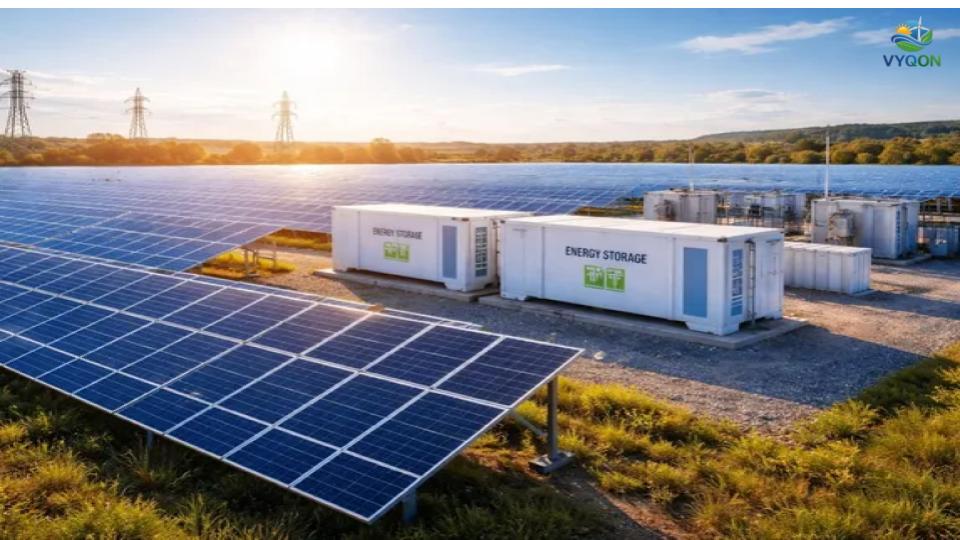
The Uttar Pradesh New & Renewable Energy Development Agency (UPNEDA) has issued Tender Bid No: 01/UPNEDA/Off Grid Solar Power Plant (1kW-75kW)/2026-27 for the deployment of decentralized, off-grid solar infrastructure. The tender invites competitive bids for the supply, installation, testing, and commissioning—along with five years of comprehensive warranty and maintenance—of 1 kW to 75 kW off-grid solar power plants.
Operating under the Capital Expenditure (CAPEX) model, the initiative targets a cumulative capacity of 2.5 MW across government buildings in Uttar Pradesh, with an estimated project value of ₹24.26 crore (inclusive of GST). By integrating high-performance lithium ferro phosphate (LiFePO4) battery storage and intelligent hybrid inverters, the state aims to establish autonomous, clean backup power for administrative offices, ending dependence on diesel generation during outages.
Key Project Highlights and Category Breakdown
The 2.5 MW cumulative capacity is divided into three distinct project categories to accommodate diverse structural and administrative needs across state facilities:
| Category | System Capacity Range | Tendered Quantity | Required EMD (BG) | Required Past Experience | Min. Average Annual Turnover (ATO) |
| Category A | 1 kW to 10 kW | 1,000 kW (1 MW) | ₹20.29 Lakh | 300 kW | ₹3.04 Crore |
| Category B | 11 kW to 50 kW | 1,000 kW (1 MW) | ₹18.95 Lakh | 300 kW | ₹2.84 Crore |
| Category C | 51 kW to 75 kW | 500 kW (0.5 MW) | ₹9.28 Lakh | 150 kW | ₹1.39 Crore |
- Total Cumulative Capacity: 2.5 MW (2,500 kW) across government buildings.
- Total Estimated Project Cost: ₹24.26 Crore (including GST).
- Contract Model: Rate Contract on Turnkey CAPEX mode, valid for 12 months with a provision for a 6-month extension.
- Execution Timeline: Complete execution and commissioning within 4 months from the date of each work order issuance.
- Tender Document Fee: ₹11,800 (inclusive of GST, non-refundable).
- Performance Security: 5% of the total Work Order value submitted as a Bank Guarantee valid for 18 months.
Technical Architecture: Advanced LiFePO4 Storage & Hybrid Inverters
UPNEDA has established strict technical standards to ensure plant reliability and performance:
- Lithium Ferro Phosphate (LiFePO4) Storage: The tender mandates prismatic LiFePO4 cells with a minimum cell rating of 3.2V 40Ah. Battery sizing is specified at 3,840 Wh per kW of installed solar capacity (e.g., 3.84 kWh for a 1 kW plant, 38.4 kWh for a 10 kW plant, up to 288 kWh for a 75 kW system). The battery pack must offer $\ge 90\%$ Depth of Discharge (DoD), deliver more than 3,000 cycles at 90% DoD before capacity drops below 75%, operate within a temperature range of 0°C to 55°C, and carry a minimum 7-year warranty.
- Battery Management System (BMS): The battery packs must feature an integrated BMS capable of real-time cell balancing, thermal monitoring, State of Charge (SOC), and State of Health (SOH) tracking, communicating seamlessly with the inverter via standard RS485 or CAN bus protocols.
- Hybrid Inverters / PCUs: Inverters must feature integrated Maximum Power Point Tracking (MPPT) with intentional islanding capabilities. The rated inverter kW capacity must equal the installed solar plant capacity. Inverter efficiency must be $\ge 92\%$ at 10% loading and $\ge 95\%$ across 25% to 100% loading conditions (tested under IS/IEC 61683). Inverters must be capable of exporting surplus generation to the grid when available and islanding to supply 3 hours of full-load backup from the battery during grid outages.
- Remote Monitoring Systems (RMS): Every installation must include a GPRS-based Remote Monitoring System logging generation and storage metrics on a minute-by-minute basis, accessible centrally by UPNEDA and integrated with the state’s RESIMS portal.
PV Module Standards & Domestic Content Mandates
To support domestic manufacturing and durability, solar PV modules must comply with the following parameters:
- Make in India & ALMM Compliance: Both the solar cells and modules must be manufactured in India and listed under the MNRE Approved List of Models and Manufacturers (ALMM).
- Efficiency and Ratings: Solar modules must be crystalline technology with a nominal rating of no less than 500 Wp per module, a module efficiency $\ge 19.5\%$, and a fill factor $\ge 70\%$.
- Certifications: Modules must be certified under IEC 61215 / IS 14286 (Design Qualification), IEC 61730 Parts 1 & 2 (Safety), IEC 61701 (Salt Mist Corrosion), and IEC 62716 (Ammonia Corrosion).
- Warranty: 25-year performance warranty guaranteeing $\ge 90\%$ power output at the end of year 10 and $\ge 80\%$ at the end of year 25.
Eligibility Criteria and Commercial Allocation Framework
To qualify for bidding, vendors and joint ventures (maximum two members allowed) must meet defined experience and financial criteria:
- Past Experience: Bidders must have successfully supplied, installed, and commissioned off-grid solar plants with battery backup for Central/State Government entities or public/private corporations within the last five financial years (FY 2021-22 to FY 2025-26). Required capacity is 300 kW each for Categories A & B, and 150 kW for Category C (cumulative if applying for multiple categories).
- Financial Turnover: Overall Average Annual Turnover in the best 3 of the last 5 financial years must meet the threshold for each category (₹3.04 Cr for A, ₹2.84 Cr for B, ₹1.39 Cr for C). The net worth of the bidder (and all JV partners) must be positive as of the end of the preceding financial year.
- MSME Benefits: Micro and Small Enterprises (MSEs) registered with manufacturing units in Uttar Pradesh are eligible for 100% EMD exemption upon submitting a Bid Security Declaration. Additionally, up to 25% of the total order capacity may be allocated to qualified MSE firms agreeing to the lowest approved L1 rate.
- Empanelment & Allocation Strategy: The L1 bidder will be awarded 50% of the total tendered capacity, with the remaining volume distributed among other empanelled bidders willing to match the L1 price within a 25% price band. Work will be assigned across districts/divisions in a phased manner.
Payment Milestones & 5-Year Maintenance Terms
The tender outlines a structured payment and maintenance framework to safeguard long-term system health:
- Initial Disbursement (85%): Released following supply, installation, testing, commissioning, and submission of the Joint Commissioning Certificate countersigned by the designated district officer and end-user.
- Security Deposit / Comprehensive AMC (15%): Retained for the 5-year Comprehensive Maintenance period. It will be released in yearly installments of 3% upon verification of quarterly generation data on the RESIMS portal and submission of satisfactory maintenance reports.
- Service Response Mandate: Contractors must set up service centers in allotted districts. Any downtime or breakdown must be resolved within 7 days of complaint registration.
Reference
- Uttar Pradesh New and Renewable Energy Development Agency (UPNEDA) The nodal executing agency under the Department of Additional Sources of Energy, Government of Uttar Pradesh, overseeing the issuance and execution of this off-grid solar tender.https://upneda.org.in/
- Government of Uttar Pradesh e-Procurement Portal (e-Tender UP) The official state portal where the bidding document is published and online submissions are processed.
- Tender Portal: https://etender.up.nic.in/
- Tender Reference:
01/UPNEDA/Off Grid Solar Power Plant (1kW-75kW)/2026-27
- Ministry of New & Renewable Energy (MNRE) The central ministry formulating quality guidelines, Approved List of Models and Manufacturers (ALMM), and off-grid solar component standards across India.
- Official Website: https://mnre.gov.in/
- Bureau of Indian Standards (BIS) The national standards body providing testing codes (IS 14286, IS 16221, IS 3043) and component safety compliance for solar inverters and battery systems.
- Official Website: https://bis.gov.in/
Leave a Comment