
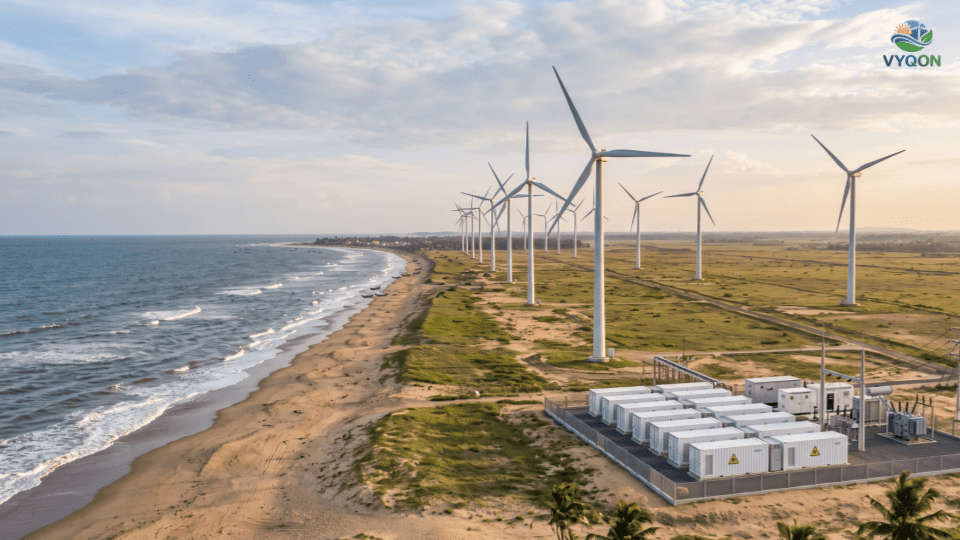
India installed 1,757.68 MW of wind power capacity during July–September 2026, the third quarter of calendar year 2026, according to installation data published by the Ministry of New and Renewable Energy (MNRE). The addition is about 30% higher than the 1,348.55 MW commissioned in April–June 2026 and takes the country’s cumulative installed wind capacity to 59,201.07 MW as on 30 September 2026, up from 57,443.39 MW at the end of June.
Month-wise Trend in the Quarter
Additions were uneven across the three months. Around 693.50 MW was commissioned in July, followed by a sharp slowdown to 383.43 MW in August, before activity recovered to 680.75 MW in September. With these installations, wind additions in the first half of FY 2026-27 (April–September 2026) reached 3,106.23 MW.
In September alone, wind accounted for 680.75 MW, or about 18%, of the 3,692.16 MW of renewable energy capacity added nationwide, while solar contributed 3,011.41 MW.
Wind’s Position in India’s Clean Energy Mix
As on 30 September 2026, India’s total installed renewable energy capacity, including large hydro, stood at 299.25 GW, and total non-fossil capacity, including nuclear, reached 308.03 GW. At 59.20 GW, wind makes up nearly one-fifth of the renewable energy base and remains the second-largest renewable source after solar, which has reached 171.05 GW.
MNRE has highlighted that nearly 45% of wind generation occurs during peak demand hours, allowing it to complement solar output in the evening and at night. Wind projects generated 106 billion units of electricity in FY 2025-26, compared with 83 billion units in each of the two preceding years, as per data placed before Parliament.
State-wise Landscape
Wind capacity remains concentrated in a handful of resource-rich states. According to MNRE’s reply in the Lok Sabha in July 2026, Gujarat led with 16,086 MW of installed wind capacity as on 30 June 2026, followed by Tamil Nadu (12,273 MW), Karnataka (8,896 MW), Maharashtra (6,318 MW), Rajasthan (5,516 MW) and Andhra Pradesh (4,461 MW). Gujarat also recorded the highest wind generation in FY 2025-26 at 33,706 million units (MU), ahead of Tamil Nadu (24,200 MU) and Karnataka (18,804 MU).
The resource base is similarly concentrated: at 150 metres above ground level, Rajasthan holds the largest assessed potential at 284.2 GW, followed by Gujarat (180.8 GW) and Maharashtra (173.9 GW). The Ministry has identified Madhya Pradesh, Telangana and Odisha as new geographies for wind expansion, while offshore leasing areas are being taken up off the coasts of Gujarat and Tamil Nadu.
Building on a Record Year
The latest quarter follows India’s strongest-ever year for wind installations. The country added 6,057 MW in FY 2025-26, compared with 4,151 MW in FY 2024-25 and 3,253 MW in FY 2023-24. According to MNRE, about 28 GW of wind capacity is currently under implementation, and domestic turbine manufacturing capacity has grown to around 24 GW per year, with 70–80% indigenisation of key components.
Speaking at the EU-India Wind Energy Business Summit at WindEnergy Hamburg in September 2026, MNRE Joint Secretary Rajesh Kulhari stated that India is on track to add 7.5–8 GW of wind capacity in FY 2026-27. With 3.11 GW achieved in the first six months, the sector would need to commission roughly 4.4–4.9 GW between October 2026 and March 2027 to reach that range.
Policy Support and Execution Challenges
The government has set targets of 100 GW of wind capacity by 2030 and 156 GW by 2036, against an estimated onshore potential of 1,163.9 GW at 150 metres above ground level. Reaching the 2030 target will require close to 41 GW of additional capacity over the next few years.
Support measures listed by the Ministry include a dedicated wind component within the Renewable Purchase Obligation framework, enforcement of Late Payment Surcharge rules, transparent bidding guidelines, a 500 MW Contracts for Difference pilot aimed at providing revenue certainty, and Viability Gap Funding of ₹6,853 crore for 1,000 MW of offshore wind projects split equally between Gujarat and Tamil Nadu. In addition, ₹500 crore was disbursed under the Generation Based Incentive scheme in 2025-26. The Green Energy Corridor scheme and the Green Energy Open Access Rules are further supporting power evacuation and direct procurement of wind energy by industry.
Execution, however, remains closely linked to grid readiness. MNRE has acknowledged that transmission delays, curtailment and Deviation Settlement Mechanism (DSM) penalties are among the issues requiring solutions. A dedicated Task Force constituted in January 2026 is examining the regulatory, land, transmission and implementation challenges faced by the sector. The Ministry’s stated priorities also include integrating wind into round-the-clock renewable supply with storage, modernising the grid and deploying AI-based forecasting to manage variability. Timely commissioning of evacuation infrastructure in high-wind zones will be central to sustaining the current pace of additions.
Outlook
The 30% quarter-on-quarter growth in July–September 2026 indicates that the wind pipeline is moving steadily towards commissioning after a slower April–June period. Performance over the remaining half of FY 2026-27 will determine whether the sector surpasses last year’s record of 6,057 MW. Continued progress on transmission, land availability and hybrid and round-the-clock project models will be key to taking India’s wind capacity past 100 GW by 2030.
Official Sources
- Ministry of New and Renewable Energy – Physical Achievements (Installed RE Capacity as on 30.09.2026): https://mnre.gov.in/en/physical-progress/
- Ministry of New and Renewable Energy – Physical Achievements Archive (monthly installed capacity data): https://mnre.gov.in/en/archive/
- Ministry of New and Renewable Energy – Year-wise Achievements: https://mnre.gov.in/en/year-wise-achievement/
- Press Information Bureau – India Records Historic Growth in Wind Energy with 6.1 GW Addition in 2025–26 (22 April 2026): https://www.pib.gov.in/PressReleasePage.aspx?PRID=2254626
- Press Information Bureau – Global Wind Day 2026 Factsheet: https://pib.gov.in/FactsheetDetails.aspx?Id=150630
- Lok Sabha – Questions and Answers (MNRE reply on installed wind capacity, July 2026 session): https://sansad.in/ls/questions/questions-and-answers
Leave a Comment