
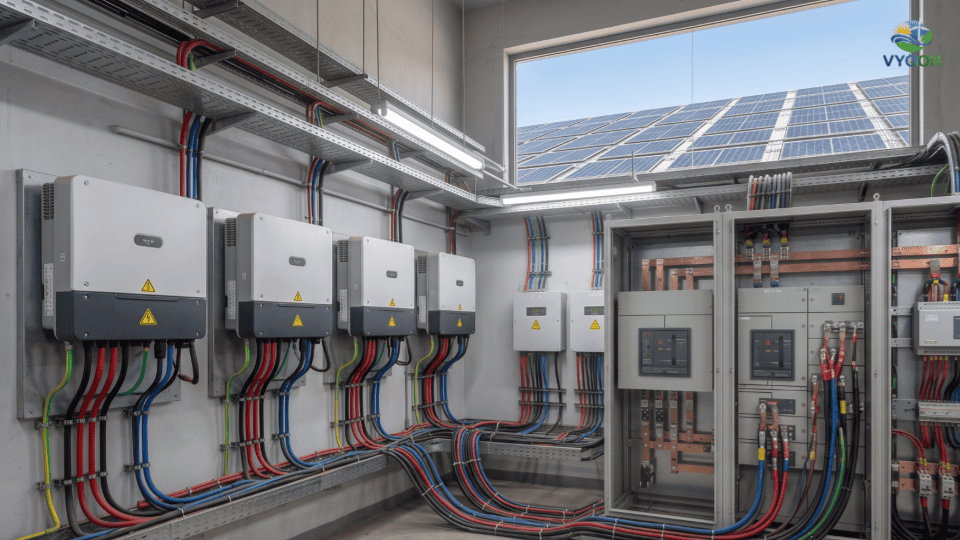
The Andhra Pradesh Electricity Regulatory Commission (APERC) issued practice directions dated August 19, 2026, and an order dated August 5, 2026, to clarify the regulatory requirements for behind-the-meter (BTM) rooftop solar installations. Impacting captive users, third-party developers, and state distribution companies (DISCOMs), the rulings establish that BTM captive plants require no prior DISCOM approval or feasibility studies. Furthermore, the Commission confirmed that these systems are exempt from specific surcharges, including those utilizing third-party financing models.
Key Highlights of the Commission’s Ruling
- Approval Exemptions: Removal of the requirement for prior DISCOM permission, feasibility approval, or line clearance for BTM installations.
- Information Sharing: Mandatory requirement for prior intimation to DISCOMs and submission of technical data before plant synchronization.
- Grid Safety: Strict “zero grid injection” requirement for all BTM systems to ensure no power enters the utility network.
- Operational Configurations: Allowability of multiple internal interconnections and inverter setups tailored to consumer load requirements.
- Surcharge Waivers: Explicit exemption from Cross-Subsidy Surcharge (CSS) and Additional Surcharge (AS) for BTM systems, including third-party financed projects.
- Residential Capacity Increase: Single-phase Low Tension (LT) consumer capacity limits raised from 3 kW to 5 kW, matching sanctioned loads.
Detailed Breakdown of Regulatory Clarifications
1. Exemption from Prior DISCOM Approval for BTM Captive Use The Commission clarified that internal electrical networks situated downstream of the billing meter are classified as private installations under Section 9(1) of the Electricity Act, 2003. Consequently, consumers are not required to obtain feasibility approval, line clearance, or prior DISCOM permission for connecting captive solar plants to internal bus bars. These directions were issued to address specific concerns raised by APEPDCL regarding protection coordination and potential revenue losses associated with BTM installations.
While prior approval is removed, the Commission has instituted a mandatory requirement for “prior intimation” to the DISCOM before synchronization or off-grid islanding. This intimation must include technical data, such as installed capacity and single-line diagrams, to assist in grid planning. Failure to comply with this notification requirement may result in penalties under Sections 142 and 146 of the Electricity Act, 2003.
2. Technical Requirements and Multiple Interconnections Under the new practice directions, consumers are permitted to utilize multiple internal interconnections and inverter setups based on their specific engineering and load requirements. Any dedicated lines connecting captive generating plants must comply with the safety and technical standards of Section 54 of the Electricity Act, 2003. These operational configurations are contingent upon the following technical conditions:
- Data Integration: Data from all installed inverters must be integrated and transmitted to the DISCOMs or the State Load Despatch Centre (SLDC) as required.
- Zero Injection Mandate: Systems must be designed to ensure zero power injection into the grid at all times. This requirement remains in effect regardless of whether the grid is live or switched off.
3. Surcharge Exemptions and Third-Party Financing APERC ruled that BTM Solar Rooftop Photovoltaic (SRTPV) installations are exempt from Cross-Subsidy Surcharge (CSS) and Additional Surcharge (AS). The Commission clarified that these exemptions extend to projects developed via third-party investment or external financing models under Regulation 4 of 2023.
A sharp distinction remains between these exempted surcharges and other regulated costs; while exempt from CSS and AS, consumers remain liable for applicable regulated capacity charges and standard tariff charges determined by the Commission. DISCOMs retain the right to seek specific service charges in future Retail Supply Tariff filings, provided they provide appropriate justification for such costs.
4. Revised Capacity Limits for Single-Phase Connections
In an order dated August 5, 2026, the Commission addressed inconsistencies between state Retail Supply Tariff rules and Regulation No. 4 of 2023. Previously, Clause 5.7 of the 2023 regulation restricted single-phase solar installations to 3 kW, even if the consumer’s sanctioned load was higher.
Exercising its “Removal of Difficulty” powers, the Commission now allows single-phase LT consumers to install systems up to 5 kW, matching their sanctioned load. This adjustment supports the implementation of the PM Surya Ghar: Muft Bijli Yojana, as several applicants with 5 kW loads had previously faced rejections due to the 3 kW cap.
Grandfathering of Existing Large-Scale Projects
The Commission provided clarity regarding existing SRTPV projects with capacities between 500 kWp and 1000 kWp. While Regulation No. 4 of 2023 introduced a 500 kWp eligibility cap for net metering for new projects, existing installations are protected by a grandfathering provision under Clause 22 of APERC Regulation No. 4 of 2023.
Projects commissioned or under construction (with approved feasibility reports) prior to the implementation of the 2023 regulation will continue to receive net/gross metering benefits as per their original agreements. These arrangements will remain valid for the duration of the projects’ contractual tenures.
The revised regulatory framework and practice directions became effective following the issuance of orders on August 5, 2026, and August 19, 2026. APERC has directed APEPDCL, APSPDCL, APCPDCL, APTransco, and NREDCAP to ensure the uniform implementation of these provisions across the state. The Commission stated that these measures aim to simplify the administrative process for distributed renewable energy while maintaining grid safety through mandatory technical information sharing.
Official Regulatory Sources & References
- Andhra Pradesh Electricity Regulatory Commission (APERC)
- Official Regulations & Code Amendments
- State Utilities & Distribution Companies (DISCOMs)
- State Renewable Energy Nodal Agency
Leave a Comment