
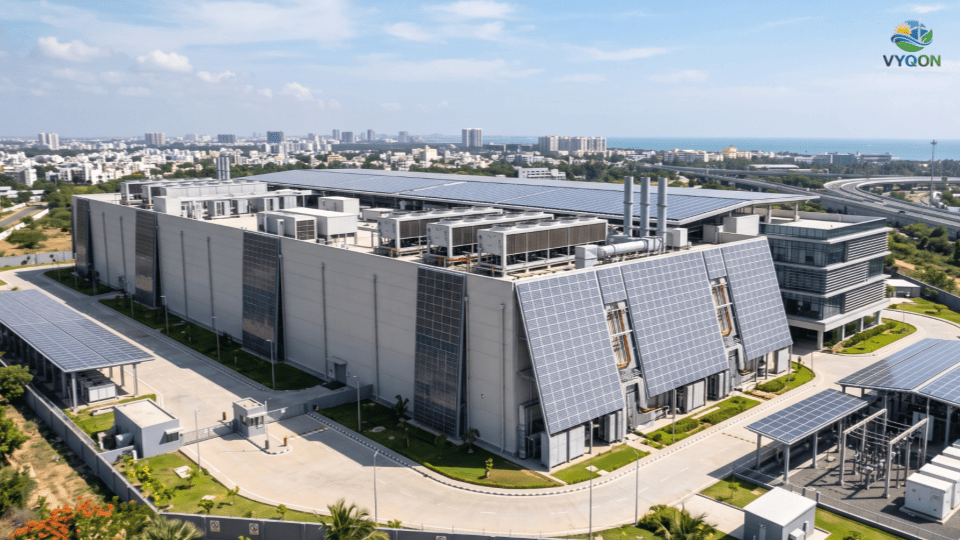
Commissioned by CtrlS Datacenters, the Chennai hyperscale campus leverages one of India’s largest vertical solar integrations to date. The infrastructure features a 974 kW Building-Integrated Photovoltaic (BIPV) system designed specifically to offset high-intensity operational power costs. Located in the Ambattur industrial area, the installation is projected to generate approximately 700,000 kilowatt-hours (kWh) of clean electricity annually.
Project Details & Technical Specifications
The facility leverages Building-Integrated Photovoltaics (BIPV), a technology where solar modules function as both a power generator and the primary building envelope material. This distinguishes the project from traditional Building Applied Photovoltaics (BAPV), which are mounted onto existing structures. In this installation, the solar components replace conventional cladding to provide structural support and weather protection.
The execution, handled by U-Solar Clean Energy Solutions, consists of 1,848 bifacial solar panels integrated directly into the building’s façade. These bifacial modules are utilized to capture reflected light from the building’s environment, maximizing energy yield on vertical surfaces where traditional panels typically underperform. The project serves as a key sustainability feature for the CtrlS facility located within Chennai’s strategic Ambattur industrial hub.
Energy & Operational Impact
Hyperscale data centers require round-the-clock electricity to maintain computing infrastructure and critical cooling systems. The BIPV system supplements grid consumption, directly reducing the costs associated with the facility’s high-intensity power demand. By generating power at the point of consumption, the system enhances the facility’s overall energy independence.
The infrastructure maintains a Power Usage Effectiveness (PUE) metric of 1.35, supported by the efficient integration of renewable energy. Because of the data center’s constant 24/7 computing and cooling loads, the system achieves a 100% self-consumption rate. This high utilization rate is a direct result of the facility’s load profile, ensuring that every kilowatt-hour generated on-site is immediately utilized.
Facility Context and Sustainability Standards
The Chennai data center park is designed as a hyperscale campus with a total IT load capacity of 72MW across two primary buildings, DC1 and DC2. To manage these substantial power requirements, the site features a state-of-the-art 230kV on-campus gas-insulated substation (GIS). The project is currently pursuing LEED Platinum certification, aligning its power generation with international sustainability standards.
Resilient engineering is a core component of the facility’s design to ensure operational continuity. The campus is positioned 14 meters above sea level for flood-proofing, with the buildings further elevated by 2.2 meters to mitigate environmental risks. Additionally, the structure is earthquake-resistant and designed to withstand seismic activity up to a magnitude of 7.5 on the Richter scale.
Operational rollout for the campus is scheduled across 2024, with the first building, Chennai DC 1, slated to begin operations in the second quarter. The second building, Chennai DC 2, is an 11-story structure with a 27MW IT load capacity expected to launch in the second half of the year. This integration of BIPV technology marks a significant shift in infrastructure design within the expanding Indian data center market.
Official Government Scientific & Standards Source
- Source: National Institute of Standards and Technology (NIST)
- Document: Measured Performance of Building Integrated Photovoltaic Panels
- Authors: A. Hunter Fanney, Brian P. Dougherty, and Mark W. Davis (Building and Fire Research Laboratory, Heat Transfer and Alternative Energy Systems Group)
- Publication: Transactions of the ASME, Journal of Solar Energy Engineering, Vol. 123, No. 2, pp. 187-193.
Official Project Owner & Developer Source
- Source: CtrlS Datacenters Ltd. (Operator of the Chennai Hyperscale Data Center)
- Document: Era of Green Datacenters: Balancing High Density Operations with Sustainability
- Author: Rishik Teepireddy (Vice President – Renewable Energy, CtrlS Datacenters)
- Corporate Portal: CtrlS Datacenters Official Site
Peer-Reviewed Academic Source
- Source: International Journal of Engineering & Scientific Research (IJESR)
- Document: Sustainable Development of Building Integrated Photovoltaic Facade Technology
- Authors: Dr. M.V. Molykutty (Professor & Dean, School of Infrastructure, B.S. Abdur Rahman University) and E. Prasanna
- Publication Details: ISSN: 2347-6532, Volume 3, Issue 5.
Leave a Comment