
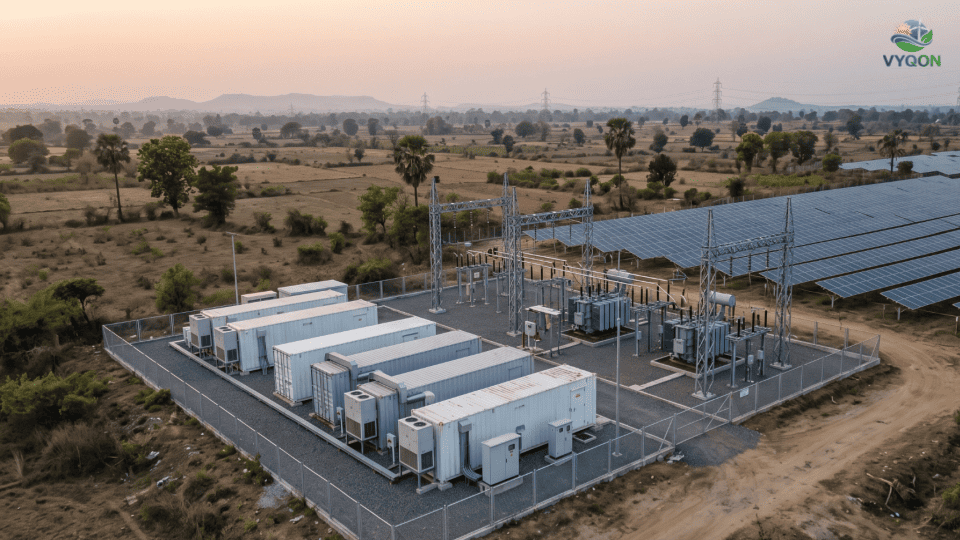
On September 22, 2026, the Chhattisgarh State Electricity Regulatory Commission (CSERC) issued Notification No. D-29/CSERC/2026, publishing the Draft Chhattisgarh State Electricity Regulatory Commission (Grid Interactive Distributed Renewable Energy Sources) (Third Amendment) Regulations, 2026. Under the proposed framework, CSERC mandates that all new distributed renewable energy projects with an installed capacity exceeding 5 MW (excluding hydro) achieving Commercial Operation Date (COD) on or after April 1, 2027, must co-locate a Battery Energy Storage System (BESS) equivalent to at least 5% of project capacity with a minimum storage duration of two hours. The regulatory intervention is explicitly designed to address mounting grid operational challenges, including severe solar-hour over-generation, thermal power plant backing down, grid frequency destabilization, and high evening peak power procurement costs for distribution licensees. Stakeholders, including independent power producers (IPPs), commercial and industrial (C&I) consumers, and distribution discoms, have been invited to submit written comments, objections, and suggestions by October 13, 2026.
CSERC’s state-level mandate mirrors a broader national regulatory push toward grid-scale energy storage integration. On September 3, 2026, the Central Electricity Authority (CEA) issued draft technical standards proposing a 10% BESS requirement (two-hour duration) for ground-mounted solar and onshore wind projects commissioned after July 1, 2027. However, CSERC’s draft specifically targets distributed generation, combining technical storage requirements with structural changes to open access charges, power banking, and Behind-the-Meter (BTM) configurations.
Battery Energy Storage System (BESS) Mandatory Technical Framework
Regulation 18.2(b) of the proposed draft outlines mandatory technical and capacity specifications for battery storage integration across upcoming Integrated Distributed Renewable Energy Sources (IDRES):
- Baseline Storage Mandate: All new IDRES projects exceeding 5 MW capacity (excluding hydro) achieving COD on or after April 1, 2027, whether co-located or distantly located from load, seeking connectivity with the licensee’s network or any state network, “are mandated to install BESS (of at least 2 hours storage) for a minimum of 5% of the RE capacity.”
- Captive Generating Plant Scale-Up: For renewable captive generating plants achieving COD on or after April 1, 2027, whose capacity exceeds 100% of their Contracted Demand (CD), CSERC mandates an additional storage tier. Developers “shall be required to install BESS for a minimum 20% of the additional capacity (of at least 2 hours storage) i.e., capacity beyond the 100% of the contract demand, in addition to the capacity of BESS as per above provision.”
- Existing Plants and System Expansions: Under Regulation 18.1, existing operational IDRES projects may install co-located BESS, which will be treated as a separate project governed by the regulations active at its own COD. Under Regulation 18.2(a), plant expansions connected to existing operational projects will be classified as distinct separate projects and will not inherit legacy regulatory benefits.
Behind-the-Meter (BTM) and Prosumer Peak Injection Framework
To prevent unmonitored power flows and incentivize peak-hour supply, the draft introduces specific restrictions and commercial mechanisms for prosumers and BTM systems:
- Prohibition of Simultaneous Operation: Regulation 18.2(c) explicitly stipulates that simultaneous operation of Prosumer Distributed Renewable Energy Sources (PDRES) and grid-connected Behind-the-Meter (BTM) solar PV projects is not permitted.
- BTM Power Banking Restrictions: Under Regulation 18.2(d), power banking with the distribution licensee is strictly prohibited for grid-connected BTM solar PV projects. However, power generated from distantly located IDRES can be banked either with the licensee or routed to a BESS installed at the consumer’s premises.
- Evening Peak Power Procurement Incentive: Under Regulation 16(xiv), electricity injected into the grid by a prosumer from its PDRES during evening peak hours (19:00 to 24:00 hrs) will be procured by the local distribution licensee at an incentivized feed-in rate of Rs 8.00 per kWh, settled within each monthly billing cycle.
Regulation 21.13: Seven-Year Open Access Waivers and Monthly Banking Restructuring
Regulation 21.13 introduces a commercial restructuring for IDRES projects exceeding 5 MW commissioned on or after April 1, 2027. CSERC combines long-term open access fee waivers with restrictive power banking terms, marking a shift from the Second Amendment Regulations, 2023 (Notification No. 106/CSERC/2023), which allowed annual banking cycles (financial year) with a 2% banking fee.
Seven-Year Open Access Charge Waivers
To offset initial capital expenditure on battery storage, CSERC proposes a 100% waiver (Nil charge) for the first 7 years post-commissioning across four primary open access categories:
- Transmission Charges: Set to Nil for the first 7 years from COD; thereafter levied as per the prevailing tariff order.
- Wheeling Charges: Set to Nil for the first 7 years from COD; thereafter levied as per the prevailing tariff order.
- Cross Subsidy Surcharges: Set to Nil for the first 7 years from COD; thereafter levied as per the prevailing tariff order.
- SLDC Fees and Charges: Set to Nil for the first 7 years from COD; thereafter levied as per the prevailing tariff order.
Revised Monthly Banking and Time-of-Day (ToD) Withdrawal Rules
Regulation 21.13(v) replaces annual energy banking with a restrictive monthly framework:
- Monthly Banking Cycle & Consumption Cap: Energy banking is defined on a strict monthly basis for the operational life of the project. For consumers availing green energy open access, the permitted quantum of banked energy is capped at up to 30% of total monthly electricity consumption from the distribution licensee. Unutilized banked credits cannot be carried forward to subsequent monthly cycles and must be adjusted within the same month.
- Quadrupled Banking Fee: The banking fee is increased to 8% of banked energy, payable in kind (up from 2% in the 2023 Second Amendment). The regulatory banking year runs from April to March.
- Time-of-Day (ToD) Withdrawal Charges (In Kind): Energy drawn back from the grid is subjected to time-differentiated in-kind withdrawal penalties:
- Off-Peak Period (09:00 to 17:00 hrs): 0% withdrawal charge during the solar daytime generation window.
- Normal Period (23:00 to 09:00 hrs): 10% withdrawal charge in kind on energy drawn during night and early morning hours.
- Peak Load Period (17:00 to 23:00 hrs): 30% peak withdrawal charge in kind on banked energy drawn during high-demand evening hours.
- Unutilized Surplus Energy Buyout: Any unutilized banked energy or surplus power remaining at the end of each monthly cycle will be deemed purchased by the local distribution licensee at a fixed settlement rate of Rs 1.94 per kWh. Procured surplus energy will be credited toward the distribution licensee’s Renewable Purchase Obligation (RPO).
- Must-Run Status and DSM Exemption: Regulation 21.13(viii) grants must-run status to IDRES projects integrated with BESS, deeming their injection scheduled. These projects are exempted from commercial Deviation Settlement Mechanism (DSM) penalties under the Electricity Act, 2003, though operational grid dispatch scheduling remains applicable.
Implementation Timelines and Regulatory Consultation Process
The proposed technical and commercial mandates set forth in the draft regulations apply strictly to new distributed renewable energy projects exceeding 5 MW achieving Commercial Operation Date (COD) on or after April 1, 2027.
CSERC has issued Draft Notification No. D-29/CSERC/2026 pursuant to its statutory powers under Sections 42, 61, 66, 86, and 181 of the Electricity Act, 2003 (36 of 2003).
The Commission has formally opened a public consultation window for all power sector market participants, including renewable energy developers, IPPs, distribution licensees, industrial prosumers, and public stakeholders. Written comments, technical counter-proposals, objections, and suggestions must be submitted to CSERC headquarters in Raipur by October 13, 2026.
Official State Regulatory Documents (Chhattisgarh)
- Draft CSERC DRE (Third Amendment) Regulations, 2026
- Issuing Authority: Chhattisgarh State Electricity Regulatory Commission (CSERC).
- Notification No. & Date: No. D-29/CSERC/2026 | Dated September 22, 2026.
- Document Scope: Proposes a mandatory Battery Energy Storage System (BESS) of at least 5% capacity (minimum 2-hour storage) for new distributed renewable projects above 5 MW commissioned on or after April 1, 2027, along with a 7-year waiver on transmission, wheeling, and cross-subsidy charges.
- Official PDF Link: https://cserc.gov.in
- CSERC (Grid Interactive Distributed Renewable Energy Sources) (Second Amendment) Regulations, 2023
- Issuing Authority: Chhattisgarh State Electricity Regulatory Commission (CSERC).
- Notification No. & Date: No. 106/CSERC/2023 | Effective September 01, 2023.
- Document Scope: Framework for distributed renewable energy, defining banking cycles on an annual financial year basis, specifying green energy open access conditions, and outlining wheeling/banking terms for initial capacity blocks.
- Official Portal: https://cserc.gov.in
- CSERC News & Public Notices Section
- Issuing Authority: Chhattisgarh State Electricity Regulatory Commission (CSERC).
- Document Scope: Official public notices, draft regulations, petition schedules, and stakeholder comment invitations issued by the Commission.
- Official Portal Link: https://cserc.gov.in/Welcome/show_news
Official Central Government Documents (Ministry of Power / CEA)
- Draft CEA (Technical Standards for Construction of Electric Plants and Electric Lines) 2nd Amendment Regulations, 2026
- Issuing Authority: Central Electricity Authority (CEA), Ministry of Power, Government of India.
- Notification No. & Date: F No. CEA-TH-17/1/2021-TETD Division | Dated September 03, 2026.
- Document Scope: Proposes technical mandates requiring ground-mounted solar and wind projects commissioned after July 1, 2027, to be equipped with co-located Energy Storage Systems (ESS) equivalent to at least 10% of installed capacity for a minimum 2-hour duration.
- Official Portal: https://www.cea.nic.in
- CEA Advisory on Co-locating Energy Storage Systems with Solar Power Projects
- Issuing Authority: Central Electricity Authority (CEA), Ministry of Power, Government of India.
- Reference & Date: Official Advisory Letter | Dated February 18, 2025.
- Document Scope: Advisory recommending all Renewable Energy Implementing Agencies (REIAs) and State utilities to mandate 2-hour co-located Energy Storage Systems (ESS) equivalent to 10% of installed capacity in future solar project tenders.
- Official Portal: https://www.cea.nic.in
Leave a Comment