
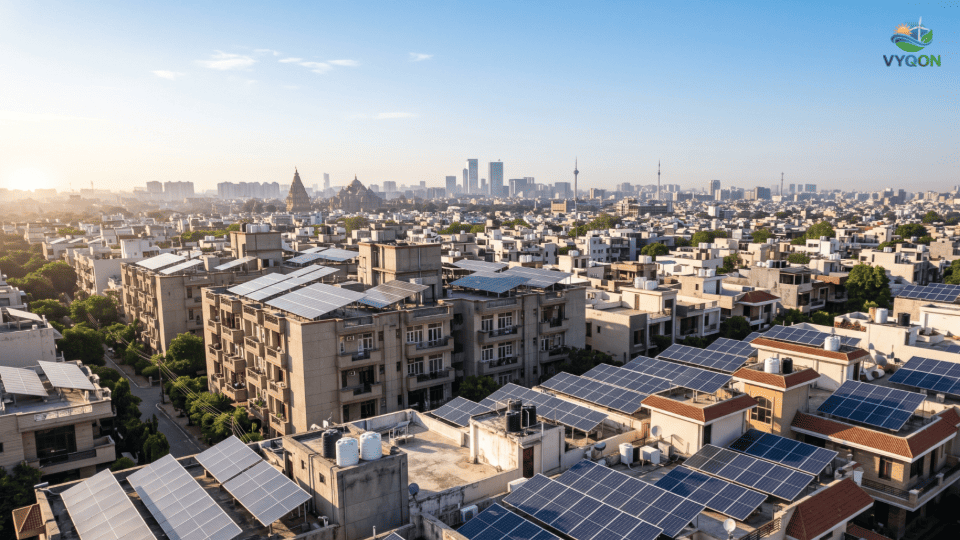
In September 2026, the Delhi Cabinet, as announced by Chief Minister Rekha Gupta, approved the second amendment to the Delhi Solar Energy Policy (Delhi Solar Policy 2026). The primary objective of the revised framework is to provide free 3 kW rooftop solar systems at zero upfront cost to approximately 2.3 lakh eligible residential households across Delhi by March 2027. By addressing initial capital expenditure constraints, the policy initiative aims to add 500 MW of new rooftop solar capacity to the national capital’s energy grid while maintaining existing domestic power subsidies.
Financial Breakdown and Subsidy Structure
The zero-upfront-cost framework for a 3 kW residential solar plant combines central financial assistance, state capital subsidies, and a state gap top-up mechanism. At an estimated benchmark and tendered cost of approximately ₹2,40,000 for a 3 kW system, the funding mechanism is structured as follows:
- Central Assistance: ₹78,000 provided under the Central Government’s PM Surya Ghar: Muft Bijli Yojana.
- State Capital Subsidy: ₹78,000 provided directly as a state capital subsidy by the Delhi Government.
- Combined Subsidy Total: ₹1,56,000 in direct, stacked capital support.
- State Gap Top-Up: An additional state government top-up of approximately ₹19,000 bridges the remaining balance between the combined ₹1,56,000 subsidy and the total tendered plant cost (~₹2,40,000), eliminating upfront capital outlays for eligible domestic consumers.
Calculation for Higher Consumption Tiers
For consumers in electricity consumption tiers above 400 units per month, the state gap top-up is not applicable. The net cost to the consumer (~₹84,000) is derived directly by subtracting the combined stacked subsidy of ₹1,56,000 (₹78,000 Central + ₹78,000 State) from the benchmark tendered plant cost of ₹2,40,000.
Ineligibility Exclusion Rule
Consumers who already have a rooftop solar system exceeding 1 kW in capacity installed against their Consumer Account (CA) Number are explicitly ineligible for installation under the Utility Led Aggregation (ULA) model. Such residential consumers may still install rooftop solar plants via standard PM Surya Ghar routes through empanelled vendors to claim standard central and state subsidies under existing provisions.
Benefit and Eligibility Breakdown by Electricity Consumption Tier
Eligibility and financial benefits under the revised policy are categorized according to average monthly electricity consumption during FY 2025–2026:
| Monthly Consumption Tier | Subsidy / Incentive Structure | Net Upfront Cost to Consumer |
| 0–200 Units | Full Central Subsidy (₹78,000) + State Subsidy (₹78,000) + State Gap Top-Up (~₹19,000). Retains existing 100% power subsidy (free electricity up to 200 units); eligible for surplus power export credits and an energy-saving incentive (up to ₹300/month). | ₹0 |
| 201–400 Units | Full Central Subsidy (₹78,000) + State Subsidy (₹78,000) + State Gap Top-Up (~₹19,000). Retains existing 50% power subsidy; eligible for surplus power export credits paid by the DISCOM. | ₹0 |
| Above 400 Units | Central Subsidy (up to ₹78,000) + State Subsidy (up to ₹78,000). Ineligible for the state gap top-up. Retains surplus power export credits. | Consumer pays net balance of ~₹84,000 (Tendered cost of ₹2,40,000 minus ₹1,56,000 subsidy). |
System Specifications, Maintenance, and Implementation Framework
- System Specifications: The policy offers standardized 2 kW or 3 kW rooftop solar plants. Under Delhi NCR solar irradiation conditions, a 3 kW system is estimated to generate between 300 and 400 units of electricity per month (averaging 350–400 units under optimal seasonal performance).
- Operations & Maintenance (O&M): Installing vendors are contractually mandated to provide five (5) years of free Comprehensive Maintenance Contract (CMC) services, covering all system repairs, component replacements, and upkeep. Following the initial five-year period, consumers can transition O&M and system insurance through their respective electricity distribution companies (DISCOMs).
- Implementation Model: Executed under the Utility Led Aggregation (ULA) model. Indraprastha Power Generation Company Limited (IPGCL) operates as the state coordinating agency, selecting empanelled vendors via competitive bidding across DISCOM divisions.
- Grid Export & Generation-Based Incentives (GBI): Net-metered surplus solar energy exported to the grid is credited by DISCOMs at the Average Power Purchase Cost (APPC) rate. Additionally, Delhi’s Generation-Based Incentive (GBI) provides tiered cash credits for five years from the date of commissioning:
- Residential Systems up to 3 kW: ₹3 per unit (kWh) generated.
- Residential Systems >3 kW up to 10 kW & Group Housing Societies/RWAs: ₹2 per unit (kWh) generated (GHS/RWA common facilities up to 500 kWp at 10 kW per house).
- Commercial & Industrial: ₹1 per unit (kWh) generated for the first 200 MW deployed across the state.
Regulatory Reforms: Streamlined Net-Metering and Approval Timelines
To eliminate administrative delays, the Delhi Electricity Regulatory Commission (DERC) notified the Delhi Electricity Regulatory Commission (Net Metering for Renewable Energy) (Second Amendment) Guidelines, 2026, effective July 16, 2026.
- Process Simplification: Replaced the previous 3-stage procedure (feasibility analysis, registration, and connection agreement) with a 2-stage online structure:
- Stage I: Technical Feasibility Analysis.
- Stage II: Integrated Document Verification, Inspection, and Net Meter Installation.
- Timeframe Reduction: Total cumulative processing time for net-metering and grid connectivity is capped at 10 days for systems ≤10 kW, and 25 days for systems >10 kW (excluding time taken by applicants for physical system installation or deficiency rectification).
- Deemed Feasibility: Systems up to 10 kW on the same supply type carry automatic (deemed) technical feasibility approval. Feasibility is also deemed approved if the DISCOM fails to communicate analysis outcomes within 15 days of receiving a complete application.
- Consolidated Deficiency Rules: DISCOMs are legally prohibited from issuing piecemeal queries. All defects or deficiencies must be communicated in a single consolidated intimation. Applicants are granted 15 days to rectify deficiencies, post-rectification, DISCOMs must complete all remaining Stage II procedures (inspection, metering, connectivity) within 5 days. Minor non-safety deviations cannot be used to delay registration.
- Digitization & Fee Waivers: Physical paper submissions are abolished in favor of mandatory digital processing on the Delhi Solar Portal or National Portal. Connection agreements are executed digitally (via electronic acceptance for domestic consumers ≤10 kW). DERC has fully waived feasibility application fees and registration charges for domestic consumers installing systems up to 10 kW.
Application Process Overview and Target Deadlines
Policy Callout: Delhi ULA Scheme Enrollment Requirement
Consumers should note that an existing application on the national PM Surya Ghar portal does not automatically enroll a household into Delhi’s zero-upfront-cost ULA framework. Explicit submission of digital consent on the official Delhi Solar Portal (solar.delhi.gov.in) is mandatory to trigger vendor allotment under IPGCL’s aggregated tender.
Step-by-Step Portal Application Procedure
- Access the Portal: Navigate to
solar.delhi.gov.indirectly or scan the official portal QR code. Applicants can initiate registration via the homepage pop-up banner (“Overview of Delhi Solar Scheme” -> “Confirm & Apply Now”) or by selecting “Consumer Consent for RTS Installation” from the right-hand menu. - Submit Identification: Enter the electricity Consumer Account (CA) Number, select the assigned DISCOM (BRPL, BYPL, TPDDL, NDMC, or MES), and enter a valid mobile number.
- OTP & Eligibility Verification: Enter the SMS OTP received on the mobile number. Upon verification, the portal automatically checks historic consumption data (FY 2025–2026) against the CA Number to display eligible benefits. If an existing solar plant >1 kW is detected, the portal issues an ineligibility notice for the ULA model and provides alternative standard PM Surya Ghar application guidance.
- Input Plant & Site Details: Select the desired plant capacity (2 kW or 3 kW), revenue district, pincode, and gender as printed on the electricity bill. Optional fields include available rooftop area (sq. ft.) and email address. Enter the mandatory displayed CAPTCHA characters to proceed.
- Submit Digital Consent: Review electricity connection details on the consent pop-up, tick the mandatory checkbox agreeing to terms under the ULA Model of PM Surya Ghar: Muft Bijli Yojana, and submit the form. A unique Reference Number is generated on screen and sent via SMS for application tracking.
- Site Feasibility Assessment: Following vendor empanelment by IPGCL (a tendering process taking approximately 1.5 to 2 months), the designated division vendor visits the premises to conduct an on-site technical feasibility inspection prior to system installation.
Targeted Macro Objectives
The revised Delhi Solar Policy 2026 targets the complete deployment of rooftop solar systems across 2.3 lakh residential roofs, adding 500 MW of decentralized renewable generation capacity to Delhi’s grid by the targeted deadline of March 2027.
Official References & Source Documentation
1. Government of NCT of Delhi (Department of Power)
- Delhi Solar Energy Policy 2023 (Second Amendment) Notification Department of Power, Government of NCT of Delhi (Gazette Notification No. F. No. DOP-EE/21/2026-EE and REM-POWER DEPARTMENT/6436, dated 17th September 2026). Official Portal: Delhi Solar Portal
- Delhi Solar Portal – Consumer Consent & Application Guide Department of Power, GNCTD / Indraprastha Power Generation Company Limited (IPGCL). Direct Application Link: Delhi Solar Portal Application Page
2. Ministry of New and Renewable Energy (MNRE), Government of India
- Operational Guidelines for PM-Surya Ghar: Muft Bijli Yojana (Central Financial Assistance to Residential Consumers) Ministry of New and Renewable Energy, Government of India (F. No. 318/140/2024-Grid Connected Rooftop). National Portal: PM-Surya Ghar National Portal
3. Statutory Regulatory Authority
- Delhi Electricity Regulatory Commission (Net Metering for Renewable Energy) (Second Amendment) Guidelines, 2026 Delhi Electricity Regulatory Commission (DERC Notification, Effective 16th July 2026).
4. Power Distribution Licensees (DISCOMs)
- BSES Yamuna Power Limited – Rooftop Solar Connectivity & Net Metering Guidelines BSES Yamuna Power Limited (BYPL) / Delhi Electricity Distribution Utilities.
Leave a Comment