
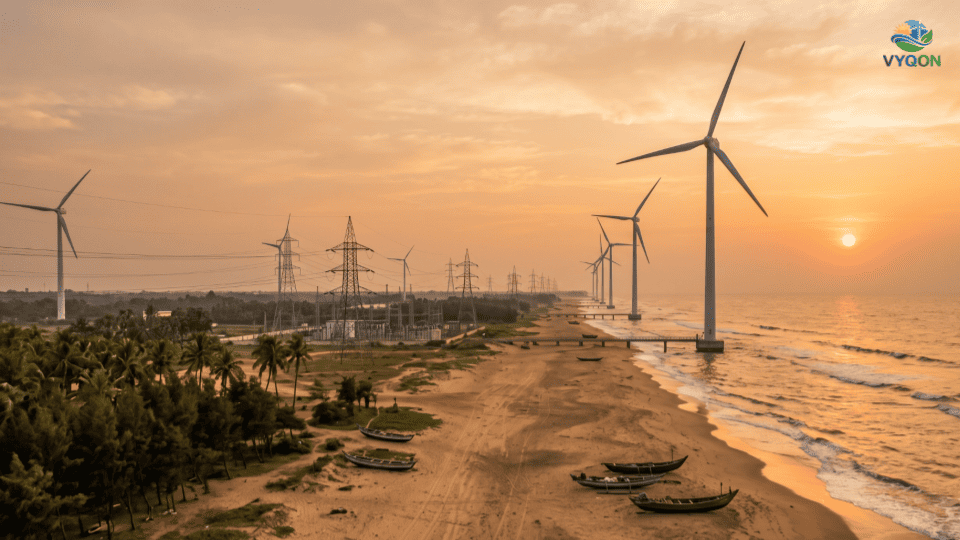
India’s installed non-fossil fuel power generation capacity reached 51.93% of the total national energy mix as of December 31, 2025, reaching 266,788.07 MW out of an All India total installed capacity benchmark of 513,729.69 MW. According to official data from the Ministry of Power’s Annual Report 2025–26, total fossil fuel capacity stood at 246,941.62 MW (48.07%). The expansion was propelled by non-fossil growth, including wind power capacity scaling to 54,510.93 MW and solar capacity reaching 135,809.94 MW. Regulatory oversight and statutory compliance under the Electricity Act, 2003 are maintained through the Ministry of Power alongside the Central Electricity Regulatory Commission (CERC), State Electricity Regulatory Commissions (SERCs), and Joint Electricity Regulatory Commissions (JERCs).
Wind and Renewable Energy Installed Capacity Breakdown
National renewable energy generation demonstrated substantial growth during the nine-month period from April to December 2025. Wind energy generation reached 88.05 Billion Units (BU), representing a 29.51% increase compared to the 67.98 BU generated during the corresponding period in FY 2024–25. Total installed wind capacity grew by 8.94%, rising from 50,037.82 MW as of March 31, 2025, to 54,510.93 MW by December 31, 2025.
Concurrently, solar power generation expanded by 19.41% year-over-year, generating 121.96 BU between April and December 2025 compared to 102.14 BU in the prior period. Total installed solar capacity increased by 28.55%, advancing from 105,646.49 MW on March 31, 2025, to 135,809.94 MW (135.81 GW) as of December 31, 2025.
In terms of project pipelines, wind capacity includes 6.5 GW under implementation and 1.8 GW in tendered capacity, bringing total wind installed and pipeline capacity to 62.81 GW. Solar project pipelines comprise 67.28 GW under implementation and 35.44 GW tendered, establishing a combined solar capacity and pipeline of 238.53 GW. Furthermore, hybrid wind capacity under implementation stands at 23.54 GW, while hybrid solar includes 60.04 GW under implementation and 11.48 GW tendered (71.52 GW total). Combined renewable energy capacity—inclusive of large hydroelectric projects (50,914.66 MW)—reached 258,008.07 MW, representing a 50.22% share of total national power capacity.
| Resource Category | Installed Capacity / Pipeline Figures (as of 31.12.2025) |
| Installed Wind Capacity | 54,510.93 MW |
| Wind Capacity Under Implementation | 6.50 GW |
| Wind Tendered Capacity | 1.80 GW |
| Hybrid Wind Capacity Under Implementation | 23.54 GW |
| Installed Solar Capacity | 135,809.94 MW |
| Solar Capacity Under Implementation | 67.28 GW |
| Solar Tendered Capacity | 35.44 GW |
| Hybrid Solar Capacity Under Implementation | 60.04 GW |
| Hybrid Solar Tendered Capacity | 11.48 GW |
| Total Renewable Energy Capacity (incl. Hydro) | 258,008.07 MW |
State Infrastructure and Odisha Capacity Data
Power generation capacity additions and operational listings within the state of Odisha, as documented in Chapter 03 of the Ministry of Power Annual Report 2025–26, include the following thermal power projects:
- JSW Energy (Utkal) Ltd., Unit-2: A private sector thermal power project commissioned in Odisha between April 1, 2025, and December 31, 2025, with a generation capacity of 350 MW, developed by JSW Energy.
- MTPCL Odisha: A private sector thermal capacity asset accounting for 30 MW within the state’s operational capacity listings.
Distribution Utilities Performance and Consumption Compliance
Operational efficiency and financial metrics across power distribution companies (DISCOMs) indicate structural improvements aimed at strengthening financial sustainability and accommodating higher grid integration:
- AT&C Loss Reduction: Aggregate Technical and Commercial (AT&C) losses across India declined from 21.9% in FY 2021 to 15.04% in FY 2025.
- ACS-ARR Gap Minimization: The national gap between the Average Cost of Supply (ACS) and Average Revenue Realized (ARR) reduced from Rs. 0.69/kWh in FY 2021 to Rs. 0.06/kWh in FY 2025.
- Financial Turnaround: Distribution utilities achieved a cumulative positive Profit After Tax (PAT) of Rs 2,701 crore in FY 2024–25, reversing a loss of Rs 25,553 crore recorded in FY 2023–24.
- Smart Meter Deployment: A total of 5.28 crore smart meters were installed nationwide across various schemes by December 2025. This includes 3.77 crore consumer meters, 12.56 lakh Distribution Transformer (DT) meters, and 1.58 lakh feeder meters deployed under the Revamped Distribution Sector Scheme (RDSS) to enable automated energy accounting and load forecasting.
Regulatory Framework and Administrative Oversight
Administrative and regulatory functions within the Ministry of Power are allocated across specialized operational divisions. Chief Engineer Hemant Kumar Pandey oversees the divisions for Regulatory Compliance Monitoring (RCM), Reforms & Restructuring (R&R), and New & Renewable Energy (NRE). Within this framework, the formulation of policy guidelines, implementation of the Tariff Policy and Electricity Act 2003, and drafting of Standard Bidding Documents (SBDs) for power procurement are executed directly by the Ministry’s Reforms & Restructuring (R&R) Division. Independent statutory enforcement, regulatory compliance, and tariff determinations remain under the jurisdiction of the Central Electricity Regulatory Commission (CERC), State Electricity Regulatory Commissions (SERCs), and Joint Electricity Regulatory Commissions (JERCs).
Official References & Sources
- Press Information Bureau (PIB), Ministry of New & Renewable Energy, Govt. of India Source: Solar Energy Corporation of India to Supply 600 MW Wind Power to GRIDCO Odisha under Power Sale Agreement Publisher: Press Information Bureau (PIB Delhi), Govt. of India Details: Official press release confirming the execution of the 600 MW wind Power Sale Agreement (PSA) under Tranche-XIII of the Inter-State Transmission System (ISTS) scheme.
- Solar Energy Corporation of India Limited (SECI) Source: SECI DISCOMs & Utility Power Procurement Portal Publisher: Solar Energy Corporation of India Ltd. (Navratna Enterprise under MNRE, Govt. of India) Details: Statutory framework governing SECI’s intermediary role in signing Power Purchase Agreements (PPAs) with developers and back-to-back PSAs with state DISCOMs.
- Odisha Electricity Regulatory Commission (OERC) Source: Odisha Electricity Regulatory Commission Official Portal Document: OERC Discussion Paper & Orders on Generic Tariff & Power Procurement Approvals Publisher: Odisha Electricity Regulatory Commission (OERC), Bhubaneswar Details: Regulatory orders approving GRIDCO’s renewable power procurement and establishing tariff/normative guidelines under Section 63 and 86(1)(b) of the Electricity Act, 2003.
- Department of Energy, Government of Odisha Document: Odisha Renewable Energy Policy 2022 (Resolution No. 11757/ENG-HYD-HYDRO-0009/2022/En.) Publisher: Department of Energy, Government of Odisha / OPGC Details: Official state policy setting out targets, land bank allocations, and regulatory incentives to meet DISCOM Renewable Purchase Obligations (RPO).
- Ministry of Power, Government of India Document: Ministry of Power Annual Report 2025–26 Publisher: Ministry of Power, Government of India Details: Gazette notifications and national trajectories for Renewable Consumption Obligations (RCO) under the Energy Conservation Act, 2001.
- SECI & GRIDCO Limited Document: Power Sale Agreement (PSA) for Sale of Wind Power on Long-Term Basis Parties: Solar Energy Corporation of India Limited & Buying Utility (GRIDCO Limited) Details: Standard 25-year long-term power sale contract specifying delivery points, trading margins, and back-to-back commercial liabilities.
Leave a Comment