
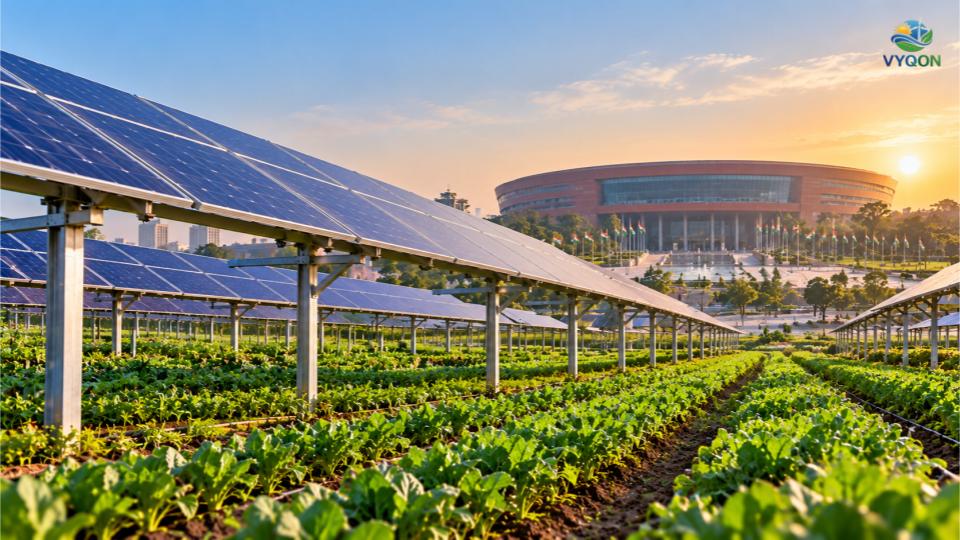
The seventh AgriVoltaics World Conference begins on 21 October 2026 at Bharat Mandapam, New Delhi, bringing together policymakers, agricultural researchers, solar technology developers and international experts to explore how farming and renewable electricity generation can coexist.
New Delhi, 21 October 2026: The 7th AgriVoltaics World Conference 2026 is scheduled to open at Bharat Mandapam in New Delhi on 21 October, bringing together stakeholders from the renewable energy, agriculture, research and policy sectors for three days of discussions on the integration of solar photovoltaic generation with agricultural activities.
Scheduled to continue until 23 October 2026, the international conference is being conducted in a hybrid format under the theme “Powering the Global South.” The programme focuses on the technical, financial, agricultural and regulatory considerations involved in developing agrivoltaic systems, which allow farmers to cultivate land while generating electricity through appropriately designed solar installations.
According to the official conference schedule, registration and networking are scheduled to begin at 9:00 AM on the opening day, followed by an opening ceremony and ministerial dialogue at 10:00 AM. The programme includes discussions on India’s agrivoltaics strategy, agricultural productivity, financing models, renewable energy technologies and international cooperation.
The conference comes as India continues expanding its renewable energy infrastructure while examining opportunities to improve land utilisation and maintain agricultural productivity.
Agrivoltaics Brings Agriculture and Solar Energy Together
Agrivoltaics is an emerging approach to renewable energy development that integrates photovoltaic electricity generation with agricultural cultivation on the same land.
Conventional ground-mounted solar installations generally prioritise electricity generation and require sufficient space for photovoltaic modules, mounting structures, electrical infrastructure and maintenance access.
Agrivoltaic systems introduce a different approach by designing solar installations around the continued use of land for agriculture. Depending on the configuration, photovoltaic modules may be elevated above crops or arranged with sufficient spacing to allow cultivation between the panels.
This approach could provide opportunities for farmers to maintain agricultural activities while participating in renewable electricity generation. However, the technical feasibility of agrivoltaics depends on crop requirements, climatic conditions, soil characteristics, irrigation arrangements and photovoltaic system design.
The relationship between solar generation and agricultural productivity must be carefully evaluated. Solar modules create shading patterns that can influence crop growth, soil temperature and water requirements. Some agricultural systems may benefit from moderated sunlight under suitable conditions, while others may require greater exposure to direct solar radiation.
Consequently, agrivoltaic installations must be assessed using both agricultural and electricity-generation performance rather than photovoltaic capacity alone.
The conference provides an international platform for examining these considerations and identifying practical approaches suitable for different agricultural environments.
India’s PM-KUSUM Strategy and Agrivoltaics Development
The conference follows an important policy statement issued by the Ministry of New and Renewable Energy (MNRE) in September 2026.
During the official curtain-raiser event held on 9 September, Union Minister for New and Renewable Energy Pralhad Joshi stated that the next phase of the PM-KUSUM programme would include a dedicated component for agrivoltaics.
The Minister highlighted the potential for farmers to continue agricultural production while earning additional income through electricity generation. Particular emphasis was placed on small and marginal farmers, Farmer Producer Organisations, agricultural cooperatives and panchayats.
The government also identified the importance of ensuring that land ownership remains with farmers while renewable energy opportunities are developed.
The proposed integration of agrivoltaics with PM-KUSUM could provide a foundation for expanding farmer participation in decentralised renewable energy development.
PM-KUSUM already supports renewable electricity generation in agriculture through decentralised solar power projects, standalone solar pumps and the solarisation of grid-connected agricultural pumping systems.
Introducing agrivoltaics within a future programme framework could help encourage systems designed to preserve cultivation rather than displace agricultural activities.
However, the September announcement represents a stated policy direction. It does not establish that a new agrivoltaics-specific subsidy, final financial allocation or application process has already been notified.
The conference’s opening-day agenda includes a dedicated discussion titled “India’s Agrivoltaics Vision under PM-KUSUM 2.0,” focusing on policy approaches, implementation models, financing and coordination between government institutions.
The discussion is expected to contribute to understanding how agrivoltaic systems could be integrated into India’s existing agricultural renewable energy programmes.
Solar Technology, Agricultural Productivity and Research
One of the main objectives of the conference is to encourage greater collaboration between photovoltaic engineering and agricultural research.
Agrivoltaic development requires technical designs that accommodate farming activities while maintaining suitable electricity-generation performance.
Important considerations include photovoltaic module height, orientation, row spacing, supporting structures, shading characteristics and access for agricultural machinery.
Unlike conventional solar installations, agrivoltaic projects must also consider crop growth, irrigation, soil conditions and the movement of agricultural workers and equipment.
These requirements can influence construction costs, project layout and long-term maintenance responsibilities.
The conference programme includes scientific sessions covering innovations in photovoltaic technologies, system design, monitoring, plant growth, agricultural yields and farm income.
Such research is important because agrivoltaic performance varies across crops, regions and operating conditions.
The suitability of a particular installation must therefore be evaluated through field measurements and agricultural studies rather than assuming that a single photovoltaic configuration can serve every farming environment.
System monitoring can help researchers compare electricity generation with agricultural outcomes, including crop yield, water consumption and seasonal productivity.
These measurements can provide evidence for identifying configurations that support both renewable electricity generation and viable agricultural activity.
For India, region-specific research will be particularly important because agricultural conditions differ substantially across states, cropping systems and climatic zones.
Farmer Participation and Commercial Business Models
Beyond photovoltaic technology, the conference places emphasis on developing commercially practical models that can benefit farmers and renewable energy developers.
Agrivoltaic projects may involve several stakeholders, including agricultural landowners, farmers, project developers, electricity distribution companies, financing institutions and local organisations.
Their participation requires clear arrangements concerning land rights, equipment ownership, electricity sales, agricultural access, operating responsibilities and revenue-sharing mechanisms.
For developers, project viability depends on factors such as installation costs, electricity-generation performance, grid connectivity, financing and long-term operational requirements.
For farmers, the commercial value of agrivoltaics depends on whether agricultural activities can continue sustainably while creating an additional source of income.
These objectives must be considered together because an installation that generates electricity but substantially disrupts agricultural production may fail to achieve its intended dual-use purpose.
The official conference programme includes discussions focusing on cooperatives, Farmer Producer Organisations and women’s self-help groups in scaling agrivoltaics.
These sessions are expected to examine how collective participation can support financing, project ownership, agricultural productivity and wider adoption.
Other programme discussions address business-model development, investment opportunities and the responsibilities of public and private institutions.
Such collaboration could help identify practical ways to reduce project risks while maintaining farmers’ participation in renewable energy development.
International Cooperation Under the Global South Theme
The conference’s theme, “Powering the Global South,” highlights the importance of developing agrivoltaic solutions that respond to the agricultural and economic conditions of emerging markets.
Countries across the Global South face challenges involving agricultural productivity, renewable energy access, land availability and rural infrastructure.
Agrivoltaic systems could provide opportunities to address some of these issues through coordinated electricity generation and farming activities.
However, solutions developed for large agricultural holdings may not be directly suitable for regions dominated by smaller or fragmented landholdings.
Local farming practices, crop selection, electricity infrastructure and financial resources must therefore influence project design.
The conference programme includes international discussions involving policymakers, researchers and industry participants examining agrivoltaic technologies, financing mechanisms and policy development.
A scheduled session on South-South cooperation is intended to explore the exchange of knowledge and experience across countries with different agricultural and energy systems.
The programme also includes scientific discussions on global best practices, regulatory frameworks and social considerations in agrivoltaic development.
For India, international collaboration could support the development of technology standards, research methods and practical business models suitable for domestic agricultural conditions.
What to Expect During the Three-Day Conference
The opening-day programme includes ministerial discussions, presentations on India’s agrivoltaics direction and technical sessions examining photovoltaic design and agricultural performance.
According to the organiser’s agenda, the opening ceremony is also scheduled to feature an agrivoltaics practice showcase and the launch of digital tools and knowledge reports.
These remain scheduled programme activities until their completion and publication are confirmed through subsequent official announcements.
The second and third days include additional scientific and policy discussions covering technology development, agricultural incomes, financial mechanisms, investment opportunities and international case studies.
The conference is scheduled to conclude on 23 October 2026 with a closing ceremony reviewing the discussions and recognising contributions to agrivoltaic development.
For the renewable energy industry, the most important outcomes will be the technical knowledge, implementation proposals and partnerships that emerge from these discussions.
Project developers will be interested in commercially feasible agrivoltaic designs, while researchers will focus on reliable methods for measuring agricultural and photovoltaic performance.
Policymakers will need to examine how supporting regulations, financing arrangements and farmer protections can enable responsible development.
Conclusion
The AgriVoltaics World Conference 2026 represents an important international platform for examining the relationship between agricultural production and renewable electricity generation.
Hosted in New Delhi from 21 to 23 October, the event brings together expertise from photovoltaic technology, agriculture, policy, finance and project development.
For India, the discussions are particularly relevant as the country examines how farmers can participate in renewable energy development while maintaining productive agricultural land.
The government’s stated intention to introduce a dedicated agrivoltaics component under the next phase of PM-KUSUM provides additional policy context for the conference.
However, the development of commercially viable agrivoltaic projects will depend on appropriate technical designs, measurable agricultural performance, financing mechanisms and clear implementation guidelines.
The conference provides an opportunity to advance these discussions and strengthen cooperation among farmers, researchers, developers and government institutions.
Official Sources and References
1. AgriVoltaics World Conference 2026 — Official Conference Website
Conference dates, location, theme and event information.
https://www.agrivoltaics-conference.org
2. AgriVoltaics World Conference 2026 — Official Programme
Opening ceremony, ministerial discussions and technical session schedule.
https://event.fourwaves.com/agrivoltaics-world-conference2026/schedule
3. Ministry of New and Renewable Energy — Press Information Bureau, Government of India
Official announcement on agrivoltaics, farmer participation and the next phase of PM-KUSUM.
Published: 9 September 2026
https://www.pib.gov.in/PressReleasePage.aspx?PRID=2308489&lang=1®=3
4. AgriVoltaics World Conference 2026 — Official Programme Overview
Conference research themes and technical programme information.
https://www.agrivoltaics-conference.org/program/program-overview
Leave a Comment