
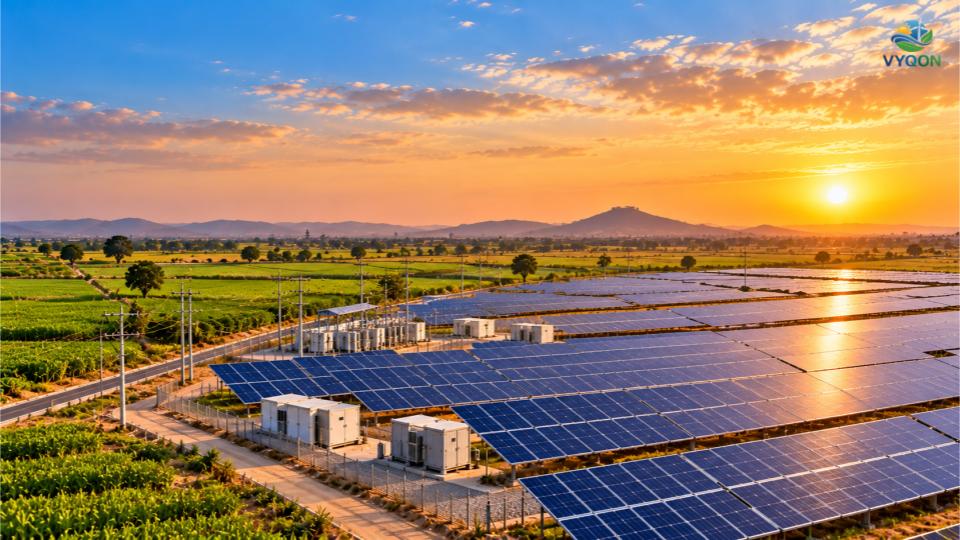
Transrail Lighting Limited has approved the proposed acquisition of a 49% equity stake in NOPL Pace Green Energy Private Limited, marking its planned entry into renewable power generation through a 990 MW AC solar portfolio under PM-KUSUM in Maharashtra.
Mumbai, 21 October 2026: Transrail Lighting Limited has announced a proposed investment of ₹20 crore to acquire a 49% equity stake in NOPL Pace Green Energy Private Limited (NOPL), a company developing an approximately 990 MW AC solar power portfolio in Maharashtra. The transaction, approved by Transrail’s Board of Directors on 19 October 2026, represents a strategic move towards renewable electricity generation alongside the company’s established engineering, procurement and construction (EPC) activities.
According to Transrail’s stock-exchange disclosure, the proposed portfolio is being developed under Component C of the Pradhan Mantri Kisan Urja Suraksha evam Utthaan Mahabhiyan (PM-KUSUM) programme, which supports the solarisation of agricultural electricity infrastructure. The company stated that the portfolio is backed by a 25-year Power Purchase Agreement (PPA) with Maharashtra State Electricity Distribution Company Limited (MSEDCL) at a fixed electricity tariff of ₹3.10 per kilowatt-hour.
The company has indicated an estimated overall project cost of approximately ₹3,900 crore, with debt financing sanctioned by a financial institution, subject to applicable financing and disbursement conditions.
However, the transaction remains subject to the necessary approvals and completion of agreed conditions. The announcement does not establish that Transrail has completed the acquisition or that the proposed 990 MW solar portfolio has entered commercial operation.
Transrail Lighting Moves Towards Renewable Power Generation
Transrail Lighting operates primarily in the power transmission and distribution infrastructure sector, with experience in engineering, manufacturing, procurement, project execution and construction.
The company’s existing operations include high-voltage transmission lines, substations, conductors, civil infrastructure and solar EPC services. Its renewable energy capabilities also extend to pooling substations, grid connectivity and selected energy storage applications.
The proposed investment in NOPL represents an expansion beyond conventional EPC activities because it would provide exposure to the ownership and development of electricity-generating assets.
In a typical EPC arrangement, a contractor earns revenue by designing, supplying and constructing infrastructure for another project owner. Participation in a renewable power generation company introduces a different commercial model, where financial outcomes can depend on electricity production, long-term power purchase arrangements and the operating performance of generating assets.
Transrail has identified renewable power generation as an opportunity to utilise its established engineering and project-management capabilities while expanding its participation across the electricity value chain.
The proposed acquisition is intended to support this strategic direction. However, the financial contribution of the investment will depend on successful transaction completion, project implementation and the commercial performance of the solar portfolio.
NOPL’s 990 MW Solar Portfolio in Maharashtra
NOPL Pace Green Energy Private Limited is developing an aggregate solar power portfolio of approximately 990 MW AC across Maharashtra.
The portfolio is associated with PM-KUSUM Component C, which provides a framework for the solarisation of grid-connected agricultural pumps and agricultural electricity feeders.
Under the feeder-level solarisation approach, photovoltaic generating facilities can be connected to appropriate electricity distribution infrastructure to support agricultural electricity requirements.
Such installations may help increase the availability of renewable electricity during daylight hours when irrigation activities can contribute to electricity demand.
The NOPL portfolio has been announced as part of this agricultural renewable energy development framework.
Unlike an individual rooftop solar system, a portfolio approaching 990 MW can involve several generating locations, electrical interconnection arrangements, substations, equipment installations and associated infrastructure.
The development of such a portfolio requires coordination across land arrangements, technical design, procurement, construction, electricity evacuation and project commissioning.
The company’s disclosure identifies the aggregate proposed capacity but does not establish that all individual installations have been commissioned.
Consequently, the 990 MW figure should be understood as the capacity of the solar portfolio under development rather than additional operational solar generation already connected to the electricity network.
The project’s eventual contribution to Maharashtra’s electricity supply will depend on the completion and commercial operation of its constituent installations.
25-Year MSEDCL Power Purchase Agreement
An important commercial feature of the proposed portfolio is the company’s disclosure of a 25-year PPA with MSEDCL at a fixed tariff of ₹3.10 per unit of electricity.
A long-term power purchase agreement can provide a contractual framework for electricity sales and support project financing decisions.
For renewable electricity developers, the availability of a defined power purchaser and contracted tariff can improve visibility regarding the commercial structure of a generating project.
However, a contracted electricity tariff does not independently establish the amount of electricity that will be generated or the revenue that will ultimately be realised.
Actual electricity sales will depend on installed and commissioned capacity, solar irradiation, equipment performance, grid availability and the applicable contractual requirements.
The announced tariff should also be distinguished from electricity tariffs charged to final agricultural consumers, which may be influenced by distribution costs, government support and other regulatory arrangements.
The MSEDCL agreement provides commercial context for the development portfolio, while verified generation and project-level commissioning records will be necessary to assess its operational contribution.
Understanding the ₹20 Crore Investment and ₹3,900 Crore Project Cost
The proposed ₹20 crore equity acquisition and the estimated ₹3,900 crore portfolio development cost represent two different financial figures.
The ₹20 crore amount relates to Transrail Lighting’s proposed purchase of a 49% equity stake in NOPL.
The approximately ₹3,900 crore figure represents the indicative overall cost associated with developing the underlying solar portfolio.
It would therefore be incorrect to describe the transaction as the purchase of 990 MW of operating solar projects for ₹20 crore or to state that Transrail has independently committed the full ₹3,900 crore.
According to the company’s announcement, debt financing has been sanctioned for the portfolio, subject to the relevant financing conditions and disbursement requirements.
Large-scale solar projects generally require capital for photovoltaic modules, inverters, mounting structures, transformers, electrical infrastructure, civil construction, land arrangements and associated development activities.
The final expenditure of such projects can depend on implementation schedules, procurement prices, infrastructure requirements and financing conditions.
Transrail’s immediate proposed equity transaction must therefore be distinguished from the financing and construction requirements of the broader development portfolio.
The company has indicated that its investment arrangement is intended to provide financial and project-management control under agreed arrangements with Onix Renewable Limited.
The agreement also provides flexibility for Transrail to increase its ownership interest potentially up to 100%, subject to mutual agreement and applicable approvals.
This possibility should not be interpreted as a completed acquisition of the remaining stake. The disclosed initial transaction concerns the proposed purchase of 49% equity.
Strategic Importance of PM-KUSUM Feeder Solarisation
The NOPL development is linked to the wider objective of increasing renewable electricity supply for agricultural applications.
Under the Ministry of New and Renewable Energy’s PM-KUSUM framework, Component C includes the solarisation of grid-connected agricultural pumps and agricultural feeders.
Feeder-level solarisation enables suitable photovoltaic generation facilities to supply electricity through distribution infrastructure associated with agricultural consumption.
This approach differs from installing individual standalone photovoltaic pumping systems because electricity generation is integrated with the distribution network.
The practical benefits of feeder-level solarisation depend on local electricity demand, available network capacity, project location and successful technical integration.
For distribution utilities, decentralised solar generation can provide an additional electricity supply resource during periods of suitable solar availability.
For agricultural consumers, the intended objective is to support electricity supply associated with irrigation requirements.
However, the effectiveness of individual projects depends on reliable generation, distribution-network readiness and the commercial conditions under which electricity is purchased and delivered.
The NOPL portfolio therefore represents a substantial proposed renewable energy development within an agricultural electricity framework, but its contribution will need to be assessed through actual commissioning and subsequent operating data.
Opportunities for Solar EPC and Electrical Infrastructure
Transrail’s proposed participation in renewable power generation is relevant to its established capabilities in transmission and electrical infrastructure.
Utility-scale and decentralised solar developments require more than photovoltaic equipment. Their implementation also depends on suitable transformers, switchgear, protection systems, electrical cabling, pooling arrangements and grid connectivity.
These components help transfer electricity generated by photovoltaic modules into the distribution or transmission network while meeting the applicable safety and operating requirements.
Transrail’s experience in electrical engineering, procurement and construction may provide capabilities relevant to the implementation of renewable electricity projects.
However, the proposed equity acquisition does not automatically constitute a separate EPC contract award to Transrail.
Similarly, the announcement does not identify specific module manufacturers, inverter suppliers or contractors selected for the entire NOPL development portfolio.
Any future equipment procurement, EPC appointments or additional project agreements should be reported independently when the relevant official information becomes available.
The wider industrial significance of the investment lies in the potential integration of infrastructure development capabilities with long-term participation in renewable power generation.
Transaction Completion and Future Project Milestones
The immediate next step is completion of the proposed acquisition in accordance with the applicable approvals and contractual conditions.
Following successful transaction completion, attention will turn towards the development progress of NOPL’s solar portfolio, including financing arrangements, site-level implementation and commercial commissioning.
Future disclosures may provide additional information on individual project locations, construction schedules, equipment procurement and grid connectivity.
These details will be important for determining how the proposed 990 MW capacity progresses from the development stage to operational generation.
For investors and renewable energy stakeholders, it is essential to distinguish the approval of an equity transaction from completed ownership transfer and commissioned solar infrastructure.
The announced development includes a proposed acquisition, an identified solar portfolio and a company-reported long-term power purchase arrangement.
It does not confirm that Transrail has already completed the transaction, received electricity-generation revenue or commissioned the full portfolio.
Official Sources and References
1. Transrail Lighting Limited — Stock Exchange Disclosure, 19 October 2026
Transrail to Enter Renewable Power Generation Through Proposed 49% Investment in 990 MW Solar Portfolio in Maharashtra.
National Stock Exchange of India — Corporate Announcements (Symbol: TRANSRAILL)
https://www.nseindia.com/companies-listing/corporate-filings-announcements?symbol=TRANSRAILL
2. Transrail Lighting Limited — Official Investor Relations
Company press releases and regulatory disclosures.
https://transrail.in/investors/investor-corner/press-releases
3. Ministry of New and Renewable Energy — Government of India
PM-KUSUM programme and Component C framework.
https://mnre.gov.in/en/pradhan-mantri-kisan-urja-suraksha-evam-utthaan-mahabhiyaan-pm-kusum
4. Transrail Lighting Limited — Official Solar EPC Business Overview
Company capabilities in solar EPC, grid connectivity and associated infrastructure.
Leave a Comment