
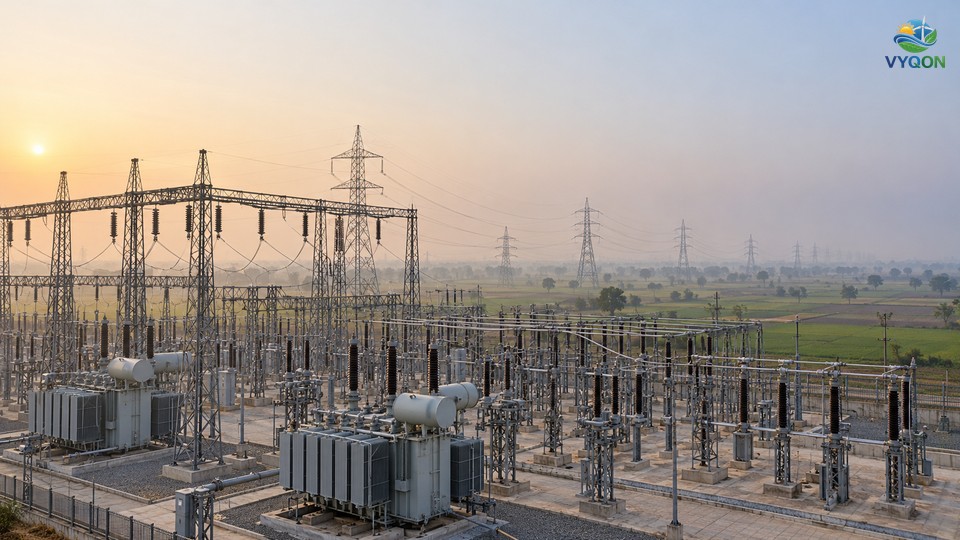
The Central Electricity Regulatory Commission (CERC) has determined the 2024-29 transmission tariff for POWERGRID’s assets under the “Augmentation of ISTS for Interconnection of HVPNL Transmission Schemes” in the Northern Region, which include two 400/220 kV, 500 MVA transformers at Jind and Bahadurgarh and 220 kV line bays at Sonepat and Bahadurgarh in Haryana. In an order dated 26 October 2026 in Petition No. 437/TT/2025, the Commission allowed annual fixed charges slightly below what Power Grid Corporation of India Limited (PGCIL) had claimed, and refused to condone part of the delay in commissioning.
The scheme
The scope of the project was discussed at the 9th meeting of the National Committee of Transmission on 28 September 2022. The Central Transmission Utility of India Limited (CTUIL) awarded it to PGCIL under the regulated tariff mechanism on 15 November 2022. PGCIL’s competent authority gave investment approval on 24 February 2023 at an estimated Rs 10,777 lakh, including Rs 492 lakh of interest during construction, at September 2022 prices.
The work covers a third 500 MVA, 400/220 kV transformer with bays at both Bahadurgarh and Jind, four 220 kV line bays at Bahadurgarh, and two 220 kV line bays at Sonepat for a line from Kharkhoda pocket A of the Haryana Vidyut Prasharan Nigam Limited (HVPNL). The Commission treated the assets as follows:
- Asset-1: two line bays at Sonepat, COD 25 August 2024
- Asset-2: 400/220 kV, 500 MVA transformer with bays at Jind, COD 25 September 2024
- Asset-3: 400/220 kV, 500 MVA transformer with bays at Bahadurgarh, COD 6 October 2024
- Asset-4: four 220 kV line bays at Bahadurgarh, COD 1 November 2024, split into Asset-4A (two bays for the Kharkhoda pocket B line) and Asset-4B (two bays for the METL line)
Assets 1 and 4 were given a commercial operation date (COD) under Regulation 5(1) of the 2024 Tariff Regulations and the Grid Code, because the bays were ready within PGCIL’s scope but could not be put to regular use as the associated transmission line within HVPNL’s scope was not ready.
The tariff
The annual fixed charges allowed for 2024-25, 2025-26, 2026-27, 2027-28 and 2028-29, in Rs lakh, are:
- Asset-1: 86.45, 179.75, 193.93, 196.33 and 194.91
- Asset-2: 356.27, 791.04, 830.14, 836.97 and 834.01
- Asset-3: 323.77, 754.17, 788.27, 794.85 and 793.19
- Asset-4A and Asset-4B, each: 47.53, 136.52, 145.54, 147.79 and 147.88
Capital cost
The capital cost allowed as on COD was Rs 469.32 lakh for Asset-1, Rs 2,799.54 lakh for Asset-2, Rs 2,730.53 lakh for Asset-3, and Rs 358.75 lakh each for Asset-4A and Asset-4B.
Time overrun only partly condoned
PGCIL had asked the Commission to condone the delays against the scheduled dates. The Commission accepted only part of the claim:
- Asset-1: 25-day delay not condoned. The Commission said testing and commissioning is a planned activity, and that the Electrical Inspectorate needs a minimum time to inspect equipment. The CEA energisation certificate was issued on 13 August 2024 after an application on 17 July 2024.
- Asset-2: 32 of 209 days condoned, for delay in approval of the shutdown needed for testing, and 177 days not condoned
- Asset-3: 56 of 67 days condoned, 11 days not condoned
- Asset-4A: 56 of 93 days condoned, 37 days not condoned
- Asset-4B: 178 of 215 days condoned, 37 days not condoned
PGCIL had blamed the delays at Assets 2, 3 and 4 on the unavailability of 40 mm coarse aggregate after restrictions on stone crushers, which it said were in force from 2 November 2023 until the Commission for Air Quality Management revoked them on 18 January 2024, and on delays in approvals for shutdowns at the Jind and Bahadurgarh substations. The Commission did not accept the aggregate claim for the 77 days. Because the overrun was only partly condoned, the Commission disallowed interest during construction and incidental expenditure during construction linked to the periods not condoned. The order disallows Rs 31.28 lakh of incidental expenditure in total. It also directed PGCIL to explain a discrepancy in the Jind erection dates, which will be reviewed at the time of truing up.
Who pays
The order says charges for Assets 1 and 4 will be shared under Regulation 7 of the 2020 Sharing Regulations, which covers the transformer component, while those for Assets 2 and 3 will be billed, collected and disbursed under the 2020 Sharing Regulations as provided in Regulation 78 of the 2024 Tariff Regulations. The Commission rejected Uttar Pradesh Power Corporation’s contention that Asset-1 had not attained COD, since its deemed COD was approved because of the delay in the downstream system. PGCIL’s request for interim tariff was declared redundant because the final tariff was set.
What it means for India’s clean-energy sector
Transformers and line bays at 400/220 kV substations are the points where power moves from the central grid to the state networks. Their tariffs are a small but steady part of the transmission costs that distribution companies in the Northern Region pay.
The order also shows the Commission’s approach to delays: shutdown approvals can justify extra time when they are documented for the specific asset, while routine testing, inspection and unexplained supply delays do not. For transmission licensees, careful records decide how much of the capital cost and interest during construction is passed on to consumers.
Official references
- CERC order dated 26 October 2026 in Petition No. 437/TT/2025 (Power Grid Corporation of India Limited vs Uttar Pradesh Power Corporation Limited and others): https://cercind.gov.in/2026/Orders/437-TT-2025.pdf
Leave a Comment