
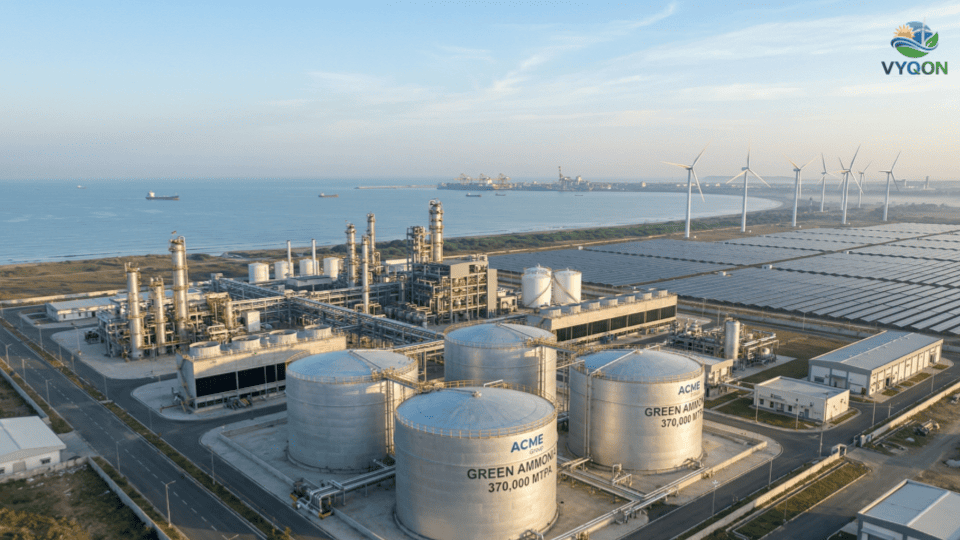
NEW DELHI, April 1, 2026 – ACME Group has executed a 10-year binding Green Ammonia Purchase Agreement (GAPA) with the Solar Energy Corporation of India (SECI) for the supply of 370,000 tonnes per annum (TPA) of green ammonia. This agreement represents the first commercial-scale implementation of demand aggregation for green hydrogen derivatives in India, coordinated through an inter-ministerial framework involving the Ministry of New and Renewable Energy (MNRE) and the Department of Fertilizers. The partnership is designed to establish a stable domestic supply chain for green nutrients, facilitating the decarbonization of industrial feedstocks at a competitive cost.
Commercial Terms and Contractual De-risking
The finalized agreement carries an estimated total contract value of ₹20,000 crore (₹200 billion) over a 10-year duration. This follows the issuance of letters of award to ACME in August and September 2025.
Central to the commercial viability of this contract is SECI’s institutional standing as a ‘Navratna’ Central Public Sector Undertaking, a status attained in August 2024 that provides the aggregator with significant financial and operational autonomy. To further de-risk the project for developers and financiers, the Government of India has established a Payment Security Mechanism (PSM). This mechanism mitigates potential offtake payment delays from fertilizer units, ensuring the bankability of the 10-year GAPA and supporting long-term infrastructure investment.
Infrastructure Development and Technical Configuration
To fulfill the domestic supply mandate, ACME Group will establish a dedicated green ammonia production facility in Odisha. This project is distinct from ACME’s 400,000 TPA export-oriented plant at the Tata Steel Special Economic Zone in Gopalpur, which is contracted for supply to Japan starting in 2029.
Technically, the facility will utilize AspenTech’s Performance Engineering solutions for process configuration and hydrolysis design. The integration of this industrial software is critical for optimizing the electrolysis process and maintaining the rigorous environmental standards required under the National Green Hydrogen Mission, specifically ensuring that hydrogen production maintains a carbon intensity of less than 2 kg of CO₂ per kg of H₂.
Intermediary Aggregator Model and Allocation Metrics
SECI operates as an intermediary aggregator under the SIGHT framework, purchasing green ammonia from ACME under the GAPA while concurrently executing Green Ammonia Sale Agreements (GASA) with fertilizer manufacturers. This centralized model enables transparent price discovery through a competitive reverse auction process.
The bidding process resulted in a watershed moment for the sector, achieving a record-low price of ₹49.75/kg at the IFFCO Paradeep unit. Conversely, the highest discovered price was ₹64.74/kg for the Indorama unit in Haldia, reflecting regional logistical and infrastructure variances.
Allocations to Fertilizer Units
| Offtaker | Plant Location (State) | Annual Volume (TPA) | Discovered Price (₹/kg) |
| IFFCO | Paradeep (Odisha) | 100,000 | 49.75 |
| IFFCO | Kandla (Gujarat) | 100,000 | 54.73 |
| Paradeep Phosphates Limited (PPL) | Paradeep (Odisha) | 75,000 | 55.75 |
| Paradeep Phosphates Limited (PPL) | Zuarinagar (Goa) | 25,000 | 49.75–64.74* |
| Coromandel International Ltd (CIL) | Visakhapatnam (A.P.) | 50,000 | 51.89 |
| India Potash Limited/Indorama (IIPL) | Haldia (West Bengal) | 20,000 | 64.74 |
*Specific unit price falls within the discovered tender range.
Regulatory Framework: SIGHT Scheme Mode-2A
The procurement was conducted under Mode-2A (Tranche-I) of the Strategic Interventions for Green Hydrogen Transition (SIGHT) Scheme, a Component-II pillar of the National Green Hydrogen Mission. Mode-2A is specifically designated for “Demand Aggregation and Offtake Support,” distinguishing it from other modes focused on electrolyser manufacturing.
To bridge the cost gap with conventional fossil-fuel-based ammonia, the scheme provides fixed Production Linked Incentives (PLI). The incentive structure is tiered over the first three years of production:
- Year 1: ₹8.82/kg
- Year 2: ₹7.06/kg
- Year 3: ₹5.30/kg
This financial support, totaling ₹1,533.4 crore for the broader scheme, was instrumental in bringing discovered prices close to the cost of grey ammonia, which was approximately $515/tonne (₹43/kg) as of March 2025.
Strategic Context: National Energy Security
This agreement addresses a critical vulnerability in India’s industrial economy. India consumes approximately 17–19 million tonnes of ammonia annually, with over 50% of the hydrogen required for its production currently derived from imported natural gas and LNG. By transitioning to domestic green ammonia, the sector reduces its exposure to volatile global gas prices and supports the National Green Hydrogen Mission’s goal of energy self-reliance.
The environmental impact of this transition is mathematically significant: the production of green hydrogen via renewable-powered electrolysis emits less than 2 kg of CO₂/kg H₂, compared to 12 kg of CO₂/kg H₂ produced via conventional steam methane reforming. Such industrial-scale decarbonization is a vital component of India’s institutional roadmap toward achieving net-zero emissions by 2070.
Leave a Comment