
BHEL synchronous condenser order: what the filing says
Bharat Heavy Electricals Limited (BHEL) has received a Notification of Award from Power Grid Corporation of India Limited (POWERGRID), acting on behalf of its project special purpose vehicle, for two synchronous condensers at the Barmer-II HVDC Terminal Station. The state-owned equipment maker disclosed the order to BSE and NSE on 7 November 2026 under Regulation 30 of the SEBI Listing Obligations and Disclosure Requirements Regulations, 2015. The order is for 2 Nos. +300/-200 MVAR synchronous condensers, and the project is valued at Rs 600 crore to Rs 900 crore, excluding GST.
BHEL’s disclosure describes the contract as a full turnkey package. The scope covers design, engineering, manufacturing, supply, erection, testing and commissioning of the two machines at the Barmer-II terminal station. The company has 44 months to execute the order. BHEL classified the award as a domestic order, since the awarding entity is POWERGRID, described in the filing as a Government of India enterprise.
Key terms of the order
The filing gives the following details:
- Awarding entity: Power Grid Corporation of India Limited, on behalf of its project SPV company.
- Order type: Notification of Award (NOA) for establishment of 2 Nos. +300/-200 MVAR synchronous condensers at Barmer-II HVDC Terminal Station.
- Nature of work: design, engineering, manufacturing, supply, erection, testing and commissioning.
- Execution period: 44 months.
- Order size: project valued at Rs 600 crore to Rs 900 crore, excluding GST.
- Domestic or international: domestic.
- Promoter interest: BHEL states that its promoter, promoter group or group companies have no interest in the awarding entity.
- Related party transaction: no.
BHEL has not disclosed an exact contract value, only the Rs 600 crore to Rs 900 crore range. The filing also does not name the project SPV or give a start date for the 44-month period, so neither is stated here.
What a synchronous condenser does
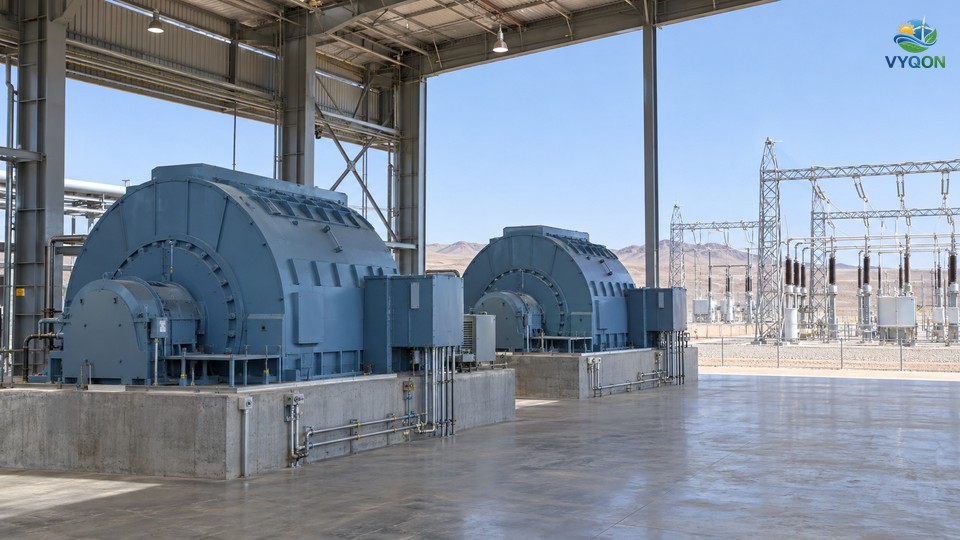
A synchronous condenser is a rotating machine that is connected to the grid without driving a mechanical load. It can supply or absorb reactive power, which helps hold grid voltage steady. The +300/-200 MVAR rating in the filing means each machine can inject up to 300 MVAR of reactive power and absorb up to 200 MVAR. Because it is a spinning machine, a synchronous condenser also adds to the short-circuit strength of the network at the point where it is connected.
This matters at an HVDC terminal. A line-commutated converter station needs a strong alternating-current grid to operate reliably, and a terminal that feeds large volumes of renewable power into a weak network can face voltage stability problems. Synchronous condensers are one of the standard tools for strengthening the grid at such a location.
The Barmer-II HVDC project behind the order
The order belongs to the Barmer-II to South Kalamb transmission system, which is designed to evacuate 6 GW of solar power from the Barmer complex in Rajasthan to demand centres in Maharashtra. POWERGRID emerged as the successful bidder for the project in a tariff-based competitive bidding process coordinated by REC Power Development and Consultancy Limited, and received its Letter of Intent on 2 September 2026. VYQON covered that award in its report on POWERGRID winning the Barmer-II transmission project for 6 GW of Rajasthan solar. Reports on the award put the annual transmission charges at about Rs 3,244 crore.
The scheme includes an approximately 1,000-kilometre, ±800 kV high-voltage direct-current corridor between Barmer-II in Rajasthan and South Kalamb in Maharashtra, along with converter terminals, 400 kV links and synchronous condensers. Equipment orders for the project have been arriving in stages. On 4 November 2026 GE Vernova T&D India disclosed a POWERGRID Letter of Award for the 6,000 MW, ±800 kV HVDC terminal station, which VYQON reported in its article on the GE Vernova T&D India award for the Barmer-II terminal station. BHEL’s order covers the reactive power equipment that sits alongside that converter station.
What it means for India’s clean-energy sector
Rajasthan has some of the country’s best solar resources, but the power has to travel long distances to reach load centres. HVDC corridors are the main way planners move multi-gigawatt volumes over about 1,000 kilometres with low losses. The corridor only works as intended if the terminal stations are supported by equipment that keeps the connected grid stable, which is the role of the condensers BHEL will supply.
For BHEL, the order adds to its transmission and power equipment business at a time when grid investment is expanding alongside renewable capacity. It also shows POWERGRID splitting a large HVDC scheme into separate packages for different suppliers: the converter terminal went to GE Vernova T&D India, while the synchronous condensers went to BHEL.
For developers of solar projects in the Barmer complex, such packages are a sign that the evacuation system is moving from award to equipment procurement. Delivery of the condensers, the converter station and the transmission line will together decide when the full 6 GW of capacity can be connected.
Official references
1. BHEL disclosure under Regulation 30, receipt of order from POWERGRID, BSE filing, 7 November 2026
2. BHEL disclosure under Regulation 30, receipt of order from POWERGRID, NSE filing, 7 November 2026
Leave a Comment