
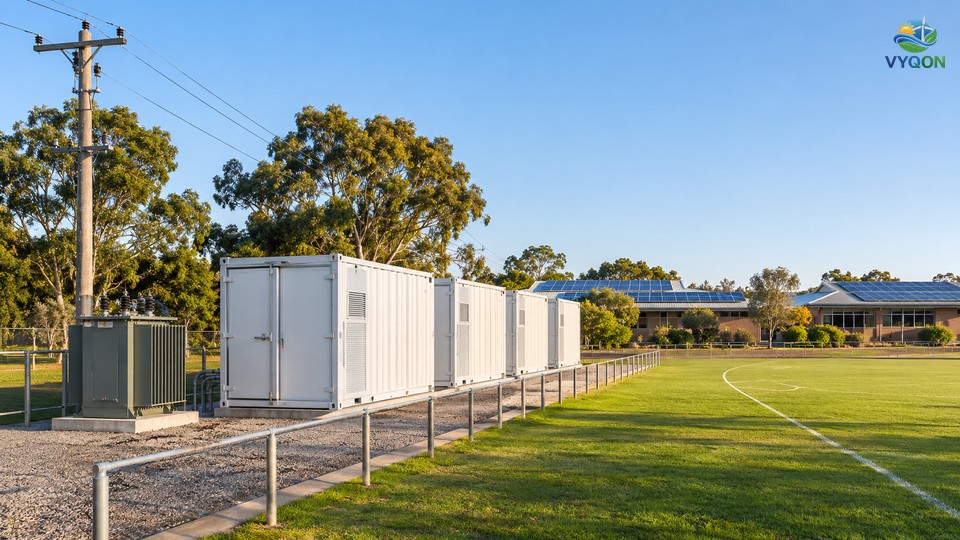
Jaipur Vidyut Vitran Nigam Limited (JVVNL), the power distribution company serving the Jaipur region of Rajasthan, and the Global Energy Alliance for People and Planet (Global Energy Alliance) have signed a memorandum of understanding (MoU) to develop what is described as India’s first sodium-ion battery energy storage system (BESS) pilot at the distribution-transformer level. The announcement was made in Jaipur on 29 October 2026. After the MoU, the two organisations issued a joint Request for Proposal (RfP) at the Distribution Utility Meet (DUM) 2026 for a pilot of 250 kW / 250 kWh at K.L. Saini Stadium, Jaipur.
The pilot is small in size, but it targets a part of the power network that is getting more attention as rooftop solar spreads: the local distribution transformer, where household and commercial demand and rooftop generation meet.
What the pilot will test
According to the Global Energy Alliance, the system will be used to manage local peak demand and improve the use of rooftop solar power. It may also help defer network upgrades, which is a common reason utilities look at storage close to the consumer. The pilot will be tested under actual network conditions, including the high summer temperatures that Rajasthan regularly records.
The assessment is broad. It will look at technical efficiency and reliability, the reduction of peak loading, the utilisation of solar power, safety, costs, degradation and lifecycle benefits. On safety, the review specifically names thermal behaviour and the risk of thermal runaway. Results will be compared against lithium-ion batteries and against conventional network upgrades, so that a discom can see whether storage is a sensible alternative to adding transformer or cable capacity.
The release does not name a technology vendor, a budget, a commissioning date or the duration of the MoU.
Roles of the partners
JVVNL will provide the site, a dedicated team and operational data. The Global Energy Alliance will give technical support for system design and performance monitoring, and will train JVVNL engineers. The findings are to be documented and shared with other distribution companies, so that they can assess sodium-ion storage for their own networks.
The pilot builds on an existing partnership between JVVNL and the Global Energy Alliance, which already includes digital twin work on JVVNL’s distribution network. JVVNL is a Champion Utility in the Global Energy Alliance’s India Grids of the Future Accelerator.
What officials said
Arti Dogra, Energy Secretary, Government of Rajasthan, and Chairperson of the Rajasthan discoms, said that as renewable energy generation grows in Rajasthan, the strain shows first at the local transformer. The pilot is meant to test whether storage that avoids lithium can ease that strain.
Tanya Singhal, Vice President and Country Head, India, at the Global Energy Alliance, said that storage will be central to India’s grids and that utilities should have more than one credible chemistry to choose from.
About the Global Energy Alliance
The Global Energy Alliance for People and Planet is a global non-profit founded in 2021 by The Rockefeller Foundation, the IKEA Foundation and the Bezos Earth Fund. It reports around 130 projects across Africa, Asia, and Latin America and the Caribbean.
Background: sodium-ion storage in India
Utility-scale batteries in India are today almost entirely based on lithium iron phosphate (LFP) chemistry, and the country has limited commercially exploitable lithium reserves of its own. That leaves grid storage exposed to import dependence and to price swings in global supply chains. Sodium-ion technology is attracting interest because sodium salts are abundant, which makes it a possible alternative for stationary storage.
Another public-sector initiative is already testing the same idea at a different point in the network. In September 2026, NTPC Limited issued a global Expression of Interest (EoI No. NTPC/PE/ET&PR/EOI-06/2026-27) for a grid-connected sodium-ion BESS pilot at its thermal power stations or office buildings, with a standard option of 100 kWh of usable energy. VYQON has covered that EoI separately.
Distribution-level storage is also not new to Jaipur’s discom. JVVNL has floated a tender for small standalone battery systems at distribution-transformer level, totalling 2 MW / 4 MWh in 20 units of 100 kW / 200 kWh each. That tender is separate from the sodium-ion pilot.
What it means for India’s clean-energy sector
Rooftop solar adds power at the edge of the network, and distribution transformers carry the stress first. If a battery at the transformer can absorb midday generation and supply the evening peak, a discom may be able to postpone equipment upgrades. The pilot is designed to measure how much of that benefit is real in Indian conditions.
The choice of chemistry is the second point of interest. A second credible chemistry could give utilities more choice and reduce dependence on imported materials. Sodium-ion batteries are less proven in field use, which is why the pilot gives so much weight to safety, degradation and lifecycle cost.
The commitment to document and share the results is important. A well-documented pilot at K.L. Saini Stadium could become a reference for other discoms planning transformer-level storage.
Which vendor will be selected, what the system will cost and when it will be commissioned remain open. Until then, the MoU and the RfP mark the first formal step towards testing sodium-ion storage on an Indian distribution network.
Official references
1. Global Energy Alliance for People and Planet, press release, “Rajasthan to pilot India’s first sodium-ion battery storage system”, Jaipur, 29 October 2026: https://energyalliance.org/india-first-sodium-ion-battery-storage-pilot-jaipur/
2. Global Energy Alliance for People and Planet, official website: https://energyalliance.org/
Leave a Comment