
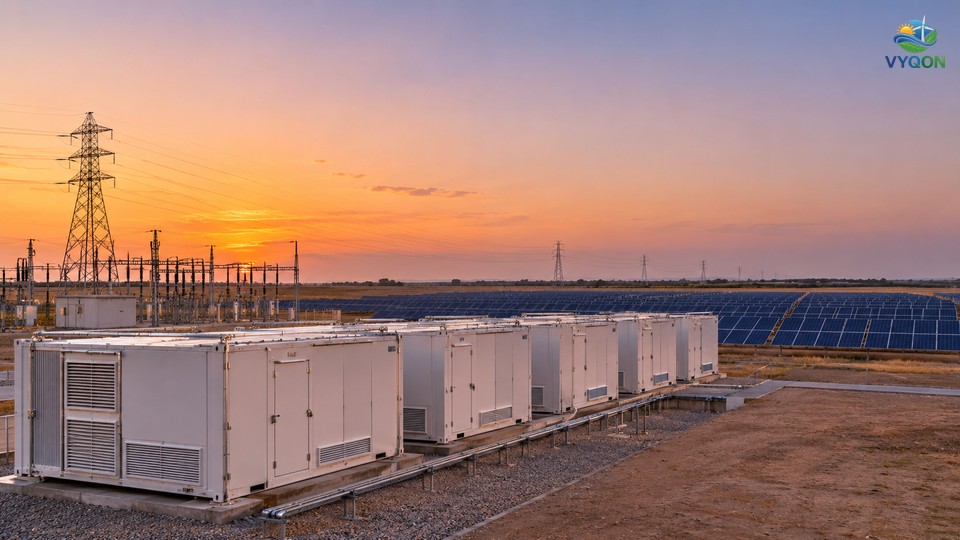
The Solar Energy Corporation of India (SECI) has invited bids for 4,800 MWh of assured peak power (1,200 MW x 4 hours) from renewable energy projects connected to the inter-state transmission system (ISTS). The SECI FDRE-X tender, issued under RfS No. SECI/C&P/IPP/13/0012/26-27, was published on 7 October 2026. Online bids are due by 17 November 2026 at 6:00 PM, and bids will be opened on 20 November 2026.
What the SECI FDRE-X tender asks for
SECI is looking for renewable energy power developers to set up ISTS-connected projects that carry an energy storage system and can supply power during evening and night peak hours. The projects will be built, owned and operated by the selected developers, and SECI will sign a 25-year power purchase agreement (PPA) with each of them. The total contracted capacity is 1,200 MW, offered through e-bidding followed by an e-reverse auction.
The tender is a “firm and dispatchable renewable energy” (FDRE) procurement, prepared under the Ministry of Power’s guidelines of 9 June 2023 for competitive bidding for firm and dispatchable power from renewable projects with energy storage. The selection is technology agnostic: developers may combine solar, wind or other renewable sources with storage, as long as the generation and storage of a single project are co-located.
SECI will act as an intermediary nodal agency. It will buy the power from the developers and sell it to buying entities on a back-to-back basis. The buying entities will be named later.
Peak-hour supply rules
The buying entity chooses four hours out of the peak hours each day, and the developer must deliver 4,000 kWh of energy per MW of contracted capacity in those hours. For every 100 MW, that means up to 400,000 kWh per day, reconciled monthly. The four hours must include continuous supply for at least one hour. A shortfall in peak supply attracts a penalty under the PPA.
Peak hours start with the evening non-solar hours and run until the morning non-solar hours of the next day, as defined by Grid-India for the state where the project is located. The energy offered must be fully renewable, although a developer may source up to 5 per cent of the annual energy from green-market sources or bilateral agreements to help meet the supply conditions. Outside peak hours, the developer may use the storage system for other applications, including sales on a power exchange, within its available connectivity.
Eligibility and project design
A bidder, together with its parent, affiliates and group companies, must submit a single bid for a cumulative contracted capacity of at least 50 MW and at most 600 MW, in whole numbers. The capacity allocated to one bidder group is also capped at 600 MW.
Projects can be located anywhere in India, at the bidder’s own cost and risk. Land, grid connectivity, approvals and the transmission line up to the delivery point are the developer’s responsibility. The installed capacity of the generating component can be smaller than, equal to or larger than the contracted capacity, but SECI’s guaranteed off-take is limited to the contracted capacity. The storage may be owned by the developer or tied up with a third party.
Developers that have already commissioned renewable projects, or are building them, and still have untied capacity may also bid; they receive a longer PPA period. No central financial assistance is planned for the selected projects.
Timelines, fees and guarantees
The scheduled commencement of supply date for the full project capacity is 18 months from the effective date of the PPA, with a further period of up to six months allowed subject to penalty. The performance bank guarantee follows a formula: Rs 24.2 lakh per MW of solar capacity, Rs 34.2 lakh per MW of wind and other renewable generation, and Rs 6 lakh per MWh of storage.
The RfS document costs Rs 50,000 plus GST. The bid processing fee is Rs 20,000 per MW plus GST, capped at Rs 20 lakh plus GST. SECI issued Amendment-01 on 29 October 2026. The offline bid deadline is 19 November 2026, 6:00 PM. Bidding is single-stage with two envelopes, through the ISN-ETS tender portal.
What it means for India’s clean-energy sector
FDRE-X is a further firm and dispatchable procurement, a format meant to move renewable supply beyond daytime solar and towards evening and night demand. VYQON has earlier reported on the tariff adopted by the Central Electricity Regulatory Commission for SECI’s FDRE-VII round of 1,200 MW. The new round is the same size, but its supply is defined by a fixed 4,000 kWh per MW each day in peak hours.
For developers, the 50 MW to 600 MW bid range and the freedom to choose location and technology leave room for solar-plus-storage, wind-plus-storage and hybrid designs. Storage is mandatory in every project, which adds to demand for battery systems in utility-scale renewable projects. For distribution companies and other buying entities, the back-to-back structure gives access to peak-hour renewable power without a direct contract with each generator. The tariff is not yet known: it will be discovered in the e-reverse auction after bids open on 20 November 2026.
Official references
1. SECI tender details page, RfS for Assured Peak Supply of 4800 MWh (1200 MW x 4 Hrs.) from ISTS-Connected RE Projects in India (SECI-FDRE-X): https://www.seci.co.in/tender-details/Ymp-
2. SECI RfS document (RfS No. SECI/C&P/IPP/13/0012/26-27): https://www.seci.co.in/uploads/tenders/RfS_for_4800_MWh_Peak_Supply_(FDRE-X).pdf
Leave a Comment