
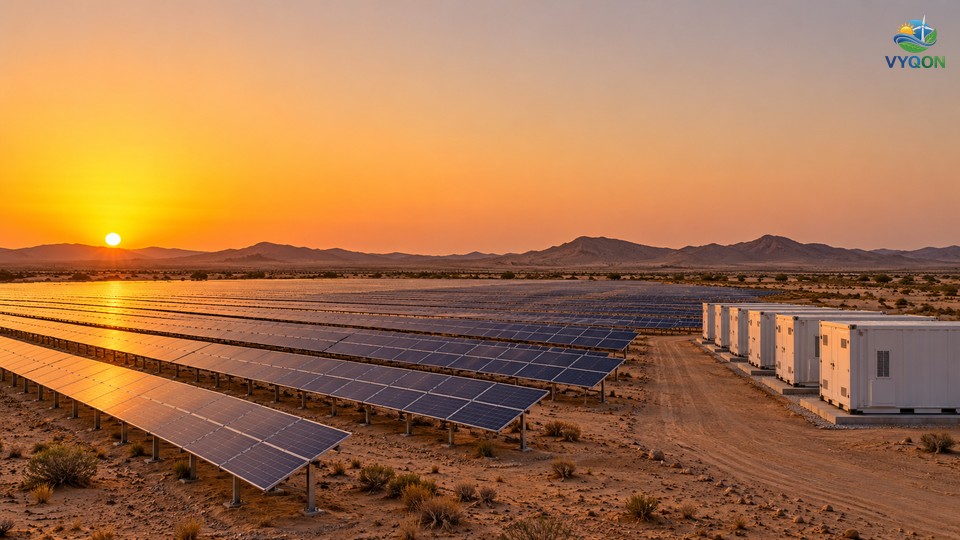
The Central Electricity Regulatory Commission (CERC) has adopted the tariffs discovered in the Solar Energy Corporation of India (SECI) tender for 1,200 MW of assured peak supply from interstate-connected renewable energy projects with energy storage. In an order dated 26 October 2026 in Petition No. 172/AT/2026, the Commission approved tariffs of Rs 6.27 per kWh for one developer and Rs 6.28 per kWh for three others. The scheme, known as SECI FDRE-VII, covers 4,800 MWh of daily peak supply, calculated as 1,200 MW for four hours.
Who won what
Four companies were declared successful in the electronic reverse auction held on 5 February 2026, and SECI issued Letters of Award on 10 February 2026. Adyant Enersol Private Limited was awarded 100 MW at Rs 6.27 per kWh. Serentica Renewables India Private Limited was awarded 600 MW, recorded as two lots of 300 MW, at Rs 6.28 per kWh. AMPIN Energy Utility Nine Private Limited was awarded 199 MW and ACME Solar Holdings Limited 301 MW, both at Rs 6.28 per kWh. The awards add up to 1,200 MW.
The tariff is fixed for the entire term of the power purchase agreement, which runs for 25 years from the scheduled commencement of supply date. The adoption is subject to SECI tying up the capacity through power purchase agreements with the developers and back-to-back power sale agreements with distribution companies or other buying entities. SECI must place copies of these agreements on the record.
How the tender ran
SECI issued the Request for Selection on 30 September 2025 under the Ministry of Power guidelines of 9 June 2023 for firm and dispatchable renewable power with energy storage. Bids closed on 7 January 2026 and the technical bids were opened on 12 January 2026. SECI received 22 bids totalling 6,145 MW. Twenty-one bids, aggregating 5,845 MW, met the techno-commercial criteria, and the financial bids were opened on 5 February 2026. Twenty bidders with 5,545 MW were shortlisted for the reverse auction, in which only 1,200 MW was available for award.
The opening financial bids ranged from Rs 6.87 per kWh to Rs 8.20 per kWh. The reverse auction brought the final prices down to Rs 6.27-6.28 per kWh.
What the project must deliver
The order records that the tender requires 100 per cent of the contracted capacity to be supplied from battery discharge during non-solar hours, with no supply obligation during daytime solar hours. This differs from earlier mixed-type firm and dispatchable renewable energy tenders, which also required supply during solar hours.
The buying entity chooses four hours of off-take during the evening window of 18:00 to 24:00 and draws up to 200,000 kWh for every 100 MW of contracted capacity each day. Projects must include a storage system of at least 0.5 MW and 4 MWh for every 1 MW of project capacity, and the storage must be located with the solar component. A shortfall in availability attracts a penalty of one and a half times the tariff for the units not supplied.
The Letter of Award reproduced in the order shows what one project looks like. Adyant Enersol’s 100 MW project is set at Bikaner in Rajasthan, connected at the Bikaner-V pooling station, with 60 MW of solar and a storage system of 96 MW and 384 MWh. Supply must start from the full project capacity within 24 months of the effective date of the agreement.
Comparison with other tenders
SECI told the Commission that a similar structure under an SJVN tender in October 2025 discovered Rs 6.74 per kWh, and that the present Rs 6.27 per kWh is about 6.97 per cent lower. The Commission noted that in Petition No. 31/AT/2026, decided by an order dated 20 June 2026, it adopted Rs 6.74 per kWh for a similar scheme with 100 per cent peak supply from battery discharge. ACME Solar and Adyant Enersol supported the petition.
Trading margin decision
SECI had also asked the Commission to approve a trading margin of Rs 0.07 per kWh payable by the buying entities. The Commission did not grant it unconditionally. It said the margin for long-term contracts is for the parties to agree, so if the distribution licensees agree to Rs 0.07 per kWh it will be treated as consistent with the trading licence regulations. If SECI does not provide an escrow arrangement or an irrevocable, unconditional and revolving letter of credit to the generators, the margin is limited to Rs 0.02 per kWh.
What it means for India’s clean-energy sector
Evening peak demand is the hardest part of the day for the grid to meet, and storage-backed tenders are meant to serve it directly. This order completes the regulatory step for a peak-only scheme whose tariff is below the Rs 6.74 per kWh adopted for a similar scheme in June 2026. Developers have since moved on to contracts. Industry reports indicate that AMPIN Energy and Serentica Renewables have signed power purchase agreements with SECI for their 199 MW and 600 MW shares respectively.
The adoption does not by itself guarantee that the capacity will be built. The next tests are the signing of power sale agreements with distribution companies, the acceptance of the Rs 0.07 per kWh margin by those buyers, financial closure and the supply start within 24 months of the effective date. For states looking for evening supply, the tariff gives a reference point of Rs 6.27-6.28 per kWh for a four-hour battery-backed product.
Official references
1. Central Electricity Regulatory Commission, Order in Petition No. 172/AT/2026 dated 26 October 2026 (SECI FDRE-VII, adoption of tariff): https://cercind.gov.in/2026/Orders/172-AT-2026.pdf
Leave a Comment