
The Central Electricity Authority (CEA) has asked equipment manufacturers to report how ready they are to supply pole structures, four-circuit lines and insulated cross arms for 400 kV and 765 kV transmission. The request came in an Office Memorandum dated 28 October 2026, issued by the Power System Engineering & Technology Development Division of CEA under the Ministry of Power. Replies are due by 5 November 2026 at ce-psetd@gov.in, the email address of the Chief Engineer of the division.
The memorandum is addressed to all interested and established manufacturers. It is titled “Furnishing of Details on Development, Manufacturing Capacity and Readiness for Various Transmission Technological Innovations” and is signed by Chief Engineer N.R.L.K. Prasad.
Why CEA is asking
CEA says the Central Government has been actively encouraging new technological innovations, such as pole structures, multi-circuits and insulated cross arms, at 400 kV and 765 kV in its effort to address Right of Way (RoW) issues for transmission infrastructure. A proposal to stipulate their use in suitable corridors of upcoming inter-state transmission system (ISTS) projects is under active consideration, according to the memorandum.
To ascertain whether industry can support these technologies, CEA proposes to seek development status, manufacturing capacity, commercial readiness and indicative costs from manufacturers, in the prescribed annexure format. The memorandum does not say that the technologies have been made mandatory. It only says that stipulating their use is being considered.
The seven items in the annexure
The annexure lists seven product categories on which manufacturers are asked to report:
- 400 kV double-circuit pole structures with quad conductor
- 400 kV four-circuit pole structures
- 400 kV insulated cross arm
- 765 kV double-circuit pole structures
- 765 kV four-circuit pole structures
- 765 kV four-circuit tower structures
- 765 kV insulated cross arm
For each item, the annexure is divided into sections on company details, development status, manufacturing capacities and costs. The development section asks about design validation, the type-testing standards followed and the completion status of each step. The capacity section asks for annual and monthly manufacturing capacity, the raw materials used, their sources and any constraints. The cost section seeks indicative costs.
Asking about raw materials and constraints suggests that CEA wants to know whether supply chains can scale up before any stipulation is made, and not only whether a design exists on paper.
What the technologies do
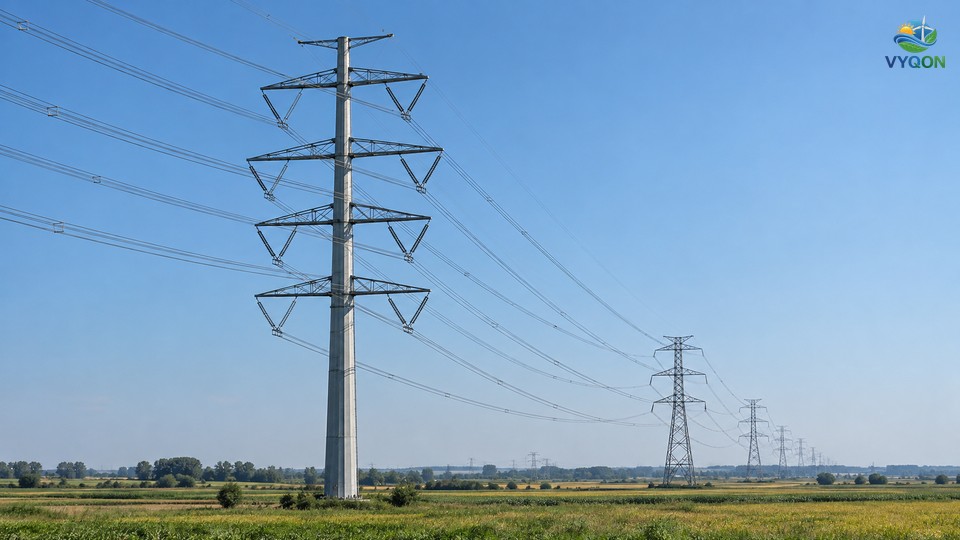
A conventional transmission line is built on lattice towers carrying one or two circuits, and each tower needs a wide strip of land under and around the line. A pole structure has a narrower footprint than a lattice tower. A multi-circuit line carries four circuits on one structure instead of two, so more power can be moved through one corridor. An insulated cross arm uses insulating material in place of a steel arm, which lets the conductors be held closer to the structure and reduces the width of the corridor.
All of these approaches aim at the same problem, which is getting a line through a limited strip of land. Land acquisition, forest clearance and the consent of landowners are frequent causes of delay for transmission projects in India, and a narrower corridor can ease all three.
Earlier steps on RoW
The memorandum builds on earlier work by CEA on the same subject. On 30 July 2026, CEA issued an advisory on the use of new technology options in forest areas to reduce RoW. CEA’s What’s New page also lists the “Report of the Committee for calculation of reduction of RoW width through technological options”. The latest request moves from advice for forest areas to testing the readiness of the supply side for a wider stipulation in ISTS projects.
What it means for India’s clean-energy sector
India’s renewable energy additions depend on the pace at which power can be evacuated from resource-rich regions, such as Rajasthan, Gujarat and Tamil Nadu, to demand centres. Transmission lines at 400 kV and 765 kV are the backbone of this evacuation. Any technology that shortens the time needed to secure a corridor can shorten the gap between a generation plant being ready and the line being available to carry its power.
For manufacturers, the memorandum points to a possible new market. A stipulation for suitable corridors of ISTS projects would create demand for pole structures, four-circuit structures and insulated cross arms from established tower and fabrication companies, and from suppliers of insulators and composite parts. The prices that companies report in the annexure will also give CEA a view of the cost difference compared with conventional lattice towers, which matters because the cost of a line is eventually passed on to power consumers through transmission charges.
For developers and transmission service providers, any stipulation would change design choices at the bidding stage. Projects in corridors with RoW constraints would have to consider these structures in their designs and cost estimates, and would need type-tested products from approved suppliers.
What to watch next
The first date to watch is 5 November 2026, when replies from manufacturers are due. CEA has not said when a decision on the proposed stipulation will follow, or which corridors will be considered suitable. The memorandum also does not say whether the data will be published.
Leave a Comment