
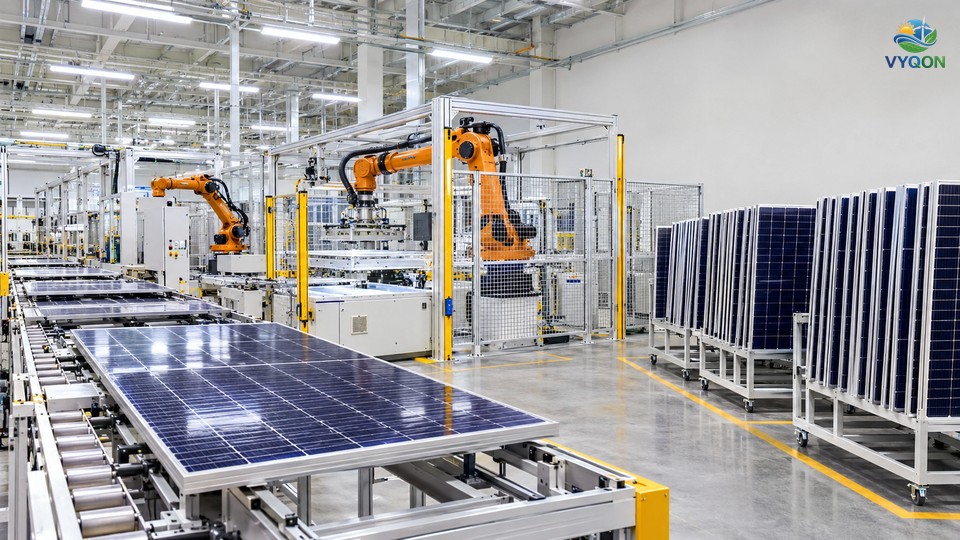
The Central Electricity Regulatory Commission (CERC) has adopted the tariff for another 400 MW of solar power under the Solar Energy Corporation of India’s (SECI) scheme that links ISTS-connected solar projects to the setting up of solar manufacturing plants. Of this, 50 MW will be sold at Rs 2.54/kWh to Tata Steel Limited, which is a distribution licensee in Jamshedpur, and 350 MW at Rs 2.42/kWh to West Bengal State Electricity Distribution Company Limited (WBSEDCL). The projects will be built by two special purpose vehicles of Azure Power India Private Limited.
What the SECI manufacturing-linked solar tariff order says
The order covers two sets of contracts. The first is a power sale agreement (PSA) dated 17 October 2025 between SECI and Tata Steel for 50 MW at Rs 2.54/kWh, plus a trading margin of Rs 0.07/kWh. The matching power purchase agreement (PPA) is dated 2 January 2026, with Azure Solar Private Limited, for 50 MW under Package I of the scheme. The second is a PSA dated 9 January 2026 between SECI and WBSEDCL for 350 MW at Rs 2.42/kWh, plus the same Rs 0.07/kWh trading margin, with a PPA dated 3 February 2026 with Azure Power Fifty Two Private Limited under Package IV.
Azure Solar Private Limited and Azure Power Fifty Two Private Limited are special purpose vehicles that Azure Power India Private Limited formed to build the projects. SECI told the Commission that the projects will help distribution companies meet their renewable purchase obligations.
How the scheme works
The scheme goes back to a Request for Selection (RfS) that SECI issued in 2019 for 7 GW of ISTS-connected solar PV projects linked with the setting up of 2 GW a year of solar manufacturing plants, under the Ministry of Power’s guidelines of 3 August 2017. The tender had two bidding packages. Package A was for cell and module manufacturing, at 500 MW each. Package B was for ingot and wafer manufacturing, at 500 MW each. A bidder was assured a PPA of up to 2,000 MW for each 500 MW of manufacturing under Package A, and up to 1,500 MW under Package B.
Three bids were received under Package A and none under Package B. The e-reverse auction on 22 November 2019 gave 2,000 MW each to Azure Power India and Adani Green Energy Four Limited at Rs 2.92/kWh. After the transfer of unsubscribed Package B capacity and a green-shoe option, the final awards were 4,000 MW for Azure Power and 8,000 MW for Adani Green, 12,000 MW in all.
The 12,000 MW is divided into four packages of 3,000 MW each. In 2021 the developers cut their tariff voluntarily. For Package I, the tariff came down from Rs 2.92/kWh to Rs 2.54/kWh, and for Packages II to IV it was cut to Rs 2.42/kWh. That is why the two new tariffs, Rs 2.54/kWh and Rs 2.42/kWh, belong to Package I and Package IV.
Earlier CERC adoptions and what remains
The 400 MW is not the first batch from this scheme. On 2 April 2022 the Commission adopted tariffs for 8,900 MW, made up of 1,900 MW under Package I and 7,000 MW under Packages II to IV. On 5 November 2023 it adopted another 334 MW under Package I. In both orders CERC allowed SECI to come back when more capacity was tied up under PPAs and PSAs. The present 400 MW is the result of that permission.
Counting these three adoptions, 9,634 MW of the 12,000 MW awarded has been adopted. The rest, about 2,366 MW by this count (a figure the order itself does not state), still has to be tied up with buyers.
A further 250 MW is pending
The order records that, at a hearing on 11 June 2026, SECI said it expected to sign a PSA for 250 MW with Punjab State Power Corporation Limited (PSPCL) once the Punjab State Electricity Regulatory Commission approved the purchase, for which the order had been reserved. SECI did not press its request to place that PPA and PSA on record in this case, so the 250 MW is not covered by this order.
Trading margin
SECI also asked CERC to approve the trading margin of Rs 0.07/kWh that Tata Steel and WBSEDCL agreed to in their PSAs. The Commission noted that, for long-term contracts, the trading margin is decided mutually between the trading licensee and the seller. The margin is treated as in line with the regulations if the distribution licensees agree to Rs 0.07/kWh. If SECI does not provide an escrow arrangement or an irrevocable, unconditional and revolving letter of credit, the margin is limited to Rs 0.02/kWh.
What it means for India’s solar and manufacturing sectors
The order shows a scheme from 2019 still delivering new tied-up capacity in 2026, with buyers that now include an industrial distribution licensee in Jharkhand and a state discom in West Bengal. For Azure Power, it adds 400 MW of contracted projects at Rs 2.54/kWh and Rs 2.42/kWh, which are tariffs that are low compared with the Rs 2.92/kWh originally quoted. The scheme ties long-term power purchase contracts to the setting up of domestic solar manufacturing capacity. The remaining untied capacity will depend on how many more distribution companies sign PSAs at these tariffs. VYQON will report when SECI brings further capacity before the Commission.
Official references
- Central Electricity Regulatory Commission, order in the petition of Solar Energy Corporation of India Limited for adoption of tariff for 50 MW and 350 MW ISTS solar power plants linked with solar manufacturing (2026): https://cercind.gov.in/2026/Orders/200-AT-2026.pdf
Leave a Comment